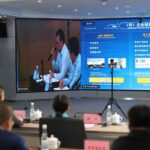
Chongqing Artificial Intelligence Bay (hereinafter referred to as the Bay) commenced construction on the 10th.
The Bay is located in Nan’an District and Chongqing Economic and Technological Development Zone. With the “One Bay” as its ecological platform, it synergizes with the Chongqing Artificial Intelligence College and the Chongqing General Artificial Intelligence Research Institute to form an integrated innovation consortium for “government, industry, academia, research, application, and finance.” It is dedicated to becoming a landmark achievement for the national AI innovation development pilot zone and innovation application leading zone.
The core goal of the Bay is to build an open, collaborative, and efficient artificial intelligence industry ecosystem and application platform, serving as a hub, testing ground, and accelerator for driving the deep integration of AI technology with all sectors of the economy. Specifically, the Chongqing Artificial Intelligence College will explore an industry-education integrated model, establish a comprehensive “general knowledge—general intelligence—general application” training system, and vigorously cultivate leading AI talent. The Chongqing General Artificial Intelligence Research Institute will create a high ground for general AI technology R&D, a center for attracting high-level talent, a platform for tackling key core technologies, and a base for industrial empowerment and innovation in ultra-large-scale city governance.
Focusing on cutting-edge directions such as industry agents, embodied intelligence, and social intelligence, the Bay will also establish a future industry incubation matrix by building concept verification centers, pilot platforms, and maker spaces. It will provide industrial land and physical space, establish a 20-billion-yuan AI industry fund, and use a “fund cluster” to guide social capital, fully incubating and aggregating AI industry clusters with core competitiveness.
The latest “Chongqing ‘AI+’ Action Plan” issued by the Chongqing Municipal People’s Government Office proposes that by 2026, significant results will be achieved in the bidirectional empowerment of AI and Digital Chongqing, forming a batch of comprehensive AI-enabled application scenarios, with the penetration rate of new-generation intelligent terminals and agents exceeding 70%. By 2027, AI will be deeply and widely integrated with six key areas: technology, industry, governance, people’s livelihood, consumption, and openness. The application penetration rate of new-generation intelligent terminals and agents will exceed 80%, and the intelligent economy will gradually become a major growth driver for local economic development.
Chongqing Artificial Intelligence Bay
Chongqing Artificial Intelligence Bay is a modern technology hub established in 2018 as part of China’s national push to become a leader in AI innovation. Located in Chongqing’s Yubei District, it serves as a core cluster for research, development, and enterprise in artificial intelligence and big data within the broader Chongqing Liangjiang New Area. Its history is brief but significant, representing the city’s strategic transformation into a major high-tech center in western China.
Nan’an District
Nan’an District is a central urban district of Chongqing, China, located on the southern bank of the Yangtze River. Historically, it was a crucial transportation and trade hub, and it now serves as a modern commercial and residential center. The district is also known for cultural sites like the Nanshan area, which features botanical gardens and historical temples.
Chongqing Economic and Technological Development Zone
The Chongqing Economic and Technological Development Zone (CETZ), established in 1993, is one of China’s earliest and most important state-level development zones. Located in the southwestern megacity of Chongqing, it was created to drive regional industrial growth and technological innovation, focusing on sectors like automotive manufacturing, electronics, and information technology. It has played a key role in transforming Chongqing into a major economic hub in inland China.
Chongqing Artificial Intelligence College
Chongqing Artificial Intelligence College is a specialized higher education institution established in Chongqing, China, focused on cultivating talent in AI and related technological fields. It was founded to support the national and regional strategic development of the artificial intelligence industry, reflecting the city’s push to become a major tech hub. As a relatively new college, its history is tied to the recent, rapid expansion of China’s AI sector and educational initiatives in the early 21st century.
Chongqing General Artificial Intelligence Research Institute
The Chongqing General Artificial Intelligence Research Institute is a recently established research center focused on advancing AI technology and its applications. It was founded as part of China’s national strategy to become a global leader in artificial intelligence, aiming to drive innovation and industrial development in the Chongqing region. While it lacks a long historical background, its mission is to contribute to the future of AI research and regional economic transformation.
Digital Chongqing
“Digital Chongqing” refers to the comprehensive smart city and digital transformation initiative of Chongqing, China, aimed at integrating big data, artificial intelligence, and the Internet of Things into urban management and services. Historically rooted in Chongqing’s role as a major industrial and economic hub, the project leverages the city’s modern infrastructure to enhance governance, industry, and citizen life in the digital era. It represents a key part of China’s national strategy to develop “digital economy” pilot zones, transforming the traditional metropolis into a leading smart city model.
Chongqing Municipal People’s Government Office
The Chongqing Municipal People’s Government Office is the administrative headquarters of the municipal government of Chongqing, a major city and provincial-level municipality in southwest China. Historically, the city served as the wartime capital of China during the Second Sino-Japanese War (1937-1945), and its government buildings today symbolize its continued importance as a political and economic center in modern China.