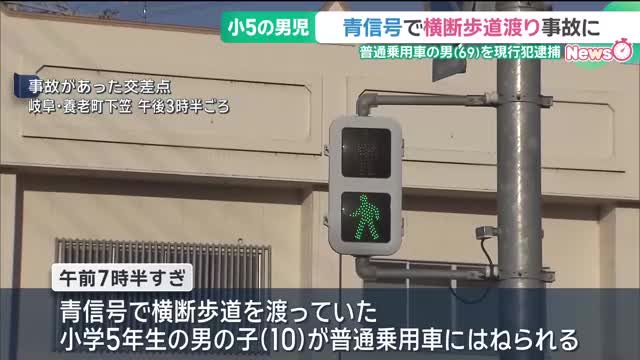
10-year-old boy hit by car at crosswalk, driver (69) arrested on suspicion of negligent driving causing injury in Gifu.
On the morning of the 9th, a 69-year-old man was arrested for hitting a young elementary school boy in a crosswalk with his car and injuring him in Yoro Town, Gifu Prefecture.
According to police, shortly after 7:30 a.m. at an intersection in Shimogasa, Yoro Town, a 10-year-old boy in the fifth grade was crossing the crosswalk on a green light on his way to school when he was hit by a passenger car. The boy suffered injuries including a sprained ankle.
Police arrested the 69-year-old part-time worker on suspicion of negligent driving causing injury. He was commuting to work driving the passenger car.
The boy was walking to school in a group of 15 children. The accident happened just as they started to cross the crosswalk after the light turned green.
In response to questioning, the man has admitted to the allegations. Police are investigating on the view that the man overlooked the red light.
Yoro Town
Yoro Town is a municipality in Hiroshima Prefecture, Japan, historically known as a post-station town along the San’yōdō highway during the Edo period. It is most famous for being the location of the Yoro Waterfall (Yoro-no-taki), which is part of a scenic park and is central to a local legend about a filial son discovering sake that healed his father. Today, the area is a popular destination for its natural beauty and its association with this ancient Japanese folktale.
Gifu Prefecture
Gifu Prefecture, located in central Japan, is a region rich in history and natural beauty, historically part of the ancient Mino Province. It is famous for the historic mountain village of Shirakawa-go, a UNESCO World Heritage site, and the city of Gifu, which was a key base for the powerful warlord Oda Nobunaga in the 16th century during the Sengoku period. Today, the prefecture is also renowned for traditional cormorant fishing (ukai) on the Nagara River and its scenic Japanese Alps.
Shimogasa
I’m unable to find specific, reliable information on a notable cultural or historical site named “Shimogasa.” It’s possible the name refers to a local place in Japan (as “shimo” often means “lower” and “kasa” can mean “hat” or “umbrella”), but it is not widely recognized as a major heritage site. To provide an accurate summary, could you please verify the spelling or provide more context about its location?