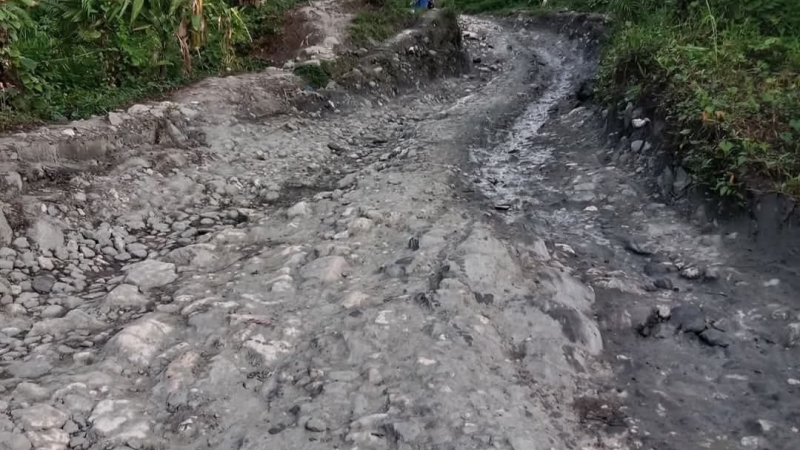
Residents of South Nias Regency (Nisel) in North Sumatra are complaining about the condition of the Huruna cross-provincial road, which remains severely damaged and is considered a threat to road users’ safety. The road is located in Bawohosi Village, Huruna District, and serves as a vital access link connecting South Nias Regency, West Nias Regency, and Gunungsitoli City.
One resident stated that the road damage has persisted for nearly 20 years, yet it has not received serious attention from the North Sumatra Provincial Government.
“This road has been damaged for 20 years. We are asking for serious attention from the central government and the North Sumatra Provincial Government,” said the resident.
According to the resident, this road section is the only main route used daily by people from several districts, such as Huruna, Ulunoyo, Lolomatua, Onohazumba, and Hilimegai, to reach the government center and economic activities in South Nias. To this day, there is no alternative route available.
The resident expressed gratitude for the ongoing road construction from Simpang Miga to West Nias Regency. However, they lamented the disparity in the condition of other roads, which are in a much worse state.
“The road from Simpang Miga to West Nias is still much better. The worst section is actually from Olayama Village in Huruna District to Lolowa’u District,” they said.
They added that the road condition, filled with large rocks, potholes, and puddles, is very dangerous, especially for motorcycle riders, four-wheeled vehicles, and trucks. Besides frequently damaging vehicles, accidents are also common.
“In the past, there were often victims here, both fatalities and material losses. Everyone who passes through must have great courage and be prepared to bear vehicle damage,” they said.
Severe damage is recorded at several points, including Ehosakhozi Village, Olayama Village (Huruna), Orahili Village, Sisarahili Oyo Village (Onohazumba), Nituwuboho Village, Hilikara Village, and Lolomoyo Village (Lolowa’u).
“The worst part is from Olayama Village to the capital of Lolowa’u District, which is about 20 kilometers long. Almost every day there is a vehicle accident,” they emphasized.
Residents hope the North Sumatra Provincial Government and the Central Government will immediately build this road. They are also asking for intervention to expedite the road construction for the safety of the community.
Huruna cross-provincial road
The Huruna cross-provincial road is a modern highway in Sri Lanka, constructed in the early 21st century to improve connectivity. It links the Central and Uva Provinces, significantly reducing travel time between major towns like Badulla and Kandy by traversing the steep terrain of the central highlands.
Bawohosi Village
Bawohosi Village is a traditional settlement of the Nias people on Nias Island, Indonesia, renowned for its well-preserved collection of ancient megalithic stone monuments and traditional houses. Historically, the village was a powerful and wealthy chiefdom, with its stone structures—including seats, tables, and jumping stones—serving ceremonial, social, and ritual purposes, particularly related to ancestor worship and status displays. Today, it stands as a significant cultural heritage site that offers insight into the pre-Christian megalithic culture of the Nias highlands.
South Nias Regency
South Nias Regency is a region on Nias Island, Indonesia, known for its unique indigenous culture and megalithic traditions. Historically, it was a powerful chiefdom society, famous for its impressive stone-jumping rituals and fortified hilltop villages with traditional houses (*omo hada*). These sites reflect a pre-Christian animist heritage that endured for centuries before significant outside influence.
West Nias Regency
West Nias Regency is a region on Nias Island, Indonesia, renowned for its unique traditional villages featuring impressive stonework, megalithic monuments, and distinctive *omosebua* (chief’s houses). Historically, it was a center of the powerful Nias chiefdom culture, which was known for its complex social hierarchy, ancestor worship, and megalithic traditions that date back centuries. Today, it offers a glimpse into a distinct indigenous heritage, with villages like Bawomataluo and Hilisimaetano being notable cultural sites.
Gunungsitoli City
Gunungsitoli is the largest city and capital of Nias Regency, located on the island of Nias in North Sumatra, Indonesia. Historically, it served as a major port and trading hub for the Nias people, whose unique indigenous culture is characterized by impressive traditional houses (*omo hada*) and ancient megalithic stone jumping traditions. Today, it functions as the main gateway and administrative center for exploring the island’s rich cultural heritage and natural attractions.
Simpang Miga
“Simpang Miga” does not refer to a widely recognized historical place or cultural site in global databases. It is likely a local name for a neighborhood, intersection, or small community, possibly in Southeast Asia (such as in Malaysia or Indonesia). Without more specific context, a detailed history cannot be provided.
Olayama Village
Olayama Village is a traditional Ainu settlement located in the Saru River region of Hokkaido, Japan. It is historically significant as one of the core communities of the indigenous Ainu people, who have inhabited Hokkaido for centuries. Today, it serves as an important cultural center for preserving and sharing Ainu heritage, language, and crafts.
Lolowa’u District
Lolowa’u is a district on the island of Nias, Indonesia, historically known as one of the island’s five main tribal regions. It is significant for its well-preserved traditional villages featuring impressive stone monuments and megalithic sites, reflecting the ancient indigenous culture and social hierarchy of the Nias people.