Video Player is loading.
Play Video
Pause
Unmute
Current Time 0:00
/
Duration 0:00
Loaded: 0%
Stream Type LIVE
Seek to live, currently behind liveLIVE
Remaining Time -0:00
1x
Playback Rate
- 2x
- 1.75x
- 1.5x
- 1.25x
- 1x, selected
- 0.75x
- 0.5x
Chapters
- Chapters
Descriptions
- descriptions off, selected
Captions
- captions settings, opens captions settings dialog
- captions off, selected
Quality Levels
Audio Track
Fullscreen
This is a modal window.
Beginning of dialog window. Escape will cancel and close the window.
TextColorWhiteBlackRedGreenBlueYellowMagentaCyanTransparencyOpaqueSemi-TransparentBackgroundColorBlackWhiteRedGreenBlueYellowMagentaCyanTransparencyOpaqueSemi-TransparentTransparentWindowColorBlackWhiteRedGreenBlueYellowMagentaCyanTransparencyTransparentSemi-TransparentOpaque
Font Size50%75%100%125%150%175%200%300%400%Text Edge StyleNoneRaisedDepressedUniformDropshadowFont FamilyProportional Sans-SerifMonospace Sans-SerifProportional SerifMonospace SerifCasualScriptSmall Caps
Reset restore all settings to the default valuesDone
Close Modal Dialog
End of dialog window.
Close Modal Dialog
This is a modal window. This modal can be closed by pressing the Escape key or activating the close button.
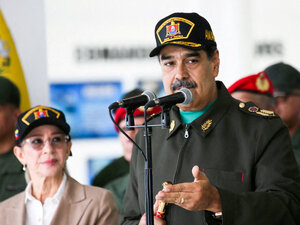
U.S. President announced on the 3rd via social media that a “large-scale and successful attack” had been carried out in South American Venezuela. He also stated that “President Maduro and his wife have been captured and transported out of Venezuela by air.” The U.S. administration expressed its intention to try Mr. Maduro in a U.S. court. However, there are suspicions that the attack may be a violation, and there are concerns that the forceful removal of a leader through military power could deal a blow to the international order.
Prior to the social media post, around 2 a.m. local time on the 3rd (3 p.m. Japan time), multiple explosions and the sound of low-flying aircraft were reported in the area around Caracas, the capital of Venezuela, with power outages occurring in some areas.
The United States does not recognize the Maduro government as a legitimate administration and has continued airstrikes against vessels it designates as drug trafficking ships in the Caribbean and Eastern Pacific. While citing “counter-narcotics operations” as the reason, it has not provided sufficient evidence. In his social media post, the President explained that this operation was “conducted in coordination with U.S. law enforcement agencies.” However, directly attacking territory under Venezuelan sovereignty and proceeding to the point of detention is an act whose legitimacy under international law will be severely questioned.
The U.S. Attorney General stated on the 3rd via X (formerly Twitter) regarding the Maduro couple, who are charged by the U.S. with crimes including “narco-terrorism,” that they “will face severe punishment under U.S. justice in a U.S. court.”
On the morning of the 3rd, the President revealed to a U.S. broadcaster that Mr. Maduro was being transferred to New York, USA, and indicated the intention that the U.S. would be involved in deciding Venezuela’s next political system. Before the President announced Mr. Maduro’s capture, the Venezuelan administration issued a statement condemning “the U.S. military invasion” and had issued a nationwide alert.
According to reports, Venezuela’s Vice President told state television that the Venezuelan government could not locate Mr. Maduro and his wife and stated they “demand proof they are alive from the U.S. side.”