On social media X, Democratic Senator Brian Schatz stated that the United States “has no vital national interest in Venezuela to justify a war.” He emphasized that the U.S. needs to learn a lesson and should not become entangled in another conflict.
Democratic Senator Ruben Gallego also viewed the U.S. attack on Venezuela as “illegal” and saw no reason for the country to be in a state of war with Venezuela.
Meanwhile, Republican Senator Mike Lee said he looks forward to “learning what, if anything, could constitutionally justify this action in the absence of a declaration of war or authorization for the use of military force.”
In the early hours of January 3 (local time), several large explosions were heard in Venezuela’s capital, Caracas. The Venezuelan government issued an official statement, calling it an “extremely serious military act of aggression” carried out by the United States. A state of emergency order has been declared across the entire territory of Venezuela.
U.S. President Donald Trump confirmed the attack and stated that and removed from Venezuela.
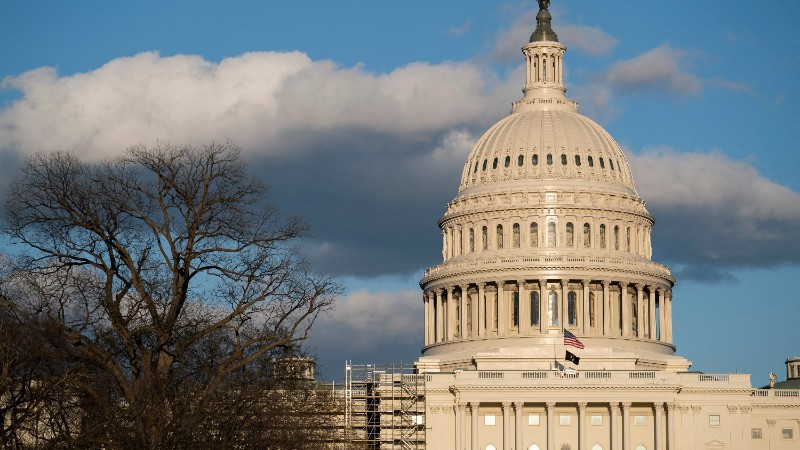
The United States Capitol Building
The United States Capitol Building in Washington, D.C., is the meeting place of the U.S. Congress and a symbol of American democracy. Its construction began in 1793, and although it was burned by British forces in 1814, it was rebuilt and has been expanded over the centuries, most notably with its iconic cast-iron dome completed during the Civil War. Today, it stands as the centerpiece of the Capitol Complex, housing the legislative branch of the federal government.
Washington, D.C.
Washington, D.C., is the capital of the United States, founded in 1790 as a planned city to serve as the nation’s seat of government. Its design, influenced by Pierre L’Enfant, features iconic landmarks like the White House and U.S. Capitol, which were largely rebuilt after being burned by British forces during the War of 1812. Today, it stands as a global symbol of American democracy and history, housing the federal government’s branches and numerous museums and memorials.
Venezuela
Venezuela is a South American country known for its diverse landscapes, ranging from the Andes Mountains to the Amazon rainforest and Caribbean coastline. Historically, it was a Spanish colony until achieving independence in the early 19th century under leaders like Simón Bolívar, becoming a key player in the liberation of northern South America. Its cultural heritage is a blend of Indigenous, African, and Spanish influences, reflected in its music, art, and traditions like the annual Carnival celebrations.
Caracas
Caracas is the capital and largest city of Venezuela, founded in 1567 by Spanish conquistador Diego de Losada. It grew as a colonial administrative center and later became the birthplace of Simón Bolívar, a key leader in South America’s independence movements. Today, it is a major metropolitan and economic hub, though it faces significant modern challenges.