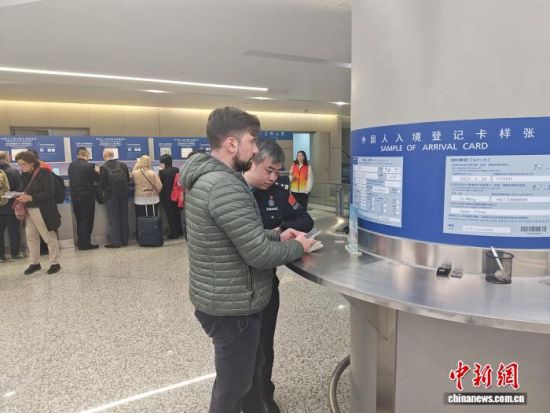
China’s National Immigration Administration officially launched an online entry card filing convenience measure for foreigners entering China on November 20. In the week since the new policy’s implementation, the number of foreign passengers entering through Shanghai Hongqiao Port who have used the online filing method has been steadily increasing. This innovative measure effectively simplifies entry procedures and significantly improves port clearance efficiency.
It is understood that this newly launched online filing policy is one of ten innovative measures implemented by the National Immigration Administration to support the expansion of opening-up and serve high-quality development. According to the new policy, starting November 20, 2025, foreigners coming to China can fill in entry-related information online through multiple channels, including the official website of the National Immigration Administration, government service platforms, the “Immigration Bureau 12367” App, WeChat and Alipay mini-programs, as well as by scanning the entry card filing QR code. Furthermore, seven categories of individuals, including holders of the Foreigner’s Permanent Residence ID Card of the People’s Republic of China, group visa holders, those eligible for group visa-free entry, and those in direct transit for 24 hours without leaving the port restricted area, are exempt from filling out the entry declaration card, further simplifying the clearance process.
On November 26, the Orchestra dell’Accademia Nazionale di Santa Cecilia from Italy entered through the Shanghai Hongqiao International Airport port, beginning a five-day global tour with performances in Beijing and Shanghai. The Hongqiao Border Inspection Station made advance arrangements, deploying additional officers with strong foreign language skills to provide on-site guidance to the orchestra members for online filing. With the professional assistance of the border inspection officers, over 130 orchestra members completed all entry procedures in just 20 minutes, ensuring their smooth clearance and preserving ample time for their subsequent performances.
After completing the entry procedures, an orchestra member said, “Completing the information filing on the phone in advance was very convenient. The service from the Chinese immigration management police was professional and thoughtful, and the entire clearance process was extremely smooth!”
A relevant official from the Hongqiao Border Inspection Station stated that the next steps will involve continuously increasing policy promotion efforts, interpreting the new policy through various channels such as port electronic display screens and new media platforms, and deepening cooperation with units like the airport and airlines to jointly promote the online filing service. The aim is to continuously improve port clearance efficiency and passenger experience, contributing to the construction of a new pattern of high-level opening-up with more professional and people-oriented immigration management services.
China’s National Immigration Administration
China’s National Immigration Administration (NIA) is a government agency established in 2018 as part of a broader institutional reform to centralize and modernize China’s immigration and border control services. It oversees immigration policies, border security, and the management of foreign nationals within China, marking a significant shift from the previously decentralized system managed by various public security departments.
Shanghai Hongqiao Port
Shanghai Hongqiao Port is a major transportation hub in western Shanghai, historically known as the city’s first airport. Opened in 1907, it served as Shanghai’s primary international airport until the opening of Pudong International Airport in 1999. Today, it functions as a key domestic airport and is integrated with a large high-speed railway station, forming a comprehensive multimodal transport center.
Hongqiao Border Inspection Station
The Hongqiao Border Inspection Station is a major immigration and customs checkpoint at Shanghai Hongqiao International Airport, primarily handling international flights. It serves as a key gateway for entry and exit in eastern China, with its modern operations reflecting Shanghai’s development as a global hub since the airport’s significant expansion and upgrade in the early 21st century.
Orchestra dell’Accademia Nazionale di Santa Cecilia
The Orchestra dell’Accademia Nazionale di Santa Cecilia is one of Italy’s oldest and most prestigious musical institutions, founded in Rome in 1908. It evolved from the even older Accademia di Santa Cecilia, which received its first papal charter as a musicians’ guild in 1585. Today, based at the Auditorium Parco della Musica, it is celebrated worldwide for its performances and recordings under renowned conductors.
Shanghai Hongqiao International Airport
Shanghai Hongqiao International Airport is one of Shanghai’s two major airports, originally opened in 1907 as a military airfield. It was later expanded into a civilian airport and served as the city’s primary international gateway until the opening of Pudong International Airport in 1999. Today, it primarily handles domestic and regional flights, featuring an integrated transportation hub with high-speed rail, metro, and bus connections.
Beijing
Beijing is the capital of China and a major historical and cultural center, with a history spanning over 3,000 years. It served as the seat of imperial power during the Ming and Qing dynasties, famously housing the Forbidden City. Today, it is a global metropolis that blends ancient landmarks like the Great Wall and Temple of Heaven with modern political and economic institutions.
Shanghai
Shanghai is a major global metropolis and financial hub on China’s east coast, which grew from a modest fishing village into a significant port after being opened to foreign trade by the 1842 Treaty of Nanking. Its iconic skyline, exemplified by the Bund’s historic waterfront and Pudong’s modern towers like the Oriental Pearl, reflects its unique history as a crossroads of Eastern and Western influence throughout the 19th and 20th centuries. Today, it stands as a symbol of China’s rapid economic development and vibrant contemporary culture.
Foreigner’s Permanent Residence ID Card of the People’s Republic of China
The Foreigner’s Permanent Residence ID Card is an official document issued by the People’s Republic of China to eligible non-Chinese nationals, granting them the right to reside indefinitely in the country without the need for additional visas. It was formally established under regulations updated in 2004 to attract foreign talent and investment, reflecting China’s evolving policies on international engagement and immigration management.