
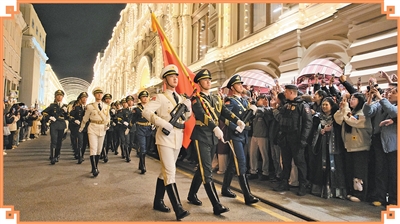
On May 3, the Honor Guard of the Chinese People’s Liberation Army participated in a rehearsal for the parade in Moscow commemorating the 80th anniversary of the victory in the Soviet Union’s Great Patriotic War.
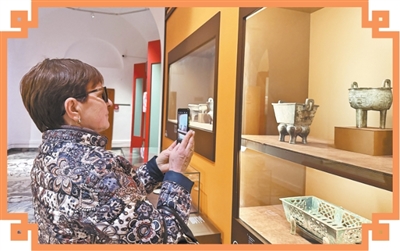
On May 5, Russian visitors viewed an exhibition on ancient Chinese food culture in Moscow.
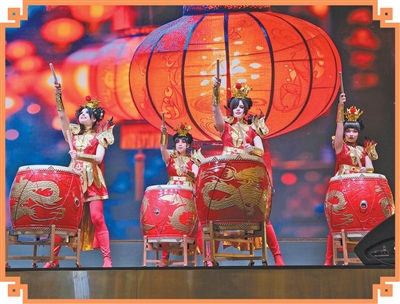
On February 12, the Russian Chinese General Chamber of Commerce held the third “Lantern Festival Gala” event in Moscow. The photo shows Russian youth performing Chinese drum music.
This year marks the 80th anniversary of the victory in the Soviet Union’s Great Patriotic War, the Chinese People’s War of Resistance Against Japanese Aggression, and the World Anti-Fascist War. Over 80 years ago, my grandfather, as a flight commander in the Soviet volunteer air force aiding China, went to China and piloted fighter planes against Japanese forces in places like Wuhan and Lanzhou, eventually laying to rest on Chinese soil. As a descendant of a martyr, I gradually learned about my grandfather’s deeds and the glorious history of the Russian and Chinese people fighting side by side against aggression, and I have devoted myself to the cause of Russia-China friendship.
“During the difficult times of the Chinese People’s War of Resistance Against Japanese Aggression, the Soviet volunteer air force aiding China ‘soared through the skies’ to intercept the Japanese invaders in Nanjing, Wuhan, Chongqing, and other places, with many pilots sacrificing their precious lives.” In May of this year, during a state visit to Russia to attend commemorations for the 80th anniversary of the victory in the Soviet Union’s Great Patriotic War, the Chinese President specifically mentioned the contributions of the Soviet volunteer air force aiding China in a signed article, demonstrating the value placed on the historical camaraderie of the Russian and Chinese people fighting together and supporting each other.
As major victorious nations in World War II, it is of great significance for Russia and China to jointly celebrate this great victory. Following the Chinese President’s visit to Russia in May, the Russian President was invited to attend commemorations for the 80th anniversary of the victory in the Chinese People’s War of Resistance Against Japanese Aggression and the World Anti-Fascist War in September. The mutual visits by the two heads of state within the year and their attendance at each other’s commemorative events highlight the strategic guidance of the two leaders for bilateral relations and inject new momentum into the development of relations between the two countries.
In 2015, I went to Beijing to attend the commemorative meeting for the 70th anniversary of the victory in the Chinese People’s War of Resistance Against Japanese Aggression and the World Anti-Fascist War. This year, I was invited to participate in the commemorations for the 80th anniversary. On September 3, I ascended the Tiananmen Rostrum and witnessed the grand military parade. The Chinese President delivered an important speech, expressing heartfelt thanks to foreign governments and international friends who supported and aided the Chinese people in resisting aggression, and emphasized: “The great rejuvenation of the Chinese nation is unstoppable! The noble cause of human peace and development is bound to triumph!” The entire venue erupted into prolonged, warm applause, leaving a very profound impression.
I have been deeply moved by the fact that the Chinese government and people have always remembered the international friends who aided China’s resistance. In recent years, I have been invited to China multiple times to learn about the history of the Soviet volunteer air force aiding China, exchange views with Chinese scholars, and pay respects at Soviet martyr cemeteries and monuments across the country. I learned that the Chinese government has made tremendous efforts in commemorating and publicizing the stories of the Soviet pilots. My grandfather sacrificed his life near Lanzhou by the Yellow River. Today, the Lanzhou Air Battle Memorial Pavilion has been renovated, and the monument records the heroic deeds of the pilots from both countries fighting side by