Chang’e-4 completes 22 months of daytime operations; latest scientific findings reveal the Moon’s internal material structure.
Chang’e-4 has spent 630 Earth days on the far side of the Moon and has traveled over a mile (547.17 meters). While this is just over a mile, it represents a significant milestone for human lunar exploration.
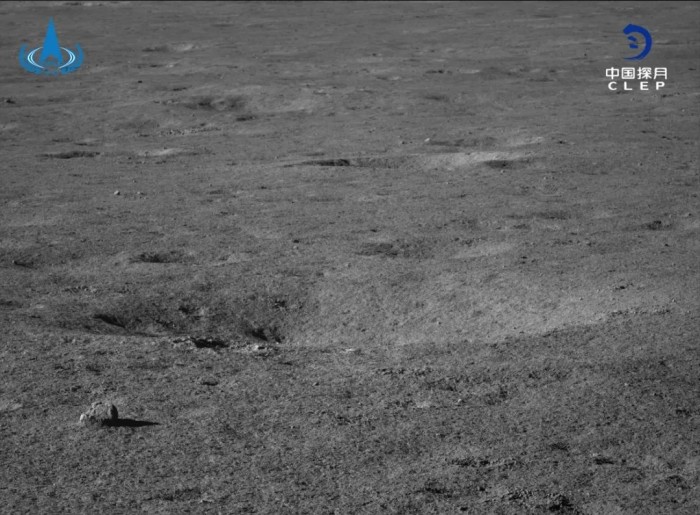
Based on data from the panoramic camera mosaic image and the DOM image from the 21st month, the Yutu-2 rover primarily traveled during the daylight hours of the 22nd month, sequentially exploring an impact crater and a high-reflectance area approximately 1.3 km northwest of the landing site.
Numerous scientific achievements have been made using the panoramic camera’s ring detection, the infrared imaging spectrometer calibration detection, and the lunar penetrating radar’s synchronization detection during the journey, which were recently published in international journals.
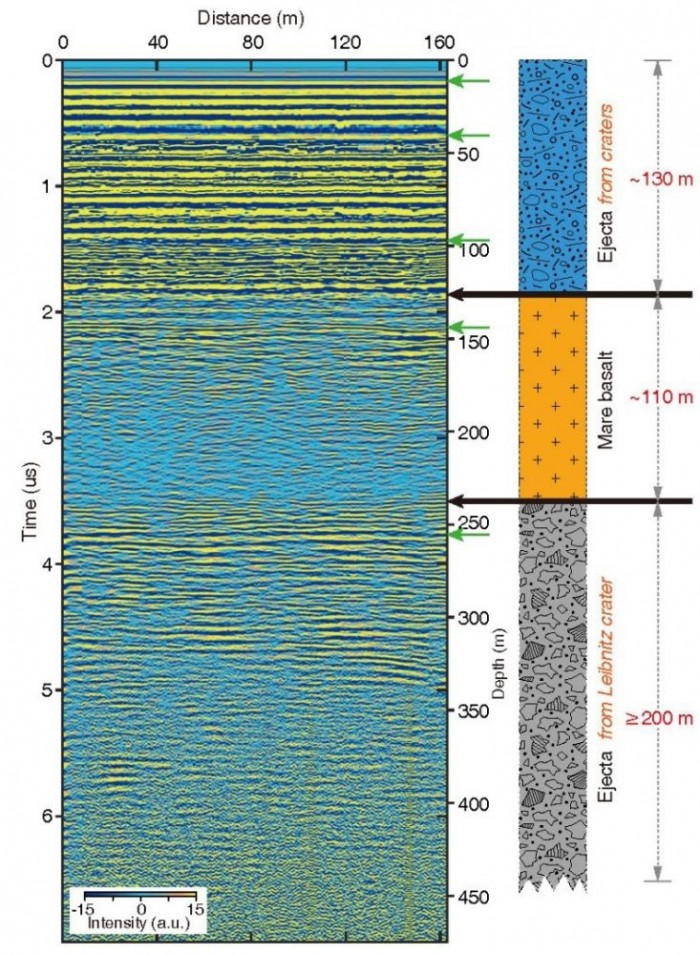
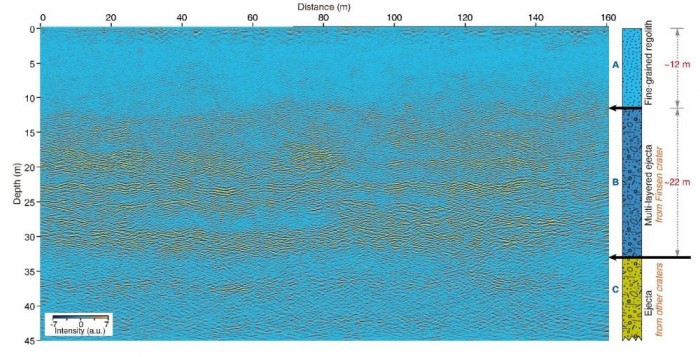
Detection profile and interpretation results of the lunar radar’s high-frequency channel
The scientific team conducted an in-depth study of the radar detection data and obtained important conclusions about the lunar soil and shallow structure of the landing area. The shallow structural profiles obtained by the Yutu-2 radar show that the lunar surface material detected by Yutu-2 originated from the Finsen crater, not from the basalt that filled the Von Kármán crater itself. Simultaneously, the radar profile also revealed that the landing zone experienced multiple periods of impact ejecta accumulation and multiple periods of filling by basaltic magma eruptions. These new discoveries are of great significance for understanding the evolution of the Moon’s South Pole-Aitken basin and for subsequent research into the composition and structure of the lunar interior.
Chang’e-4
Chang’e-4 is a Chinese lunar exploration mission that achieved the historic first-ever soft landing on the far side of the Moon in January 2019. It consists of a lander and the Yutu-2 rover, which continue to conduct scientific experiments, studying the lunar surface composition and low-frequency radio astronomy from this unexplored region.
Yutu-2
Yutu-2 is China’s robotic lunar rover, which landed on the far side of the Moon in January 2019 as part of the Chang’e 4 mission. It is the first rover to operate on the Moon’s far side, exploring the Von Kármán crater within the South Pole-Aitken basin to study lunar geology and surface composition. As of 2024, it holds the record for the longest operational duration of any rover on the lunar surface.
Finsen crater
The Finsen crater is a prominent impact feature on the far side of the Moon, named after the Danish Nobel laureate Niels Ryberg Finsen. It is a relatively young crater, estimated to be less than a billion years old, and is notable for its large central peak and bright ray system of ejected material.
Von Kármán crater
The Von Kármán crater is a large lunar impact basin located on the far side of the Moon, within the immense South Pole-Aitken basin. It is historically significant as the landing site of China’s Chang’e 4 mission in 2019, which achieved the first-ever soft landing on the lunar far side. The crater is named after Theodore von Kármán, a Hungarian-American physicist and aeronautical engineer.
South Pole-Aitken basin
The South Pole-Aitken basin is the largest, deepest, and oldest known impact crater in the solar system, located on the far side of the Moon. Formed by a colossal asteroid impact over 4 billion years ago, it provides crucial insights into the Moon’s geological history and interior composition. Its unique features make it a prime target for future lunar exploration missions.