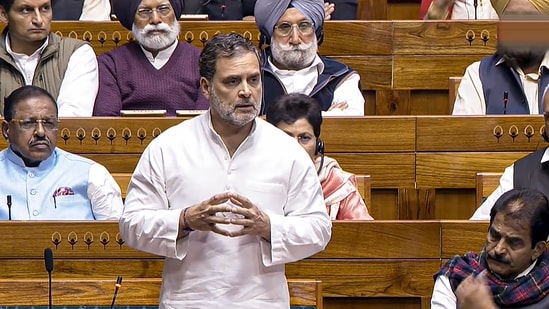
Rahul Gandhi, Leader of Opposition in the Lok Sabha, asked three questions to the Centre and presented four demands before the government while speaking during the debate on the Election Commission’s special intensive revision (SIR) of electoral rolls.
He raised questions on the panel that selects the chief and other election commissioners of the poll body, as well as on the instructions for accessibility of the CCTV footage recorded during polls.
Rahul Gandhi’s 3 questions
Following a ruckus in the Lower House of the Parliament during a debate on the electoral reforms, Congress MP Rahul Gandhi said he wanted to ask three questions "which will make it clear that the BJP is directing and using the EC to damage India’s democracy".
- CJI’s removal from selection panel for election commissioners
"Why was the CJI removed from the selection panel for appointing election commissioners? What motivation could there be to remove the CJI?" Rahul Gandhi asked, "Why is the Prime Minister and Amit Shah so keen on choosing exactly who the election commissioner would be?"
Gandhi said that he himself was also a part of the selection panel as the LoP, but claimed that he had no voice in the committee as he was outnumbered by the other side, which had Prime Minister Narendra Modi and Union home minister Amit Shah.
The Congress leader went on to pose his second question, which he termed an "even more devastating one", saying that no Prime Minister in the history of India has done this.
While moving toward his question, Rahul Gandhi said in Lok Sabha that in December 2023, the central government changed the law to ensure that no election commissioner could be penalised for any action they take while holding their post.
2. Immunity to election commissioners
"Why would the Prime Minister and home minister give this gift of immunity to the election commissioner? Why would they need to give this tremendous gift that no Prime Minister has ever given before to the election commissioner?"
He then moved on to his third question and asked about the .
3. CCTV recording of elections
"Why was the law with regards to CCTVs and the data that they contain changed? Why was a law put in place that allows the Election Commission to destroy CCTV footage 45 days after the election? What is the need?
Gandhi said that the answer given by the other side was that the law was brought in "as it is a question of data". The Congress rebutted, saying, "It is not a question of data; rather, it is a question of stealing the elections."
Rahul Gandhi’s 4 demands
After posing his three questions, Rahul Gandhi presented four demands, the “electoral reforms” that the Opposition wants.
He said:
1. Give a machine-readable voter list to all parties one month before elections.
2. Take back the law that allows the destruction of CCTV footage. Very simple, not difficult.
3. Also, tell us what the architecture of the EVM (electronic voting machine) is. Give us access to the EVM. Let our experts see what is inside the EVMs. Till today, we have not had access to the EVM.
4. Finally, please change the law that allows the election commissioner to get away with whatever he wants to do.
Rahul Gandhi said he wanted to “assure” the CEC and ECs that the Opposition will get the law changed, adding that they are actively working towards it. “And then, we will come and find you,” the LoP added.
EC on video footage accessibility
In June this year, the Election Commission of India revised its rules for the accessibility of video footage recorded during polls, saying that