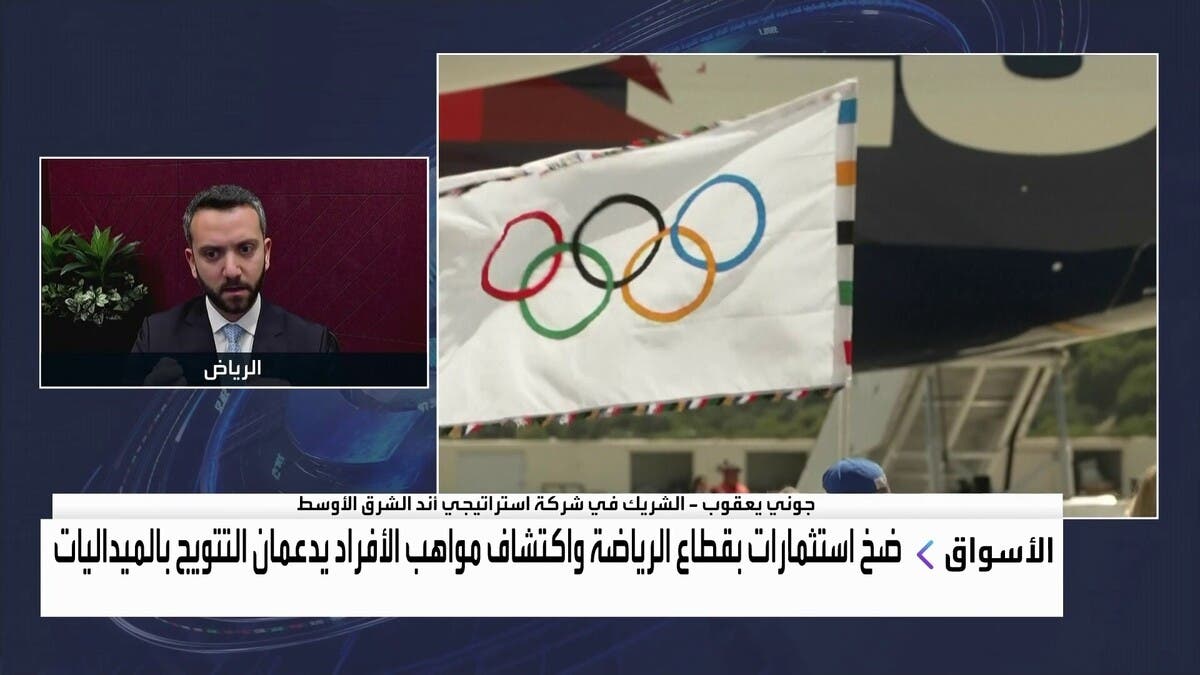
A report by Strategy & shows that countries hosting the Summer Olympic Games win an average of 20 additional medals compared to their performance four years before hosting the premier sporting event.
It was noted that the Arab world represents about 5.4% of the global population but wins only 1.4% of Olympic medals.
It was confirmed that the gap is not due to a lack of talent but rather the absence of an integrated sports system.
Sustainable Olympic success comes from a clear roadmap starting with broadening the base of community participation, systems for talent discovery and development, world-class coaches, structured development programs, advanced infrastructure, sustainable funding, and governments that focus resources on sports with higher chances of winning, not just football.
It was emphasized that investments must be shifted towards robust systems and better infrastructure to ensure Arab athletes appear on the podium.
Arab countries have made massive and unprecedented investments in sports. Saudi Arabia’s Public Investment Fund has identified sports as a key pillar of Vision 2030, and Qatar invested tens of billions in infrastructure to host the 2022 World Cup.
Building an integrated sports system is crucial for developing national Olympic strategies, which should go through three stages: starting with schools and universities, then a talent refinement phase, and finally an excellence phase involving intensive participation in major tournaments, especially those held in the region.
The Strategy & report coincides with successful experiments in the Gulf region, such as Qatar hosting the Asian Games in Doha in 2006, where it won 32 medals compared to just 17 medals four years prior.
Qatar has officially announced its intention to bid to host the 2036 Olympics, and both Egypt and Saudi Arabia have expressed interest in hosting either the 2036 or 2040 Games.
Summer Olympic Games
The Summer Olympic Games are a major international multi-sport event held every four years, with a tradition originating in ancient Greece. The modern iteration was revived in 1896 by Baron Pierre de Coubertin, establishing the International Olympic Committee to oversee the games. They have since evolved into a global spectacle promoting athletic excellence, international unity, and cultural exchange.
Vision 2030
“Vision 2030” is not a physical place or cultural site, but rather a strategic framework and ambitious national transformation program for the Kingdom of Saudi Arabia. Launched in 2016, its history is rooted in the goal of diversifying the nation’s economy away from oil dependence and developing its public service sectors. The vision outlines long-term goals and expectations in three key themes: a vibrant society, a thriving economy, and an ambitious nation.
2022 World Cup
The 2022 FIFA World Cup was an international football tournament hosted by Qatar, making it the first World Cup held in the Middle East and the Arab world. The event was notable for being held in November and December instead of the traditional summer months to avoid the extreme heat, and it featured significant infrastructure development, including new stadiums and transportation systems. The tournament concluded with Argentina winning its third title after a dramatic final against France.
Asian Games
The Asian Games is a major international multi-sport event held every four years, featuring athletes from all over Asia. It was first held in 1951 in New Delhi, India, with the goal of promoting solidarity and friendly competition among Asian nations. Modeled after the Olympic Games, it has grown to become the second-largest multi-sport event after the Olympics itself.
Doha
Doha is the capital city of Qatar, a modern metropolis on the coast of the Persian Gulf. Historically a small fishing and pearling village, it grew into a regional hub after Qatar’s independence in 1971 and the subsequent discovery of vast oil and natural gas reserves. Today, it is known for its futuristic skyline, world-class museums like the Museum of Islamic Art, and its role as a major center for commerce and culture.
2036 Olympics
The 2036 Olympics is a future Summer Games for which a host city has not yet been selected. The event is part of the modern Olympic tradition, which began in 1896, and several cities have expressed interest in bidding for the honor of hosting these games.
Egypt
Egypt is home to one of the world’s oldest civilizations, dating back to around 3100 BCE with the unification of Upper and Lower Egypt under a single pharaoh. It is globally renowned for its iconic monuments, such as the Pyramids of Giza and the Great Sphinx, which were constructed as tombs and tributes for its ancient rulers. This rich history, preserved through millennia of artifacts and hieroglyphics, continues to define Egypt’s cultural identity and attract global fascination.
Saudi Arabia
Saudi Arabia is a modern nation founded in 1932, but its history is deeply rooted as the birthplace of Islam in the 7th century. It is home to the religion’s two holiest cities, Mecca and Medina, and its vast territory was historically a crossroads for ancient trade routes. The country’s contemporary significance is defined by its immense oil reserves, which have shaped the global economy and its rapid development.