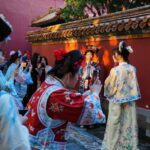
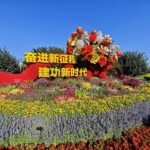
During the 14th Five-Year Plan period, Beijing’s rural industries have continued to innovate and develop, with more integrated business models. It has been learned that currently, Beijing has 116 national and municipal-level beautiful leisure villages, over 260 village cafes, and 3,932 rural homestays, creating more than 100 high-quality leisure tourism routes including the Great Wall scenery, Xishan Yongding, and Canal wetland areas.
During the 14th Five-Year Plan period, Beijing has precisely addressed issues encountered in rural industrial development such as insufficient land supply, incomplete industrial chains, and scattered financial support, implementing comprehensive measures to form a strong policy toolkit supporting rural industrial development.
In terms of industrial land supply, guidelines were formulated to meet various land use needs for the integrated development of primary, secondary, and tertiary industries in rural areas. Regarding industrial chain improvement, measures were introduced to enhance and streamline the development path of agricultural product processing. For financial support, management measures were issued establishing a coordinated mechanism among government, banks, guarantors, and enterprises, collectively supporting industrial projects that enhance rural industrial development and increase farmers’ income.
Meanwhile, during the 14th Five-Year Plan period, Beijing focused on key regions and areas, developing dominant industries. The three national industrial clusters, six national modern agricultural industrial parks, and nine national agricultural industrial strong towns have continuously improved their leading industries, becoming important platforms driving rural industrial development. Additionally, platforms for cultivating rural industry leaders were established, creating mutual assistance and learning platforms while building bridges between government and markets.
In terms of industrial entities, during the 14th Five-Year Plan period, Beijing guided new farmers to return home and start businesses through project support, creative selection, and promotional activities, cultivating a large number of new rural industry entities. Currently, the city has 8,743 leisure agriculture business entities and 318 municipal-level leisure agricultural star-rated parks. Nearly 300 cultivated “leaders” have become navigators and new forces promoting rural industrial development, driving the flourishing development of new formats such as village cafes, baking, intangible cultural heritage workshops, specialty markets, cultural performances, and agricultural innovation activities.
Regarding business models, during the 14th Five-Year Plan period, Beijing actively expanded agriculture’s multiple functions and explored rural多元价值, establishing specialized teams for high-quality rural tourism development and deeply promoting the integration of agriculture, culture, and tourism. A large number of high-quality leisure tourism routes were created, including the Great Wall scenery, Xishan Yongding, and Canal wetland areas, while continuously cultivating the “Jinghua Xiangyun” regional brand for leisure agriculture, establishing benchmarks for the integration of agriculture, culture, and tourism. With 116 national and municipal-level beautiful leisure villages, over 260 village cafes, and 3,932 rural homestays, Beijing’s suburbs have become capital residents’ “second living space” and “second cultural space” for亲近自然 and experiencing culture.
In terms of income generation, during the 14th Five-Year Plan period, Beijing focused on establishing and implementing mechanisms connecting agriculture with farmers, playing an active role in promoting agricultural product sales, farmer employment, and village collective income. Last year, the total output value of agriculture, forestry, animal husbandry, and fishery in the city achieved positive growth, with the per capita disposable income of rural residents growing 2.4 percentage points faster than that of urban residents. The 106 implemented comprehensive rural revitalization industrial development projects are expected to directly increase business revenue by 850 million yuan, drive agricultural product sales of 450 million yuan, and generate village collective income of 134 million yuan, becoming new driving forces for the economic development of Beijing’s suburbs.