Ho Chi Minh City leaders affirmed the city’s desire to cooperate with Chinese businesses on its journey to become a leading innovative startup center in Southeast Asia.
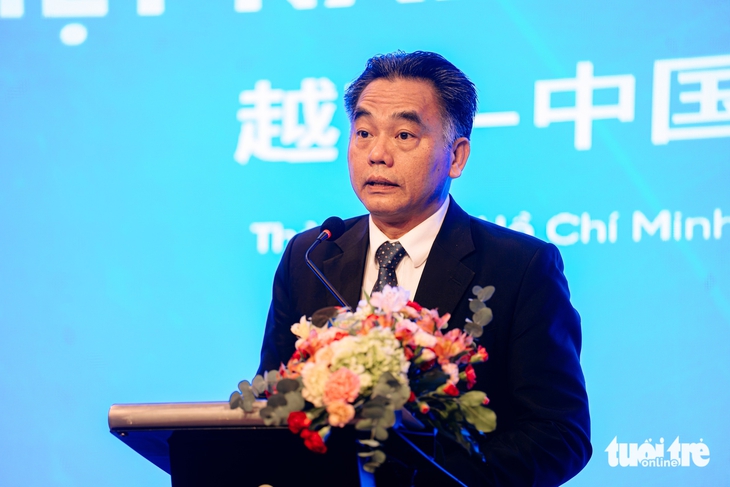
On the afternoon of November 27, the Center for the Fourth Industrial Revolution in Ho Chi Minh City coordinated with the Chinese Consulate General in Ho Chi Minh City and the Chinese Business Association in Vietnam to organize the “Connection” seminar.
The seminar was an important side activity.
Commitment to promoting Vietnam-China economic relations
Speaking at the seminar’s opening, the Vice Chairman of the Ho Chi Minh City People’s Committee stated that the city takes pride in being the leading locality attracting investment from China in Vietnam. He said there are currently over 800 investment projects from China with total registered capital of nearly $3 billion.
Investment projects focus on the following areas: information technology and digital transformation; smart manufacturing and supporting industries; logistics and e-commerce; renewable energy and green technology.
Looking toward the future, city leadership stated that Ho Chi Minh City is building a comprehensive innovation ecosystem, with the goal of becoming a leading innovative startup center in Southeast Asia.
In this effort, Ho Chi Minh City wishes to cooperate with Chinese businesses in developing AI, big data, Internet of Things (IoT), and blockchain.
He emphasized: “The innovative urban super-project in Ho Chi Minh City will be an ideal space for Vietnam-China technological cooperation, creating modern knowledge infrastructure to serve digital economic development.
Additionally, with its role as a financial center, the city is ready to cooperate in developing digital financial products, cashless payments, and green finance, meeting the needs of businesses from both countries.”
Aiming for cooperation that contributes to Vietnam-China relations, the Vice Chairman affirmed the city’s commitment to continue improving the business investment environment, simplifying administrative procedures, and creating maximum convenience for Chinese businesses to invest and develop.
Ho Chi Minh City also commits to building special cooperation mechanisms, creating bridges for Chinese businesses to access the ASEAN market, as well as promoting cooperation in sustainable development, green economy, and climate change response.
“As Vietnam’s economic locomotive, Ho Chi Minh City is ready to be a reliable bridge and strategic partner for Chinese businesses in their journey to conquer regional and global markets,” he emphasized.
China continues to optimize business environment for Vietnamese investors
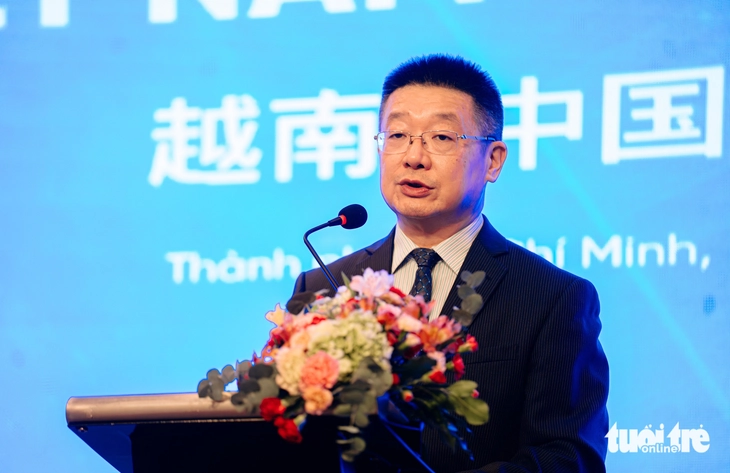
For their part, he assessed that the Vietnam-China Comprehensive Strategic Partnership is continuously deepening.
Bilateral trade turnover has shown stable growth, infrastructure connectivity cooperation has been strengthened. Industrial chains and supply chains have also integrated deeply and broadly, creating a vast foundation for business cooperation.
He stated that 2025 is the year China formulates its 15th Five-Year Plan (2026-2030) with a focus on high-quality development, bringing new opportunities for cooperation between Vietnamese and Chinese businesses.
The Chinese Consul General emphasized that in the coming period, they will continue to optimize the business environment, improve intellectual property rights protection, and open up more deeply and broadly to foreign businesses.
He committed that the Consulate General will continue to play its bridging role, promoting substantive investment and cooperation between localities and businesses of both countries, elevating the cooperative relationship to new heights.
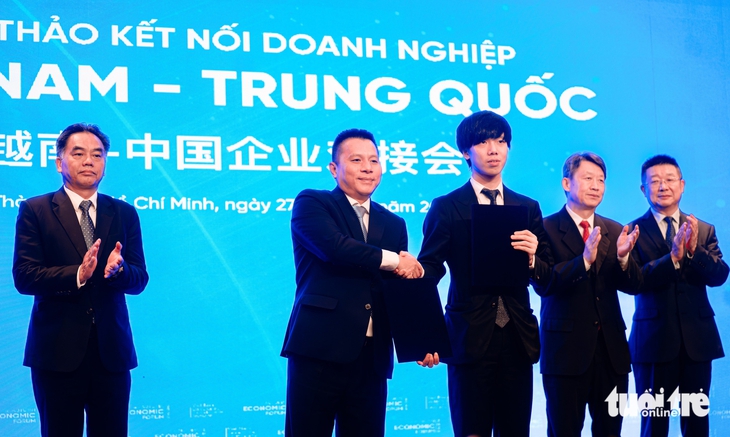
At the seminar, representatives from several Vietnamese businesses and Chinese businesses and localities presented discussions on cooperation opportunities and investment attraction policies in fields such as semiconductors, AI, IoT, smart logistics, green industry…
Participants jointly affirmed that there remains significant potential for cooperation between Chinese and Vietnamese businesses, particularly in digital economy, smart cities, green manufacturing, and advanced technologies.
In this context, Ho Chi Minh City plays a strategic bridging role, helping businesses from both countries connect supply chains and promote sustainable development models.
Meeting with the delegation of Chinese businesses, the Vice Chairman emphasized that alongside business cooperation, sister-city relationships between localities of both countries are also very necessary.