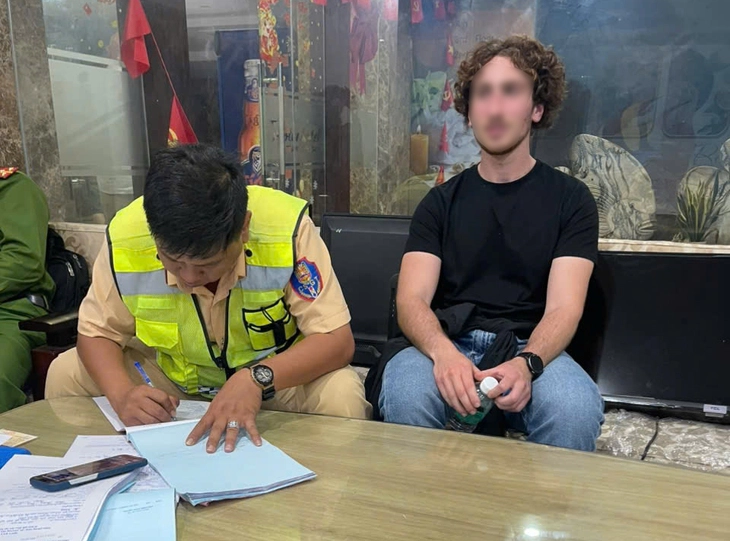
Several recent cases of foreigners violating the law in Da Nang and Ho Chi Minh City may be isolated incidents, but what is concerning is not the number of cases, but the warning signal they send.
Vietnam is on an irreversible path toward deeper integration, stronger openness, and faster internationalization. In major cities like Ho Chi Minh City and Da Nang, the sight of people living, working, and traveling has become commonplace.
Cafes with multiple languages, neighborhoods with many foreigners, bustling international flights… reflect the appeal of a stable, friendly, and opportunity-rich country.
We have reason to be proud of this because not many countries have maintained a stable political and social environment while sustaining growth and tourist appeal as Vietnam has for many years. The policy of openness, attracting investment, and promoting international exchange is a correct strategic choice that has clearly brought many results.
But there is one principle that has never changed: the more open a country is, the stronger its management capacity must be. In other words, friendliness cannot be mistaken for leniency.
Recently, the public has witnessed many cases of foreigners breaking the law, causing outrage. From acts of assault on people in the street, vandalism, robbery, to particularly serious cases involving foreign elements.
Although each case has a different nature, there is a common point worth pondering: people see behaviors that go beyond normal limits of conduct.
More notably, these incidents occur in tourist cities and international trade centers, places that should be models of security and urban civility.
The majority of foreigners coming to Vietnam abide by the law, do legitimate business, and contribute to the economy, education, science, tourism, and cultural exchange. Many consider Vietnam their second home.
It would be unfair to use the wrongful acts of a few individuals to cast a shadow over the entire community. But conversely, it would also be subjective to view recent cases as mere “isolated accidents” and quickly forget them.
Several honest questions need to be raised: Has the management of immigration and residence truly kept pace with the internationalization speed of major cities? Are we identifying early those individuals at risk of violating the law, abnormal groups, or networks exploiting open policies to commit illegal acts?
One reality to recognize is that along with capital flows, tourists, and international labor, cross-border crimes are also moving increasingly fast. From high-tech fraud, organized gambling, money laundering, transnational black credit, to extortion, hired debt collection, and personal data trading… physical borders are becoming increasingly fragile against new forms of crime.
Of course, control at border gates alone is not enough. Modern governance requires data to be connected, information to be shared, and warnings to come before illegal acts occur.

A person entering for tourism but staying unusually long, engaging in activities beyond their visa purpose, forming closed groups, or generating suspicious transactions—these should be signals identified early, rather than waiting until the matter becomes a criminal case. This is not only the responsibility of the police or immigration authorities.
Local governments, accommodations, landlords, tourism businesses, residential areas, and even citizens must become “social security links” that are responsible but not extreme.
Somewhere, there is still a lax attitude toward deviant behaviors due to fear of conflict or concerns about affecting the investment or tourism environment. But leniency toward violations has never been a way to protect a