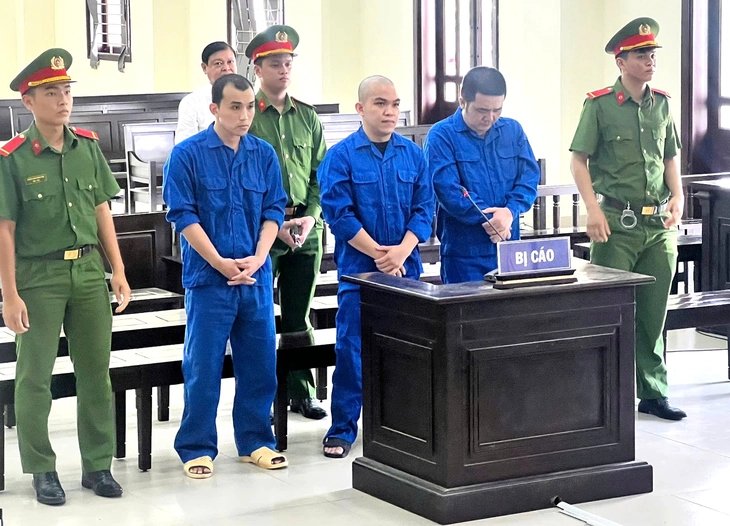
On the evening of April 22, the trial panel of the first-instance court sentenced all three defendants—Huynh Ba Hien (33 years old, residing in Dong Hung Thuan ward, Ho Chi Minh City), Vo Chi Bao (26 years old), and Huynh Thien Duc (30 years old, both residing in Dong Thanh commune, Tay Ninh)—to life imprisonment for the same crime of illegal drug transportation.
Duc was also charged with the additional crime of illegal drug possession.
All three are drug addicts. Hien had been sent to compulsory rehabilitation multiple times since 2013. Bao was previously administratively penalized in 2018 for illegal drug use and sentenced to three years in prison in 2019 for illegal drug trafficking. Duc was also administratively penalized for illegal drug use in 2016 and had been imprisoned multiple times for theft.
According to the indictment, on November 22, 2024, Bao heard that Hien had a broken leg and was renting a house in My Hanh commune, Tay Ninh, so he went to visit. Knowing that Bao’s house was near the Cambodian border, Hien asked Bao to find someone to transport drugs from Cambodia for him, with a fee of 20 million VND per kilogram.
The next day, while at a coffee shop, Bao met Duc, who lived nearby, and they exchanged greetings and became friends on Zalo. Bao then invited Duc to transport drugs, and Duc agreed.
Under Hien’s guidance, in the early morning of November 30, 2024, Duc crossed into Cambodia, went to a casino, and was directed by someone to a location to pick up the drugs. Duc hired a motorbike taxi to travel partway toward the border, then continued on foot toward Vietnam.
At that time, Bao rented a car and waited at a parking lot near the border to pick up Duc. However, around 5:15 a.m. the same day, as Duc approached border marker 186 in My Quy commune, Tay Ninh, he was discovered and arrested by forces from the My Quy Tay border gate station.
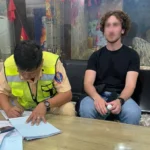
Following this, border forces quickly summoned Bao for questioning and searched Hien’s residence in My Hanh commune. However, Hien had fled. Hien was later arrested and charged by Ho Chi Minh City Police in another case for two crimes: illegal drug trafficking and organizing illegal drug use.
The drugs Duc was transporting at the time of his arrest weighed nearly 9 kilograms of methamphetamine and nearly 1 kilogram of ketamine.
In this case, Hien was the person who arranged the illegal drug transport from Cambodia, directly hired, instructed, and provided transportation for Bao and Duc. Bao was the one who introduced and relayed instructions from Hien to Duc and vice versa, and also provided transportation for Duc.
On April 22, the People’s Court of Tay Ninh province held a first-instance trial and sentenced Do Bao Anh (27 years old, residing in Long Phu ward, An Giang) to life imprisonment for murder.
Cambodia
Cambodia is a Southeast Asian nation known for its rich history, most famously as the heart of the ancient Khmer Empire, which built the magnificent Angkor Wat temple complex in the 12th century. After a period of French colonial rule, the country endured the devastating Khmer Rouge regime in the 1970s, which caused immense suffering. Today, Cambodia is rebuilding its cultural heritage and is a popular destination for visitors drawn to its ancient ruins and resilient spirit.
Vietnam
Vietnam, located in Southeast Asia, has a rich history shaped by centuries of Chinese rule, French colonization, and the Vietnam War, which ended in 1975. Its cultural heritage is a blend of indigenous traditions, Confucian influences, and French colonial architecture, evident in landmarks like Hanoi’s Old Quarter and Ha Long Bay. Today, Vietnam is known for its vibrant street food, stunning landscapes, and resilient spirit, drawing millions of visitors annually.
Tay Ninh
Tay Ninh is a province in southern Vietnam, best known as the headquarters of the Cao Dai religion, a unique faith that blends elements of Buddhism, Christianity, Taoism, and Confucianism. Its most prominent cultural site is the Cao Dai Holy See, a colorful and ornate temple built in the 1930s. During the Vietnam War, Tay Ninh was also a strategic area near the Ho Chi Minh Trail and the site of the Battle of Loc Ninh.
My Hanh commune
My Hanh commune is a rural area in Vietnam, historically known for its agricultural roots and traditional village culture. Located in the Mekong Delta region, it has developed over time while preserving local customs and community-based farming practices. The commune reflects the resilience and adaptation of Vietnamese rural life amid modernization.
My Quy commune
My Quy is a rural commune located in the Tien Giang Province of the Mekong Delta region in Vietnam. Historically, the area has been shaped by the region’s agricultural development and the network of canals and waterways that define the delta, with local livelihoods traditionally centered on rice cultivation and fruit farming. Today, it remains a quiet, community-focused area that reflects the enduring cultural and agricultural heritage of southern Vietnam.
My Quy Tay border gate station
My Quy Tay border gate station is a border crossing located in the Quang Tri province of Vietnam, near the border with Laos. Historically, it has served as an important point for trade and travel between the two countries, and its significance grew after the Vietnam War as a symbol of cross-border cooperation and economic exchange. Today, it facilitates the movement of goods and people, contributing to the local economy and regional integration.
Ho Chi Minh City
Ho Chi Minh City, formerly known as Saigon, is Vietnam’s largest city and economic hub. It played a pivotal role during the Vietnam War, serving as the capital of South Vietnam until 1975, when it was renamed after the communist leader Ho Chi Minh. Today, the city blends historic French colonial architecture with modern skyscrapers, reflecting its dynamic history and rapid development.
An Giang
An Giang is a province in the Mekong Delta region of southern Vietnam, known for its rich cultural diversity and stunning natural landscapes, including the Tra Su Cajuput Forest and the Sam Mountain. Historically, it was a key area during the Khmer Empire and later became a frontier territory under the Nguyen dynasty, with significant Cham and Khmer influences still present today. The province is also famous for its role in the region’s agricultural development and its vibrant floating markets and pagodas.