Trump announces cancellation of second attack on Venezuela.
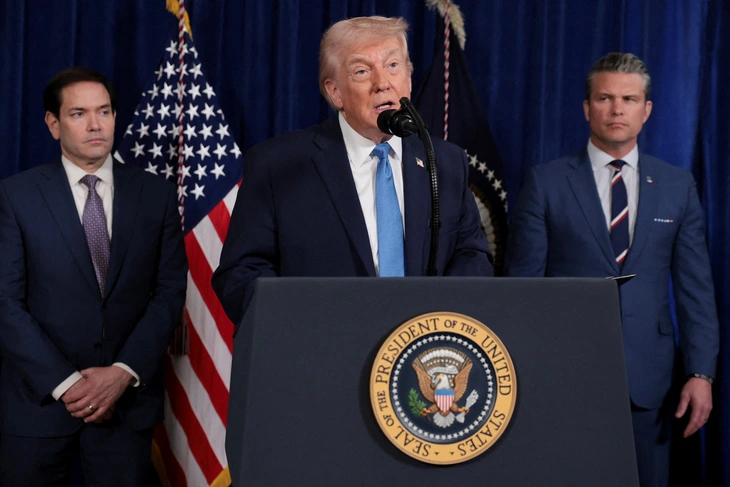
On January 9, US President Donald Trump announced he had canceled plans for a second military strike against Venezuela. He explained the decision stemmed from acknowledging the cooperative and good-faith attitude of Venezuela’s interim government.
Forces Will Not Be Withdrawn from the Region
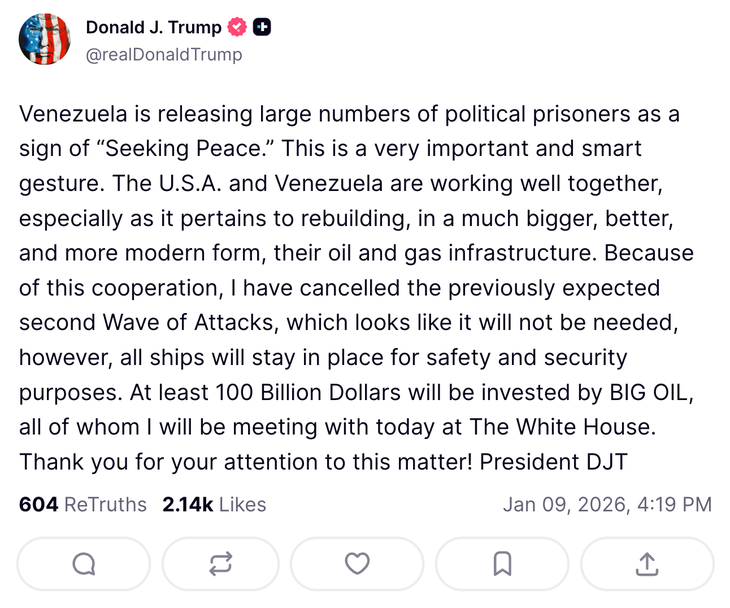
Sharing on Truth Social, Mr. Trump noted that Caracas had just released a “large number of political prisoners” and called this a “very important and wise gesture in seeking peace.”
“The United States and Venezuela are cooperating very well together, especially in the work of rebuilding this nation’s oil and gas infrastructure on a larger, better, and much more modern scale. Because of that cooperation, I have canceled the second strike on Venezuela, which had been previously planned. This no longer seems necessary,” Mr. Trump announced.
However, the US President affirmed that forces would not be withdrawn from the region. “All warships will remain in position for safety and security purposes,” he stated.
Will US Oil and Gas Corporations Invest at Least $100 Billion in Venezuela?
Additionally, the American leader announced that major US oil and gas corporations would invest at least $100 billion in Venezuela, and said he would meet with representatives of these companies at the White House on the same day, January 9.
After directing the strike on Caracas and detaining the President of Venezuela on January 3, Mr. Trump had repeatedly hinted at the possibility of launching another attack if the new government refused to cooperate with the US.
Just hours before Mr. Trump’s statement, the US Senate had passed a procedural step paving the way for a vote on a resolution to prevent Mr. Trump from taking further military action against Venezuela without congressional approval.
The vote result was 52 in favor and 47 against, with some Republican senators siding with all Democratic senators to support this resolution.
However, the above move is seen as largely symbolic. Even if the resolution formally passes both chambers, which are both controlled by the Republican Party, it would still require Mr. Trump’s signature to take effect.
The US President confirmed he will soon meet the recipient of the 2025 Nobel Peace Prize, and said he was “very honored” by the invitation to share the award.
Venezuela
Venezuela is a South American country known for its diverse landscapes, including the Andes Mountains, the Amazon rainforest, and Angel Falls, the world’s highest uninterrupted waterfall. Historically, it was a Spanish colony until the early 19th century, when it became a leading force in the independence movement led by Simón Bolívar. Its modern cultural identity is deeply shaped by this history, its oil-rich economy, and a blend of Indigenous, African, and Spanish influences.
Caracas
Caracas is the capital and largest city of Venezuela, founded in 1567 by Spanish conquistador Diego de Losada. Historically a key colonial administrative center, it later became the birthplace of Simón Bolívar and a focal point for South America’s independence movement in the early 19th century. Today, it is a major metropolitan and cultural hub, though it faces significant modern economic and political challenges.
Truth Social
Truth Social is a social media platform launched in 2022 by Trump Media & Technology Group, founded by former U.S. President Donald Trump. It was created following Trump’s bans from major platforms like Twitter and Facebook, positioning itself as a platform promoting free speech and an alternative to what it describes as “Big Tech censorship.” Its history is directly tied to the political and online media landscape following the 2020 U.S. presidential election.
White House
The White House is the official residence and workplace of the President of the United States, located in Washington, D.C. It was designed by James Hoban, with construction beginning in 1792 and the first president, John Adams, moving in in 1800. The building has been expanded and renovated over the centuries, notably after being burned by British forces in 1814, and stands as a powerful symbol of the U.S. government and its history.
US Senate
The United States Senate is the upper chamber of the U.S. Congress, established by the Constitution in 1789 as part of the Great Compromise to balance the interests of large and small states. It is composed of 100 senators, two from each state, who serve six-year terms and hold unique powers such as confirming presidential appointments and ratifying treaties.
Republican Party
The Republican Party, founded in 1854, is one of the two major contemporary political parties in the United States. It was established primarily to oppose the expansion of slavery and its first successful presidential candidate was Abraham Lincoln in 1860. Historically associated with classical liberal and socially conservative policies, it has played a defining role in U.S. political history.
Democratic
“Democratic” does not refer to a specific place or cultural site. It is a political principle or system of government (democracy) meaning “rule by the people,” rather than a physical location. Its history is rooted in ancient civilizations like Athens, with modern forms developing through centuries of philosophical thought and political revolutions.