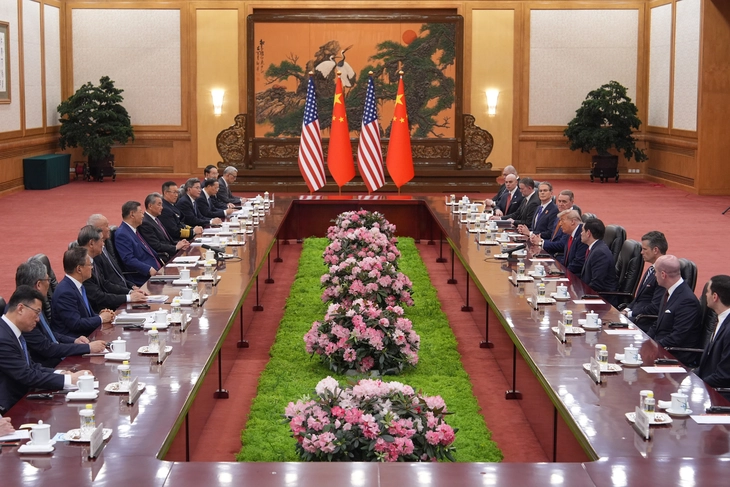
When “Air Force One” took off heading to Beijing on May 13, U.S. President Donald Trump did not travel alone. The 17 most powerful CEOs in America shared his cabin — an unprecedented number in the history of U.S. presidential trips.
This was not an ordinary diplomatic trip, but the largest business summit in history.
Trump’s first visit to China after a nine-year absence took on a completely different form.
Joining him on the plane were Apple CEO Tim Cook, Tesla CEO Elon Musk, and Nvidia CEO Jensen Huang — three people holding the levers shaping the global digital economy — along with 14 other leaders of top corporations.
The message from that entourage was clear before the plane even landed: this was the trip of a businessman sitting in the president’s chair, someone who believes that every problem in the world, ultimately, can be reduced to a balance sheet.
The Three B’s and the Language of Deals
In diplomatic circles, people often use chessboard metaphors to describe summit meetings. But Trump brought a different vocabulary to Beijing: not one but three B’s at once — Boeing, Beans, and Beef.
It sounds simple, but this is exactly what he wanted to put on the negotiating table. China buying Boeing planes to rescue the struggling U.S. aviation industry competing with Airbus; China opening its market to U.S. soybeans and beef to appease farmers in the West — his core voters.
The three B’s, though rough, represent the language Trump speaks most fluently: the language of deals, of exchange, of immediate balance on the trade ledger.
He did not come to Beijing to discuss universal values or a rules-based international order. He came to demand that China open its market, buy U.S. goods, and share the burden of the trade deficit weighing on American workers.
But beneath those simple three B’s lies a much more complex layer — and it was this layer that was brought onto the plane at the last minute.
Nothing in politics is coincidental. The fact that Jensen Huang — CEO of Nvidia, architect of global AI infrastructure — was added to the passenger list of “Air Force One” right before departure was a calculated signal.
Nvidia is at the center of the greatest technological conflict of this century. The previous Biden administration imposed export controls on China — a restriction Beijing considers an economic weapon, while Washington calls it a national security measure. Nvidia lost a massive market; China lost access to chips to fuel its AI ambitions. Both are suffering losses.
Trump does not believe in long-term embargoes. He believes in specific deals. The presence of Jensen Huang sent a clear message: the chip issue will be on the negotiating table in Beijing.
The question is not whether the U.S. will sell AI chips to China, but rather what to sell, how to sell it, and what to get in return. This is no longer technology diplomacy — this is technology bargaining, and Trump is a natural at bargaining.
The Gravity of 17 CEOs
The real gravity pulling “Air Force One” toward Beijing is not just chips, not just soybeans or Boeings awaiting delivery.
<div class="
Air Force One
Air Force One is the official air traffic control call sign for any U.S. Air Force aircraft carrying the President of the United States, though it is most commonly associated with the two highly customized Boeing VC-25A planes in service since 1990. The term originated during the Eisenhower administration, and the iconic blue-and-white livery was designed under President John F. Kennedy. Serving as a flying White House, the aircraft is equipped with advanced communications and defensive systems, allowing the president to conduct national business and serve as commander-in-chief from anywhere in the world.
Beijing
Beijing, the capital of China, is a historic city with over 3,000 years of recorded history, serving as the nation’s political and cultural center for centuries. It is home to iconic landmarks like the Forbidden City, the Great Wall, and Tiananmen Square, reflecting its imperial past and modern significance. Today, Beijing blends ancient traditions with rapid modernization, hosting major events like the 2008 Olympics and showcasing its rich heritage through preserved sites and vibrant local culture.
Great Hall of the People
The Great Hall of the People is a massive state building located on the western side of Tiananmen Square in Beijing, China. Constructed in just 10 months in 1959 as one of the “Ten Great Buildings” to commemorate the 10th anniversary of the People’s Republic of China, it serves as the primary venue for the National People’s Congress and other major political and cultural events. The hall is renowned for its grand architecture, which includes the famous 10,000-seat Great Auditorium and numerous meeting halls named after Chinese provinces.
Boeing
The Boeing Company is a major American aerospace and defense corporation founded in 1916 by William Boeing in Seattle, Washington. Originally known for building early aircraft like the Model 40, it grew into a global leader in commercial aviation with iconic jets such as the 747 and 737, as well as a key player in space exploration through its work on the International Space Station and the Space Launch System. Over its history, Boeing has faced significant challenges, including production issues and safety scandals, but remains a cornerstone of the aviation industry.
Airbus
Airbus is a leading European aerospace corporation known for designing, manufacturing, and selling commercial aircraft, helicopters, and defense systems. Founded in 1970 as a consortium of European companies to compete with American giants like Boeing, it has since grown into a global symbol of international collaboration. Its headquarters are in Toulouse, France, and it is famous for producing the A380 superjumbo and the A320 family of narrow-body jets.
Nvidia
Nvidia is a leading American technology company known for designing graphics processing units (GPUs) for gaming, professional visualization, and artificial intelligence. Founded in 1993 by Jensen Huang, Chris Malachowsky, and Curtis Priem, it began by making chips for 3D graphics and later revolutionized computing with its CUDA platform, enabling GPUs to handle complex parallel processing tasks. Today, Nvidia is a dominant force in AI, data centers, and autonomous vehicles, with its products powering everything from video games to advanced machine learning models.