10 years of living and studying in Vietnam gave me the opportunity to deeply understand the pulse of Vietnamese society. Now, when teaching students about Vietnamese society from what I have seen and heard, I always feel it is a profound responsibility.
In 2026, a historic turning point is marked as the restructuring of the global order requires both Vietnam and South Korea to chart a new path beyond the achievements of the past 30 years.
In that context, I believe there are several reasons and goals for the two countries to build a new bilateral relationship, aiming for shared prosperity and overcoming challenges together.
Since establishing diplomatic relations in 1992, South Korea and Vietnam have written an unprecedented success story in global diplomatic history over the past three decades.
Vietnam has become South Korea’s largest investment destination in ASEAN, while South Korea is Vietnam’s most reliable partner in its economic modernization.
In the context of increasingly fierce great power competition, challenges of resource security and rapid climate change, the two countries celebrated 30 years of diplomatic relations in 2022 by elevating ties to a Comprehensive Strategic Partnership, marking a new milestone.
However, instead of resting on past successes, it is time to reaffirm why the two nations are “irreplaceable partners” in the evolving global order.
While past cooperation was based on a production model combining Vietnam’s infrastructure and human resources with South Korea’s capital, the next 30 years should develop into an “innovation partnership” – sharing high value-added industrial value chains.
In particular, Vietnam holds a key position in mineral security for future industries such as semiconductors and batteries.
When Vietnam’s abundant essential minerals combine with South Korea’s advanced technology, a powerful synergy can be created, allowing both countries to overcome global supply chain risks.
Trust built through long-term economic exchanges and improved technology transfer further supports this transformation.
Moreover, Vietnam’s digital transformation goals and commitment to net-zero emissions offer new opportunities for both nations. South Korea’s smart city and renewable energy technologies are poised to become models for sustainable growth across Asia.
In the political and security field, closer cooperation between the two countries is an urgent historical requirement. Peace and stability in the Indo-Pacific region directly relate to the prosperity of both nations.
Notably, Vietnam can play a mediating role in fostering peace on the Korean Peninsula.
Alongside this, with the global rise of Korean culture (K-Culture), it is time to anticipate the development of Vietnamese culture (V-Culture), initiating two-way cultural exchanges based on deep understanding and respect for each other’s history and traditions.
Finally, the large communities of Koreans in Vietnam and Vietnamese in South Korea form the most valuable bridge to maintain and strengthen bilateral relations.
Through these efforts, the two countries can look toward each other not only as “business partners” but also as “true neighbors.”
The new strategic relationship between South Korea and Vietnam will transcend bilateral interests, paving the way for a new chapter: coexistence, overcoming challenges together, and shared prosperity. In that process, I look forward to continuing to inspire and nurture future generations who can contribute to the friendly development between the two countries.
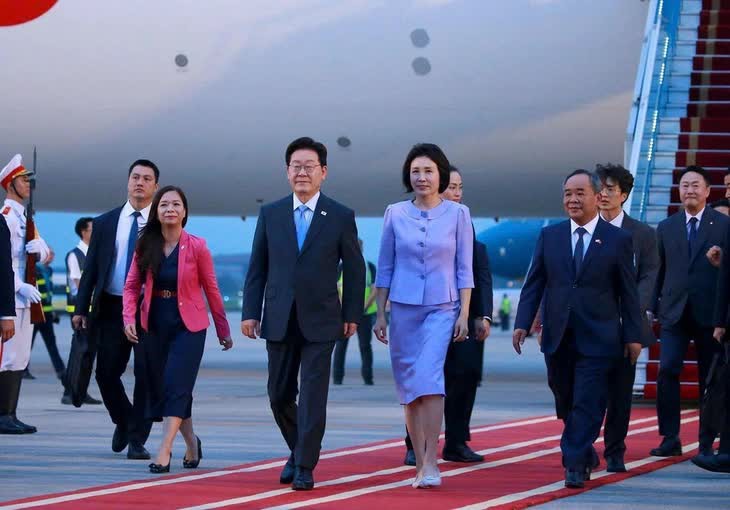
This is the first state visit of South Korean President