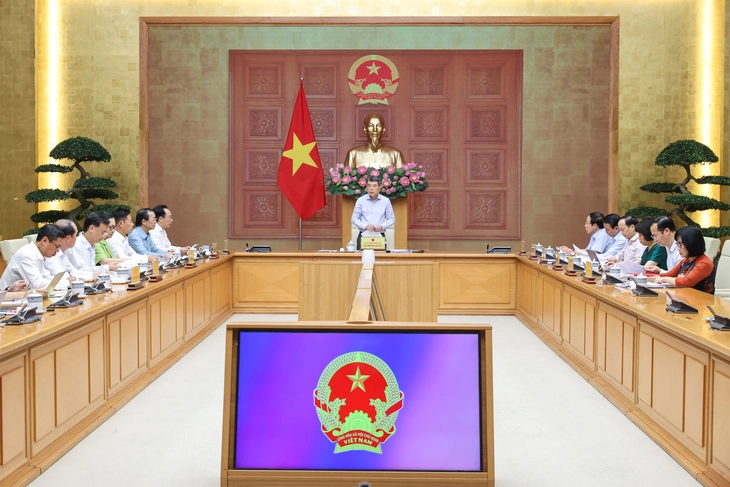
On the morning of April 25, the Prime Minister chaired a working session with the Ministry of Education and Training on key and urgent programs, plans, and tasks, as well as addressing difficulties, obstacles, recommendations, and proposals.
According to a report from the Ministry of Education and Training, many institutions, mechanisms, and policies in the sector have been essentially completed. Universal preschool education for children aged 3 to 5 years is being substantively addressed to ensure stability.
Enhancing the responsibility of leaders
A single set of textbooks will be uniformly adopted nationwide starting from the 2026-2027 school year, ensuring consistency and synchronization in content, methods, and teaching organization in general schools.
The sector is focusing on training high-quality human resources to serve the development of key industries, with 102 majors and 92 talent training programs. A project to make English a second language in schools is being implemented. Efforts are concentrated on building 229 inter-level general schools, simplifying and reducing administrative procedures and business conditions.
In conclusion, the Prime Minister emphasized that the sector has a very large volume of tasks and work, identified by the Party and State as a top national priority.
Along with the achieved results, the Prime Minister pointed out shortcomings, such as a relatively large number of unfinished documents, projects, and tasks. The review and reorganization of higher education and vocational education institutions are progressing slowly. The digitization of sector-wide data and the restructuring of administrative procedures face many difficulties.
Therefore, the head of the Government requested that the Ministry and the education and training sector continue to prioritize building a clean and strong Party organization. This includes improving regulations, reforming work practices, enhancing the responsibility of leaders, and promptly replacing officials who fail to complete tasks or ensure work quality.
Focus on institutionalizing and concretizing the Party’s guidelines and policies, as well as the resolutions of the National Assembly and the Government. This includes reviewing and amending decrees on the functions, tasks, and organizational structure of the ministry so that “one task is assigned to only one lead agency,” avoiding delays in issuing documents.
Emphasis should be placed on planning, reorganizing, and improving the quality and operational efficiency of public service units. This involves restructuring higher education institutions, merging or dissolving substandard facilities, and continuing to review and reorganize internal structures towards being streamlined, effective, and efficient.
Ensure sufficient teacher staffing and adequate textbooks
Promote universal preschool education for children aged 3 to 5 years; maintain and improve the quality of universal preschool education for children aged 5 to 6 years. Ensure a sufficient number of