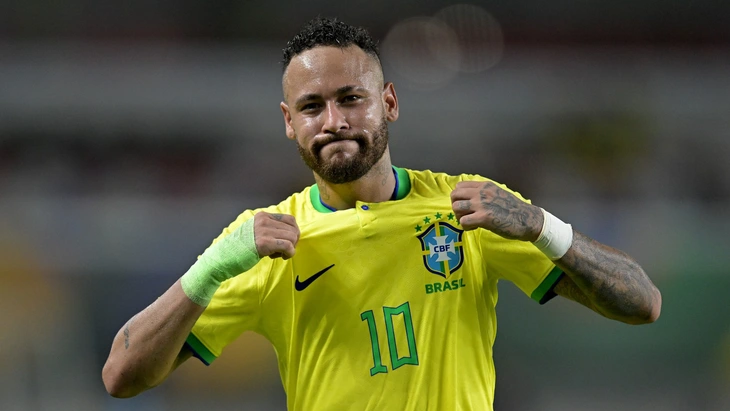
Neymar officially set for World Cup, another Brazilian star left off the squad.
Neymar’s presence is one of the most debated topics as the football world looks toward the 2026 World Cup.
Under coach Carlo Ancelotti, Neymar has never played for Brazil. He has actually been absent from the national team for the past three years, a consequence of constant injuries along with the lifestyle of the 34-year-old superstar.
Since the start of 2025, Neymar has been determined to salvage his career by returning to play for club Santos. He has played fairly regularly, with 43 matches and 17 goals in the past year and a half.
Neymar’s consistency has made coach Ancelotti reconsider. Earlier this year, the Italian strategist revealed to the media that he was very conflicted about this player’s future, to the point of asking for an opinion from Brazil – Mr. Lula da Silva about whether to call up Neymar or not.
Neymar was named in the preliminary 55-player squad announced over a week ago. Media predicted coach Ancelotti would cut him from the final list.
But then the Italian strategist surprised everyone at the last minute by keeping Neymar, instead removing Joao Pedro.
Neymar’s return excites Brazil fans, but Ancelotti’s decision to drop Pedro is truly puzzling.
Pedro is 24 years old and a top superstar for Chelsea. He has been very consistent with 20 goals in 49 appearances for Chelsea this season.
However, Pedro has not shown a knack for scoring in the national team jersey, remaining goalless after 8 caps for the Selecao.
Besides Pedro, Ancelotti also dropped two other Chelsea stars, Andrey Santos and Estevao. In Estevao’s case, he actually did not recover from injury in time, similar to Brazil’s Rodrygo.
Brazil will gather in a week, before playing friendlies against Panama and Egypt on May 31 and June 6. At the 2026 World Cup, they are in a group with Morocco, Haiti, and Scotland.
Defenders: Alex Sandro (Flamengo), Bremer (Juventus), Danilo (Flamengo), Douglas Santos (Zenit), Gabriel Magalhaes (Arsenal), Ibanez (Al Ahli), Leo Pereira (Flamengo), Marquinhos (PSG), Wesley (Roma)
Midfielders: Bruno Guimaraes (Newcastle), Casemiro (Manchester United), Danilo Santos (Botafogo), Fabinho (Al Ittihad), Lucas Paqueta (Flamengo)
Forwards: Endrick (Lyon), Gabriel Martinelli (Arsenal), Igor Thiago (Brentford), Luiz Henrique (Zenit), Matheus Cunha (Manchester United), Neymar (Santos), Raphinha (Barcelona), Rayan (Bournemouth), Vinicius Jr (Real Madrid)
On the morning of May 19, Arsenal won a minimal victory over Burnley in round 37 of the Premier League, taking another step closer to the 2025-2026 season title.
Santos
Santos is a major port city in the Brazilian state of São Paulo, known for its historic role in the coffee trade during the late 19th and early 20th centuries. The city is home to the Coffee Museum, housed in the former state-run coffee exchange, and features the world’s largest urban garden, the Santos Garden, which includes the famous Santos Beach. Its rich history as a hub for immigration and commerce has shaped the vibrant cultural and architectural landscape seen today.
Chelsea
Chelsea is a historic area in West London, England, known for its affluent residential streets, artistic heritage, and the iconic King’s Road shopping district. It rose to prominence as a bohemian enclave in the 19th and 20th centuries, home to writers, artists, and musicians like Oscar Wilde and the Rolling Stones. The area also features notable landmarks such as the Chelsea Physic Garden (founded in 1673) and the Royal Hospital Chelsea, a retirement home for army veterans.
Panama
Panama is a Central American country known for the Panama Canal, a vital waterway connecting the Atlantic and Pacific Oceans. Its history includes indigenous cultures, Spanish colonization from the 16th century, and later independence from Spain, joining Gran Colombia before becoming a separate nation in 1903. The canal’s construction, completed by the United States in 1914 and returned to Panamanian control in 1999, has shaped its economy and global significance.
Egypt
Egypt is a country in Northeast Africa, famous for its ancient civilization and monumental architecture, such as the Pyramids of Giza and the Sphinx. Its history spans over 5,000 years, beginning with the unification of Upper and Lower Egypt around 3100 BCE and the rise of pharaohs who built a powerful empire along the Nile. Today, Egypt is a vibrant nation that blends its rich archaeological heritage with modern culture and tourism.
Morocco
Morocco is a North African country with a rich history shaped by Berber, Arab, and European influences. It was once part of the Roman Empire and later became a center of Islamic culture and learning, with cities like Fez and Marrakesh flourishing as trade hubs. Today, Morocco is known for its vibrant souks, stunning architecture, and diverse landscapes ranging from the Sahara Desert to the Atlas Mountains.
Haiti
Haiti is a Caribbean nation sharing the island of Hispaniola with the Dominican Republic, known for its rich history as the first independent black republic. It was a French colony called Saint-Domingue, where a successful slave revolt led by Toussaint Louverture culminated in independence in 1804. Today, Haiti is recognized for its vibrant culture, including Vodou traditions and art, but also faces significant economic and political challenges.
Scotland
Scotland is a country that is part of the United Kingdom, known for its rich history of clans, castles, and the fierce struggle for independence led by figures like William Wallace and Robert the Bruce. Its cultural heritage includes iconic symbols such as the kilt, bagpipes, and the mythical Loch Ness Monster, while its historic cities like Edinburgh and Glasgow showcase medieval architecture and a vibrant arts scene. Today, Scotland retains a distinct identity with its own legal and education systems, and it held a referendum on independence in 2014.
Arsenal
The Arsenal, often referring to the historic naval base and armory in Venice, Italy, was a massive complex that served as the backbone of the Venetian Republic’s maritime power from the 12th century onward. It pioneered assembly-line production techniques, allowing it to construct and equip ships at an unprecedented speed, which was crucial for Venice’s military and commercial dominance. Today, it stands as a symbol of industrial innovation and is used for cultural events, including the Venice Biennale.