Heavy morning rain in many parts of Ho Chi Minh City, up to 160mm of rain in Western provinces.
According to the Southern region, the weather pattern causing thunderstorms is due to a low-pressure trough with a northwest-southeast axis passing through the South Central region. Southwest winds are active at weak to moderate intensity over the southern coastal waters.
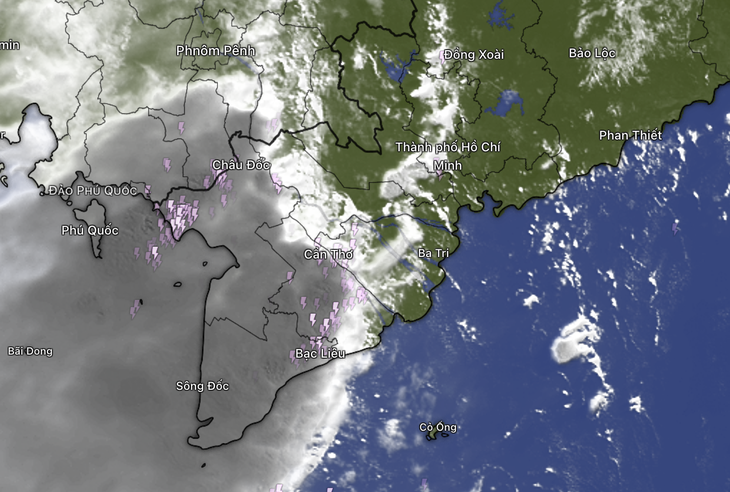
Satellite cloud images, weather radar, and lightning location data show developing convective clouds, causing rain with thunderstorms and lightning in Phu Dinh, Dien Hong, Rach Dua (Khang Linh area), Phu My (Ngoc Ha neighborhood), Binh Khanh commune (Binh An hamlet), An Thoi Dong, Chau Pha, Dat Do, Nghia Thanh, Xuan Son, Hoa Hoi (hamlet 7), Binh Chau, Hoa Hiep, and Thanh An (Thieng Lieng hamlet).
Predicted rainfall is 5-20mm, with some places receiving over 30mm. During thunderstorms, be cautious of tornadoes, lightning, hail, and strong gusts of wind around level 5-7 (8-17 m/s).
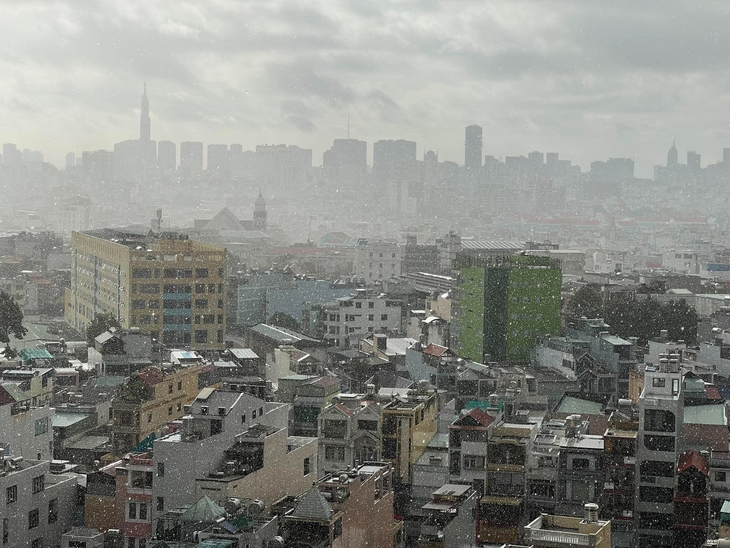
Currently, in the Tan Binh, Tan Phu, and Phu Nhuan areas, heavy rain has already started while the sun was still shining. The morning rain is causing difficulties for people traveling.
Meanwhile, thunderstorms in the Western region are concentrated in Ca Mau, An Giang, and Dong Thap. Predicted rainfall could range from 24-120mm, with some places receiving over 160mm. During thunderstorms, be cautious of tornadoes, lightning, hail, and strong gusts of wind at level 5-8 (8-21 m/s).
Dark thunderclouds over the Western provinces.
This week, the weather across the country will experience a period of thunderstorms, with less oppressive heat, but be cautious of dangerous tornadoes and lightning.
Tan Binh district
Tan Binh District is a central urban area in Ho Chi Minh City, Vietnam, known for its bustling residential and commercial activity. It was established in the late 19th century during the French colonial period and has since grown from a suburban area into a densely populated district. Today, it is notable for hosting Tan Son Nhat International Airport, the country’s largest airport, making it a key gateway for travelers.
Phu Dinh
Phu Dinh is a historic and cultural site in Vietnam, best known for its 19th-century communal house that exemplifies traditional Vietnamese architecture with intricate wood carvings. Located in Tien Giang Province, it served as a vibrant hub for local governance, religious ceremonies, and community gatherings. The site holds deep cultural significance, reflecting the spiritual and social life of the Mekong Delta region through its preserved statues, altars, and annual festivals.
Dien Hong
Dien Hong is a historic square in Da Nang, Vietnam, named after the Dien Hong Conference held during the Ly Dynasty in the 11th century. The site commemorates a pivotal meeting where King Ly Thai To consulted with his courtiers before deciding to move the capital from Hoa Lu to Thang Long (modern-day Hanoi). Today, it serves as a public gathering space and a reminder of Vietnam’s rich feudal history and strategic decision-making.
Rach Dua
Rach Dua is a historic site in Vietnam, located in the Cu Chi district of Ho Chi Minh City. It is best known as a former base for the Viet Cong during the Vietnam War, featuring an extensive network of tunnels used for shelter, supply routes, and living quarters. Today, it serves as a memorial and tourist attraction, offering insight into the resilience and tactics of Vietnamese soldiers during the conflict.
Phu My
Phu My is a coastal town in Ba Ria-Vung Tau Province, southern Vietnam, known for its deep-water port, which is a key hub for international shipping and industrial development. Historically, the area was part of the larger Vung Tau region, which played a role in Vietnam’s maritime trade, but Phu My itself grew rapidly in the 21st century with the expansion of the Phu My Industrial Zone and port facilities. Today, it serves as an important economic gateway for the country, though it retains some local fishing and cultural traditions.
Binh Khanh commune
Binh Khanh commune is a rural area located in Can Gio district, Ho Chi Minh City, Vietnam. Historically, it was part of the vast mangrove forests that played a crucial role during the Vietnam War as a refuge for revolutionary forces. Today, it is known for its agricultural activities, including salt production and aquaculture, as well as its proximity to the Can Gio Mangrove Biosphere Reserve.
An Thoi Dong
An Thoi Dong is a cultural and historical site located in the Mekong Delta region of southern Vietnam. It is known for its ancient architectural structures, including a communal house and pagoda, which date back several centuries and reflect the area’s rich agricultural heritage. Historically, the site served as a local administrative and spiritual center for the community, preserving traditional customs and playing a role in the region’s resistance movements during the Vietnam War.
Chau Pha
Chau Pha is a historic Cham temple complex located in An Giang Province, Vietnam, dating back to the 8th-9th centuries. Built by the Champa civilization, it served as a Hindu religious site dedicated to the god Shiva, featuring distinctive brick architecture and sandstone carvings. Today, it remains an important archaeological site and cultural symbol of the Cham people’s heritage in the Mekong Delta region.