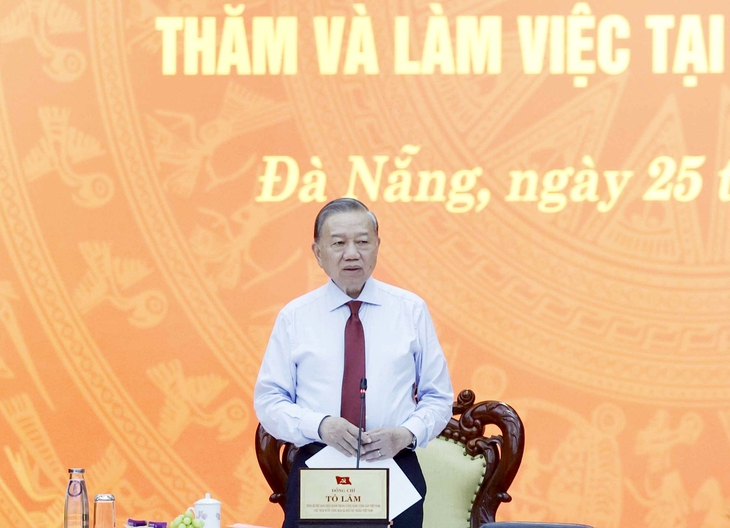
On the afternoon of April 25, in Da Nang, the General Secretary and President and a Central working group met with the Standing Committee of the Da Nang City Party Committee on the implementation of the 14th Party Congress Resolution and some key political tasks of the city.
Also attending were Politburo members: Nguyen Duy Ngoc, Secretary of the Party Central Committee and Head of the Central Organization Committee; Tran Sy Thanh, Secretary of the Party Central Committee and Chairman of the Central Inspection Committee; Le Minh Tri, Secretary of the Party Central Committee and Head of the Central Internal Affairs Committee; Trinh Van Quyet, Secretary of the Party Central Committee and Head of the Central Propaganda and Mass Mobilization Committee; Nguyen Thanh Nghi, Secretary of the Party Central Committee and Head of the Central Policy and Strategy Committee; Pham Gia Tuc, Permanent Deputy Prime Minister; General Luong Tam Quang, Minister of Public Security; and members of the Party Central Committee, leaders of the Party, State, and central ministries and agencies.
Continue to thoroughly understand and synchronously implement resolutions
According to a summary report from the City Party Committee’s Standing Committee, it has led and directed the thorough understanding, dissemination, and concrete, serious, synchronous, and methodical implementation of the 14th Party Congress Resolution, Central resolutions, and the first City Party Congress Resolution.
Many innovative and creative approaches, closely aligned with reality, have significantly contributed to quickly bringing the resolutions into life. The work of building and rectifying the Party and the political system continues to be strengthened, carried out methodically and in depth, creating unity and consensus throughout the city’s Party organization.
The city’s development space and economic scale have expanded after the merger; economic growth has met set targets. In 2025, the city’s GRDP grew well, reaching 9.18%, exceeding the target set by the Prime Minister, ranking 9th out of 34 centrally-run provinces and cities.
In the first quarter of 2026, the city’s GRDP increased by 8.45%, ranking 3rd out of 6 centrally-run cities; budget revenue achieved good results; tourism, trade, exports, and investment attraction continued to recover and grow; national defense, security, social welfare, poverty reduction, social housing, and people’s livelihoods received attention. The two-tier local government model has initially operated stably and smoothly.
At the working session, after hearing the report from the Da Nang City Party Committee, various ministries and agencies provided responsible, frank, and dedicated opinions, clearly pointing out the opportunities, advantages, difficulties, challenges, and issues facing Da Nang in its new development phase.
Concluding the working session, acknowledging and highly appreciating the efforts of the Da Nang City Party, government, military, and people over the past time, the General Secretary and President emphasized that while simultaneously carrying out many large, new, difficult, and highly transitional tasks, the city has maintained stability, sustained its development pace, and achieved many positive results.
The General Secretary and President pointed out that the coming period will bring more challenges, and Da Nang must strive for a double-digit growth target amid a still-difficult global economy.
Therefore, Da Nang must innovate its thinking, quickly upgrade its growth model towards modernity, innovation, digital transformation, and green development, with high competitiveness, while simultaneously building strong internal capacity, proactively ensuring infrastructure, energy, and supply chains, and improving governance quality.
The General Secretary and President emphasized continuing to build and rectify the Party and political system comprehensively, cleanly, and strongly; enhancing leadership capacity, combativeness, and organizational effectiveness.
Da Nang must continue to deeply understand and synchronously implement new resolutions, conclusions, and regulations of the Central Committee on Party building; maintain unity and consensus; tighten discipline and order; improve the quality of ideological, organizational, inspection, supervision, internal affairs, and anti-corruption, negativity, and wastefulness work; closely link Party building with the results of political task implementation, with the effectiveness of handling specific tasks, with the quality of serving the people and businesses, and with the spirit of
<div class="my-4