A person from Thanh Tri commune (Hanoi) admitted 7 people to Trung Vuong University (Hanoi) without entrance exams and issued fake certificates, pocketing over 300 million VND.

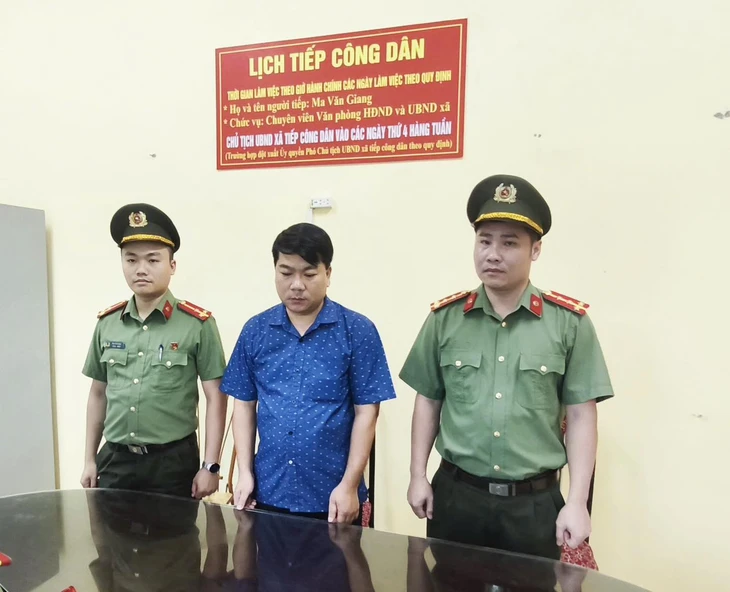
The security investigation agency of Tuyen Quang Provincial Police announced on April 22 that it had issued a decision to prosecute the case, prosecute the suspect, and issue an arrest warrant for temporary detention of a person residing in Thanh Tri commune, Hanoi, for fraud, property appropriation, and forgery of documents and seals of agencies and organizations.

This person admitted 7 citizens from the former Ha Giang province to study at Trung Vuong University (Hanoi) without entrance exams, collected over 300 million VND, and issued fake graduation certificates.

Study university first, take entrance exams later to legalize

Specifically, the suspect is Pham Quoc Duong (born 1983), residing in Thanh Tri commune, Hanoi. According to initial investigation results, from December 2020 to March 2025, Duong was assigned to manage two part-time university classes majoring in economic law in the former Ha Giang province.

University - Photo 2.
Leaders of Tuyen Quang Provincial Police directly extracting information and directing the investigation

Duong arbitrarily allowed 7 citizens with permanent residence in the communes of Hoang Su Phi, Nam Dich, Po Ly Ngai (Hoang Su Phi district, former Ha Giang) to attend the two law university classes without entrance exams. Duong promised to arrange for these 7 individuals to take exams later to legalize the entrance procedures.

Throughout the training period of the course, from 2020 to 2025, Duong did not report to Trung Vuong University, allowed the 7 people to study, and collected over 300 million VND from them. This money was not submitted to Trung Vuong University by Duong.

Forging graduation certificates

By February 2025, Pham Quoc Duong organized for the class to complete exams, meeting conditions for graduation recognition. Some individuals needing graduation diplomas to submit to their files urged Duong to contact and push Trung Vuong University to issue university graduation diplomas.

Duong forged temporary graduation certificates from the school to provide to those who had paid tuition fees to him.

The police are continuing to expand the investigation into the case.

<img alt="Arrest of person who admitted 7 students to university without entrance exams and issued fake graduation certificates – Photo 3.<<div class="my-4 p-4 rounded-lg

Thanh Tri commune

Thanh Tri commune, located in Hanoi, Vietnam, is a historically significant area known for its traditional craft villages, particularly the production of young rice flakes (cốm) and other agricultural goods. Its history dates back centuries, with the region playing a role in the Red River Delta’s cultural and economic development through farming and artisanal trades. Today, it remains a symbol of rural

Thanh Tri commune

Thanh Tri commune, located in the suburban area of Hanoi, Vietnam, is historically known for its traditional craft villages, particularly the production of “banh cuon” (steamed rice rolls) and other local specialties. It has long been an agricultural and artisanal hub, with roots dating back centuries as a supplier of food and goods to the capital. Today, the commune retains its cultural heritage while gradually modernizing, attracting visitors interested in its culinary traditions and rural Vietnamese life.

Trung Vuong University

Trung Vuong University is a private institution located in Hanoi, Vietnam, named after the Trung Sisters, legendary female warriors who led a rebellion against Chinese rule in the 1st century AD. Established in the early 2000s, the university reflects Vietnam’s modern push to expand higher education access, particularly for women, honoring the sisters’ legacy of strength and independence. It offers a range of undergraduate and graduate programs, contributing to the country’s educational development.

Ha Giang province

Ha Giang province, located in northern Vietnam, is renowned for its stunning mountainous landscapes and the famous Dong Van Karst Plateau Geopark, a UNESCO Global Geopark. Historically, it has been a remote frontier region inhabited by diverse ethnic minorities, and it played a significant role in Vietnam’s border defense and the preservation of traditional cultures. The province’s iconic Ha Giang Loop offers travelers breathtaking views of terraced rice fields, limestone peaks, and winding roads, making it a must-visit destination for adventure seekers.

Hoang Su Phi

Hoang Su Phi is a mountainous district in northern Vietnam, renowned for its stunning terraced rice fields that have been cultivated for centuries by ethnic minority groups such as the H’Mong and Dao. The area’s terraces, recognized as a national heritage site, were built through generations of manual labor, transforming steep slopes into agricultural masterpieces. Today, Hoang Su Phi is a popular destination for trekkers and photographers, offering breathtaking landscapes and a glimpse into the traditional, sustainable farming practices of the region.

Nam Dich

Nam Dich is a historic village in Hanoi, Vietnam, known for its traditional craft of making fermented fish sauce, a key ingredient in Vietnamese cuisine. The village has preserved this art for centuries, with many families continuing the practice passed down through generations. Its cultural significance lies in maintaining this age-old culinary tradition amidst modern development.

Po Ly Ngai

Po Ly Ngai is a revered figure in the Cham culture of Vietnam, known as a legendary king and cultural hero who is credited with introducing agriculture, irrigation, and the construction of temples. According to Cham folklore, he ruled during a golden age and is often associated with the ancient kingdom of Champa. Today, his legacy is honored in festivals and rituals, particularly among the Cham people in Ninh Thuan and Binh Thuan provinces.

Hoang Su Phi district

Hoang Su Phi is a mountainous district in Ha Giang Province, northern Vietnam, renowned for its stunning terraced rice fields, a UNESCO-recognized heritage site. Historically, the area has been inhabited by ethnic minority groups like the H’Mong, Dao, and Tay for centuries, who carved the terraces into the steep slopes for wet-rice cultivation. Today, it remains a culturally rich destination, celebrated for its pristine landscapes and traditional ways of life.

Tuyen Quang Provincial Police

The Tuyen Quang Provincial Police is the law enforcement agency responsible for maintaining public order and security in Tuyen Quang Province, a mountainous region in northern Vietnam with a history tied to the country’s revolutionary struggles. During the Vietnam War, the province served as a key base for the Viet Minh and later the People’s Army of Vietnam, and the police force has since evolved to support modern community safety and countercrime efforts. Today, it continues to uphold its duties amid the region’s cultural heritage and ongoing development.