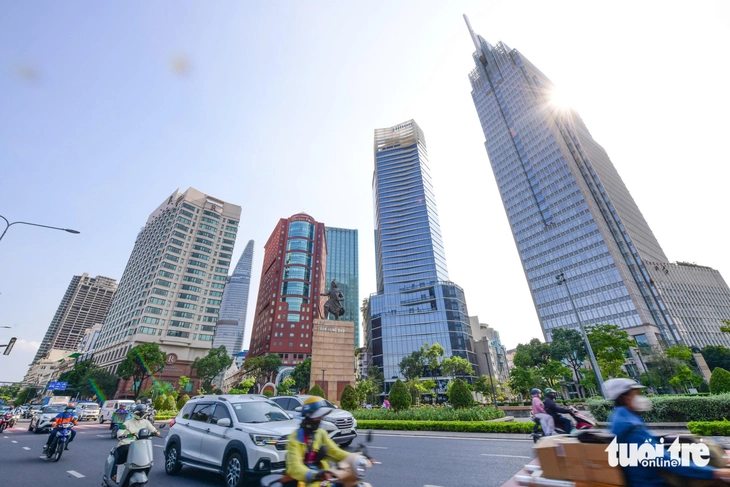
Ho Chi Minh City is moving towards becoming an international financial center, a smart city, a digital economy, a green economy, high-quality services, modern logistics, and an innovative ecosystem.
Resolution 09 opens a new development space for Ho Chi Minh City by addressing the construction of breakthrough and outstanding mechanisms, allowing proactive piloting of new mechanisms and policies, controlled testing of “sandbox” models, or implementing models different from current legal regulations when necessary.
This is a strong delegation of power, reflecting the central government’s trust in Ho Chi Minh City’s leading role, while also setting very high requirements for organizational capacity.
Ho Chi Minh City is moving towards becoming an international financial center, a smart city, a digital economy, a green economy, high-quality services, modern logistics, and an innovative ecosystem.
These are all fast-moving fields where many new models emerge from practice before the law can be perfected.
If the city waits until all regulations are fully in place before implementing, it may miss the development pace.
Conversely, if it rushes ahead without proper safeguards, risks could shift to the people, the budget, and the investment environment.
Therefore, the core point is to turn the right to pilot into a systematic implementation capacity. A “sandbox” must have clear public objectives, a specific scope, a defined timeline, an independent monitoring mechanism, quantifiable evaluation criteria, and conditions for termination when risks exceed thresholds.
For Ho Chi Minh City, “sandbox” should not be simply understood as “allowed to do things differently” but must be seen as a modern governance method for development, where new models are tested within a safe scope, unprecedented issues are verified with data, and legal obstacles are assessed for impact before proposing adjustments.
Innovation needs to be facilitated, but it must operate within a safe corridor. Creativity should be encouraged, but social benefits must be demonstrated, data must be transparent, and responsibility must be taken for quality, costs, and resulting impacts.
Management agencies are granted more proactive authority, but they must be accountable with evidence, results, and actual impacts on people’s lives.
The city can proactively announce major problems that need solutions, such as reducing congestion, combating flooding, exploiting land around metro lines, developing social housing, greening industrial zones, sharing urban data, green finance, the night economy, digital health, smart education, regional logistics, and public asset management. When the government correctly identifies the issues, businesses, universities, experts, and associations will have a basis to participate with more specific and responsible proposals.
Ho Chi Minh City also needs a capable institution to support urban policy experimentation. This could be a council or a “sandbox” coordination center, operating leanly and professionally without adding administrative layers.
This institution would be tasked with receiving initiatives, standardizing dossiers, organizing independent critiques, assessing risks, proposing pilot scopes, monitoring implementation, and recommending scaling, adjustments, or termination.
An indispensable principle is to place people at the center of all experiments. A new policy is only truly meaningful if it helps people travel more conveniently, live more safely, access better public services, and gain more opportunities for employment, housing, healthcare, education, and living environment.
Therefore, each “sandbox” needs indicators measuring social benefits, citizen satisfaction, impacts on vulnerable groups, the environment, and any resulting social costs.
In implementation, the city should select a few priority areas to do first, focusing efforts and conducting reviews. Successful models should be standardized for replication. Models that do not meet expectations also have value if they help the system identify risks early, preventing larger mistakes in broader deployment.
Resolution 09 gives Ho Chi Minh City a new space to pioneer. The remaining issue is for the city to turn that space into a concrete action system with procedures, data, people, institutions, and enforcement discipline.
Pham Thai Son, a lecturer