
What would happen if Vietnam’s e-commerce market became a playground for only the two largest platforms?
The tech economy sector has witnessed many races that ended with only two or three major players remaining, such as digital wallets and ride-hailing. E-commerce is now heading toward a similar final stage.
Assumptions under new pressure
Many intense rounds of competition took place among Sendo, Tiki, and Lazada, followed by the emergence of Shopee, which, despite arriving later, surged to the top spot. Recently, TikTok Shop has once again disrupted the rankings. However, statistical data shows that the assumption of a two-horse race is closer to reality than ever before.
Data from Metric, Google, Statista, and other sources up to the end of 2025 and the first three months of 2026 indicate that the scenario of Vietnam’s e-commerce becoming a two-horse race is no longer a playful hypothesis but is gradually becoming reality. Shopee and TikTok Shop now account for about 97% of e-commerce revenue market share in Vietnam, pushing earlier competitors like Lazada and Tiki into a niche group with a mere 3% market share.
 |
In that context, regardless of whether the last two positions survive, the market will operate under the rules set by the two leading names, leading to core changes. First, the market will no longer compete solely on price but will become a confrontation between two distinct operating models. Shopee follows a proactive buyer approach, with strengths in a complete logistics system and a loyal customer base accustomed to shopping through promotions. Meanwhile, TikTok Shop targets an entertainment-driven customer base that purchases based on emotion and impulse.
Second, both are prioritizing official brand stores and major authorized distributors, leading to a strong elimination of shops that lack the budget for content production and marketing (video/livestream) or do not have direct sourcing.
“Early 2026 data shows that the number of active shops has decreased by more than 7%, while revenue has increased,” said an industry observer. This differentiation also affects other supporting businesses, such as marketing and advertising partners. Companies specializing in platform operations will become extremely sensitive to the algorithms of the two leading platforms, as it directly impacts their profits.
Finally, delivery services will see a strong split: one side consists of satellite shipping units serving Shopee, while the other is a specialized warehouse and shipping system for TikTok’s livestream goods. For buyers, service costs and fees will rise because the game now involves only two platforms, with no pressure from a third party. “In return, they will receive better services, such as faster delivery and more convenient and transparent refund and return policies,” the observer added.
Business responses
Before the two-horse race formally takes shape, businesses have already been trending toward reducing their dependence on platforms due to tax and fee regulations in recent years. Some experts note that companies are shifting customers to their own websites and other platforms like Zalo, positioning e-commerce channels more as brand-building tools. Additionally, many small and medium-sized enterprises (SMEs) in Vietnam have leveraged the e-commerce wave to achieve certain successes.
However, platform taxes and fees have forced many businesses to recalculate and gradually shift to offline channels, such as opening physical stores or placing products in supermarkets and shopping centers, to optimize profits. For example, domestic fashion brand Coolmate decided to open its first retail store after seven years of developing on e-commerce platforms. Some have even proposed that authorities should implement policies to support SMEs in this transition, specifically by facilitating access to supermarket chains nationwide. “Accessing these channels still faces many limitations compared to large corporations or foreign brands, making it difficult for SMEs to execute sales campaigns,” noted one business leader.
 |
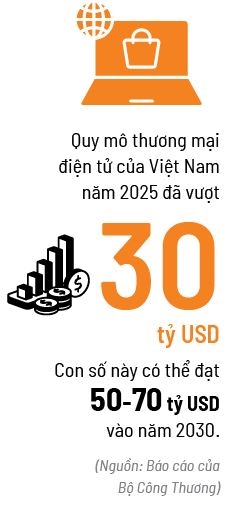
According to a report from the Ministry of Industry and Trade, the e-commerce market size could reach $50-70 billion by 2030, with an annual growth rate of 20%, driven by modern shopping trends and increasingly complete logistics infrastructure. Will such rapid growth lead to the emergence of a new e-commerce platform that shakes up the rankings, similar to what TikTok Shop did recently?
Some analysts predict that
<div class="