Cooperation promoted between four Vietnamese border provinces and China’s Yunnan Province
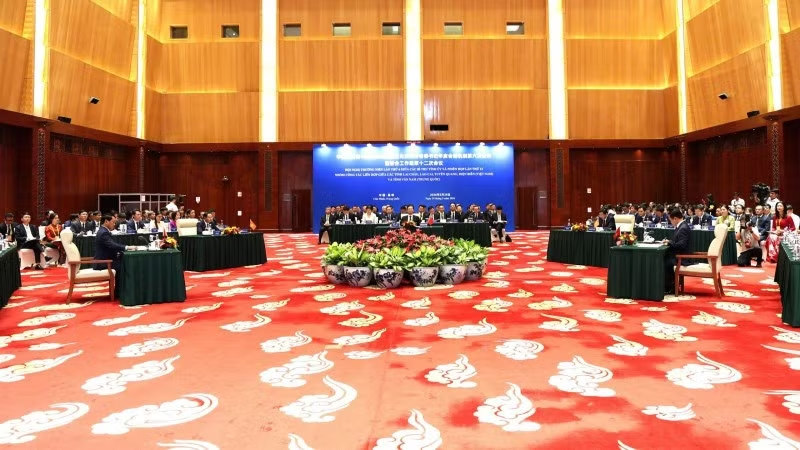
Delegates attending the Conference in Kunming City, Yunnan Province (China).
The conference aimed to evaluate the results of implementing the contents agreed upon in the minutes of the 5th annual conference and to sign the minutes of the 6th annual conference.
During the implementation of the 5th annual conference minutes, the parties actively carried out the agreed contents; continued to maintain close and intimate ties; political trust was strengthened; difficulties and obstacles in the cooperation process were promptly resolved; territorial sovereignty and security remained basically stable; economic and trade cooperation continued to bring practical benefits to the people of both sides.
In the recent period, the four border provinces of Vietnam and Yunnan Province have closely followed the contents of the Joint Statement of the two Parties and two States of Vietnam and China “On continuing to deepen the Comprehensive Strategic Cooperative Partnership, promoting the construction of a Vietnam-China community with a shared future that is of strategic significance at a higher level in the new era,” promoting comprehensive development cooperation relations in various fields with many outstanding results. This contributed to further deepening the Vietnam-China Comprehensive Strategic Cooperative Partnership in the new period.
Yunnan Province delegation at the conference.
At the conference, the Secretary of the Yunnan Provincial Party Committee proposed that in the coming time, the four border provinces of Vietnam and Yunnan Province continue to strengthen cooperation in areas such as trade, tourism, agriculture, culture, construction, and people-to-people exchanges… contributing to the successful implementation of the Resolution of the 14th National Congress of the Communist Party of Vietnam and the 15th Five-Year Socio-Economic Development Plan of the Communist Party of China.
Lai Chau Province delegation at the conference.
Representatives from Vietnamese localities attending the conference agreed and highly concurred with the strategic proposals and long-term vision of the Yunnan provincial leadership, aiming to further promote the achieved cooperation results and deepen the cooperative relations between the four border provinces of Vietnam and Yunnan Province, in line with the potential and advantages of each side.
Localities also proposed several key cooperation contents for the coming time, such as: continuing to thoroughly grasp and effectively implement the high-level common perceptions of the leaders of the two Parties and two States of Vietnam and China. Strengthening guidance for sectors and localities on both sides to actively implement signed cooperation agreements, ensuring substance, effectiveness, clarity in content, responsibility, and results in the spirit of equal, friendly, and mutually beneficial cooperation. Strengthening organization of visits and exchanges between the Party, government, mass organizations, and people of both sides. Enhancing coordination to promote the development of transport infrastructure and border gate infrastructure in the border area; continuing to well implement the three legal documents on the Vietnam-China land border and related agreements…
At the conference, the Secretaries of the Provincial Party Committees of Lai Chau, Lao Cai, Tuyen Quang, Dien Bien (Vietnam) and Yunnan Province (China) signed the minutes of the 6th annual conference, and witnessed the exhibition of cooperation documents from various departments, sectors, and localities of both sides.
Kunming City
Kunming, the capital of Yunnan Province in southwestern China, is known as the “Spring City” for its mild, year-round climate. With a history spanning over 2,400 years, it became a key hub on the ancient Southern Silk Road and later a center for trade and cultural exchange. Today, it is famous for its diverse ethnic cultures, scenic spots like Dianchi Lake, and the nearby Stone Forest.
Yunnan Province
Yunnan Province in southwestern China is renowned for its stunning natural landscapes, rich biodiversity, and diverse ethnic cultures, with over 25 minority groups. Historically, it was a key region on the ancient Tea Horse Road trade route and later became a strategic border area. Today, it is a popular tourist destination
Kunming City
Kunming, the capital of Yunnan Province in China, is known as the “Spring City” for its mild, pleasant climate year-round. Its history dates back over 2,000 years, serving as a key hub on the ancient Southern Silk Road and later becoming a center for trade and cultural exchange. Today, Kunming blends its rich heritage with modern development, featuring attractions like the Stone Forest and Dianchi Lake.
Yunnan Province
Yunnan Province, located in southwestern China, is known for its breathtaking natural landscapes, rich biodiversity, and diverse ethnic cultures, with 25 of China’s 56 officially recognized ethnic groups calling it home. Historically, it was a key region on the ancient Tea Horse Road, facilitating trade between China, Tibet, and Southeast Asia, and was later incorporated into the Chinese empire during the Yuan Dynasty. Today, it remains a popular destination for travelers seeking to explore ancient towns like Lijiang and Dali, as well as iconic sites such as the Stone Forest and the terraced rice fields of Yuanyang.
Dianchi Lake
Dianchi Lake, located near Kunming in Yunnan Province, China, is a large freshwater lake known as the “Pearl of the Plateau.” With a history spanning over 2,000 years, it was an important cultural and economic hub during the Dian Kingdom and later flourished under the Ming and Qing dynasties. Today, it is a popular scenic spot, though it faces environmental challenges due to pollution and urban development.
Stone Forest
The Stone Forest, or Shilin, is a remarkable karst landscape in Yunnan Province, China, featuring towering limestone formations that resemble a petrified forest. Formed over 270 million years ago from an ancient seabed, the site holds cultural significance in local folklore, particularly the story of Ashima, a legendary Sani girl who turned to stone. It is a UNESCO World Heritage Site and a popular tourist destination.
Tea Horse Road
The Tea Horse Road was a network of ancient trade routes connecting tea-producing regions in Yunnan, China, with Tibet and beyond, flourishing from the 7th to the 20th century. It facilitated the exchange of Chinese tea for Tibetan horses, along with other goods like salt and silk, fostering cultural and economic ties between diverse ethnic groups. This historic path, traversing rugged mountains and deep gorges, played a crucial role in shaping the region’s history and remains a symbol of cross-cultural exchange.
Southern Silk Road
The Southern Silk Road, also known as the Ancient Tea Horse Road, was a network of trading routes linking southwestern China to Tibet, South Asia, and Southeast Asia. Emerging over 1,000 years ago, it primarily facilitated the exchange of tea, horses, salt, and other goods, fostering cultural and economic connections between diverse regions. This route played a crucial role in shaping the history of Yunnan, Sichuan, and Tibet, and its legacy is preserved today as a UNESCO World Heritage tentative site.
Lai Chau Province
Lai Chau Province, located in northwestern Vietnam, is known for its stunning mountainous landscapes and diverse ethnic cultures. Historically, it was part of the ancient Tai tribal territories and later became a key area during French colonial rule, with the town of Lai Chau serving as an administrative center. Today, it is famous for terraced rice fields, the scenic O Quy Ho Pass, and the vibrant traditions of its Hmong, Dao, and Thai communities.
Lao Cai Province
Lao Cai Province is a mountainous region in northern Vietnam, known for its stunning landscapes and rich cultural diversity, home to many ethnic minority groups. Its history includes being a key trading post along the Red River, and it gained modern prominence as the gateway to the popular tourist destination of Sa Pa, which was established as a hill station by French colonists in the early 20th century. Today, the province is celebrated for its terraced rice fields, vibrant markets, and the iconic Fansipan peak, the highest mountain in Indochina.