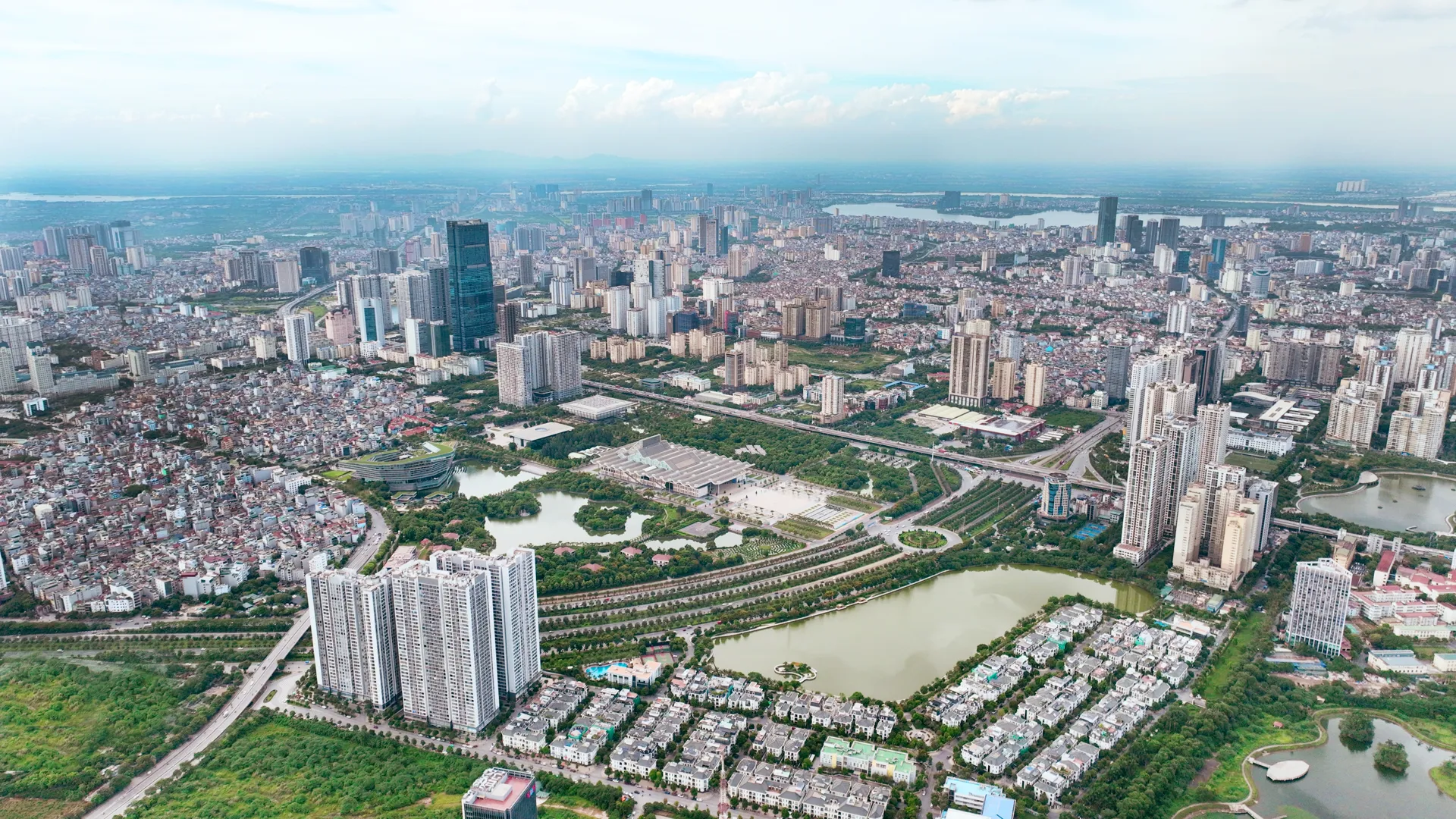
After more than a year of implementing the Capital Law 2024, practical enforcement has shown important initial results, while also raising the urgent need to continue perfecting the institutional framework towards stronger, more stable, and superior decentralization.
From the fields of agriculture – environment, planning – architecture, high-tech zone development…, opinions are unanimous: amending the Capital Law is an inevitable step for Hanoi to promote its role as the locomotive and central driver of the country’s development.
New Legal Corridor for Agriculture and Environment
According to the Deputy Director of Hanoi’s Department of Agriculture and Environment, the Capital Law 2024 dedicates many important provisions, focusing on Articles 28, 32, and 33, creating a solid legal foundation for the fields of agriculture, rural areas, and environmental protection. On that basis, the Department has advised the City People’s Committee to submit to the City People’s Council for the issuance of 9 thematic resolutions, covering areas from low-emission zones, administrative penalties in the fields of environment and land, to mechanisms for exploiting agricultural land funds on riverbanks and islets, and policies for agricultural and craft village development.
A prominent highlight is the implementation of low-emission zones according to Article 28 of the Capital Law. The Department of Agriculture and Environment has guided the development of projects, organized training, communication, and coordinated with localities for implementation. In the Hoan Kiem and Ba Dinh areas, project development has been initially deployed. Based on practical experience, the City People’s Council issued Resolution No. 57/2025/NQ-HĐND to replace Resolution No. 47/2024/NQ-HĐND, ensuring compatibility with the two-tier local government model and new central directives. Currently, the Department is leading the development of a Low-Emission Zone Project within Ring Road 1, seeking community and scientific expert opinions, and is expected to submit it to the City People’s Council in the first quarter of 2026.
Concurrently, Resolution No. 08 and 09/2025/NQ-HĐND on administrative penalties in the fields of environment and land have been applied, contributing to increased deterrence, timely detection, and handling of violations in land management, mineral exploitation, and environmental and water resource protection. Regarding Resolution No. 21/2025/NQ-HĐND on exploiting agricultural land funds on riverbanks and islets, the Department is advising on the issuance of a City People’s Committee decision, expected in June 2026.
From practical implementation, the Department of Agriculture and Environment believes it is necessary to continue removing bottlenecks and supplementing more flexible mechanisms in the amended Capital Law, especially concerning land management, land use purpose conversion, agricultural development, and environmental protection. Proposals focus on maintaining existing incentives that have been concretized, while granting additional authority to the city government in issuing detailed regulations, standards, and technical regulations suitable for the Capital’s conditions; strengthening mechanisms for low-emission zones, carbon credits, green transition, and environmental pollution treatment in the Capital region.
Planning – Architecture: An “Institutional Revolution” for Urban Areas
Assessing the Capital Law 2024 as a fundamental shift compared to the 2012 Capital Law, the Deputy Director of Hanoi’s Department of Planning and Architecture stated that the new law has created an “institutional revolution,” moving from an orientation mindset to granting the city self-determination authority in many key areas. Three breakthrough points emphasized include: decentralization for local planning adjustments; providing legal tools for preserving and promoting architectural value; and legalizing “hot” issues such as relocating polluting facilities and inner-city urban renovation.
Over the past year, the Department of Planning and Architecture has strived to concretize the Law’s provisions, gradually “filling” legal gaps. However, practice has also revealed many challenges. To date, although Resolution 34/2024/NQ-HĐND has been issued, no case of local planning adjustment has been approved under the new Law, showing a significant policy lag. Additionally, there is a misalignment between the Capital Law 2024 and new specialized laws and resolutions. For example, the Capital Law requires the formulation and appraisal of detailed planning tasks for social housing, while Resolution 201/2025/QH15 allows the simplification of this procedure. Or in the field of functional zone planning,