The conference was chaired by: National Assembly Chairman Tran Thanh Man; Politburo member and Standing Secretary of the Secretariat Tran Cam Tu; Politburo member and Vice Chairman of the National Assembly Do Van Chien; Central Committee Secretary and Deputy Prime Minister Pham Thi Thanh Tra; Central Committee member and Vice Chairman of the National Assembly Nguyen Thi Thanh.
The conference was attended by Central Committee members and Vice Chairmen of the National Assembly; leaders of the National Assembly Office; representatives of the Standing Committee of the Ethnic Council and various National Assembly committees; representatives of the Standing Committee of the Central Committee of the Vietnam Fatherland Front and several central ministries and sectors; and leaders of provincial and municipal People’s Councils…
The People’s Council continues to affirm its role as the local state authority
In his opening speech, National Assembly Chairman Tran Thanh Man emphasized that today’s conference is very significant, not only to summarize the term’s activities of People’s Councils at all levels, but also to comprehensively assess the position and role of local elected bodies in the country’s new development phase.
At the same time, it deeply evaluates the achieved results, limitations, shortcomings, lessons learned, and the operational direction for the 2026-2031 term in the context of streamlining the political system’s organizational structure for effective and efficient operation—building a modern, professional, people-centered local government that serves the people.
According to the National Assembly Chairman, the 2021-2026 term was a special term in the history of People’s Councils at all levels, as the country faced many unprecedented difficulties and challenges: the Covid-19 pandemic, natural disasters, and climate change causing severe consequences; and a rapidly changing, complex, and unpredictable global situation. The Party and State issued and implemented many strategic decisions on growth model innovation, national digital transformation, organizational reform, decentralization, and administrative unit reorganization.
Under the close leadership and direction of the Central Committee, the Politburo, and the Secretariat; the guidance of the National Assembly Standing Committee; and close coordination with the Government, the Vietnam Fatherland Front, and local party committees, People’s Councils at all levels have strived to overcome difficulties, continuing to affirm their role as local state authorities, representing the will, aspirations, and mastery rights of the people.
However, the National Assembly Chairman also frankly acknowledged that the implementation of the two-tier government model still faces many difficulties and challenges: broader management areas, a greater volume of work, higher requirements; limited capacity of officials in some places, sometimes confused in handling tasks; and inconsistent material facilities and information technology infrastructure. These are issues that need continued attention and focused resolution.
The National Assembly Chairman emphasized that at this conference, the National Assembly Standing Committee hopes to hear opinions and share experiences on the results of task implementation in the 2021-2026 term, and to propose tasks, solutions, new determination, new thinking, and new working methods for the 2026-2031 term; to assess the working relationship between the National Assembly Standing Committee and National Assembly bodies with provincial People’s Councils; and between the Standing Committee of the People’s Council with the party committee, the People’s Committee, and the Fatherland Front Committee at the same level.
Especially experiences in promoting the role of the People’s Council in building breakthrough mechanisms to drive double-digit economic growth; controlling power in the two-tier government model; and applying science, technology, and artificial intelligence in the People’s Council’s activities.
Using service effectiveness as the measure of the governing capacity of government bodies at all levels
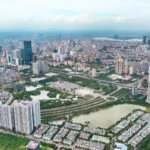
In his welcome speech, Central Committee member, Deputy Secretary of the City Party Committee, and Chairman of the Hanoi People’s Committee Vu Dai Thang stated that during the past term, the Hanoi City Party Committee, People’s Council, and People’s Committee focused on decisive leadership and direction, achieving many important and fairly comprehensive results across various fields.
The capital’s economy continued to maintain positive growth; the GRDP scale was continuously expanded; state budget revenues consistently met and exceeded estimates. The business investment environment continued to improve; Hanoi remained one of the leading localities in the country in attracting investment and developing enterprises.