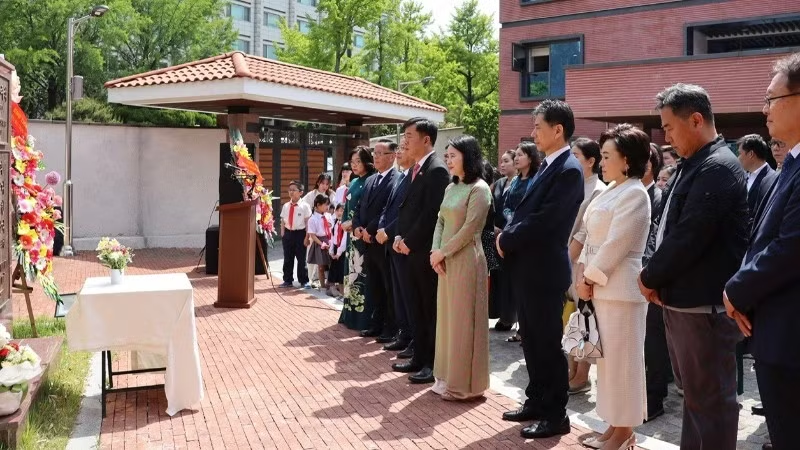
On the occasion of the 136th anniversary (May 19, 1890 – May 19, 2026), on May 17, the Vietnamese Embassy in South Korea solemnly organized a ceremony to honor President Ho Chi Minh, with the participation of a large number of officials and staff from Vietnamese representative agencies in South Korea, representatives of associations and the Vietnamese community in South Korea, along with many scholars, artists, partners, and friends who love Vietnam.
This year’s event carries profound political, cultural, and diplomatic significance, not only expressing the heartfelt reverence of the Vietnamese community in South Korea for President Ho Chi Minh – the national liberation hero and outstanding cultural figure – but also contributing to widely promoting to the South Korean public the image of the country, its people, and the noble humanitarian values of Vietnam.
In a solemn and moving atmosphere, delegates together reviewed the life, glorious revolutionary career, and immense contributions of President Ho Chi Minh to the cause of national reunification and building the foundation for friendship and peace among nations worldwide.
Speaking at the ceremony, the Vietnamese Ambassador to South Korea, Vu Ho, emphasized that honoring President Ho Chi Minh in South Korea not only holds significance for the Vietnamese community far from home but also serves as an opportunity to enhance understanding, empathy, and connection between the peoples of Vietnam and South Korea, based on shared values of peace, cooperation, and development.
A highlight of the program was an exhibition of paintings, photos, and documents about President Ho Chi Minh, vividly recreating important milestones in his life and revolutionary career, while introducing to attendees simple yet inspiring stories about his ethics, lifestyle, and humanitarian thoughts. The exhibition attracted special interest from many South Korean friends, with numerous delegates expressing emotion and impression at the image of a simple, approachable leader of great stature for the era.
Sharing his feelings when attending this meaningful event, Mr. Kwon Sung Taek – Chairman of the Korea-Vietnam Cultural and Economic Exchange Association (KOVECA) expressed deep admiration for President Ho Chi Minh. According to him, President Ho Chi Minh’s thoughts on peace, national independence, humanitarian spirit, and development aspirations are not only significant for Vietnam but also hold universal value for the international community.
KOVECA Chairman Kwon Sung Taek emphasized that through activities organized by the Vietnamese Embassy in South Korea, more and more South Korean people understand President Ho Chi Minh as well as Vietnam’s history, culture, and people, thereby contributing to promoting people-to-people exchanges and strengthening friendship between the two countries.
For Professor Park Yeon Kwan – Head of the Vietnamese Language Department at Hankuk University of Foreign Studies, attending this event was an honor. He emotionally shared that, as someone who has dedicated his entire career to researching and teaching about Vietnam, he deeply admires the far-reaching and insightful vision of President Ho Chi Minh – who not only led the Vietnamese people to regain independence and freedom but also was a sage with decisions of epoch-making stature.
Professor Park Yeon Kwan stated that in the Vietnamese Language Department at Hankuk University of Foreign Studies, when teaching South Korean students, teachers not only convey the language but also share with them the simple yet immensely great life of President Ho Chi Minh.
“President Ho Chi Minh is not only the great leader of the Vietnamese nation but also a symbol of the aspiration for independence, peace, and compassion. The image of President Ho Chi Minh – simple, approachable yet full of wisdom and courage – has generated special interest among many generations of South Korean students and scholars studying Vietnam,” Professor Park Yeon Kwan shared.
Professor Park Yeon Kwan highly appreciated the role of the Vietnamese Embassy in South Korea in persistently promoting academic and cultural exchange activities and specialized exhibitions about President Ho Chi Minh, thereby helping South Korean students and the public gain deeper perspectives on Vietnam’s history, culture, and development path.
Within the framework of the program, delegates offered incense to commemorate President