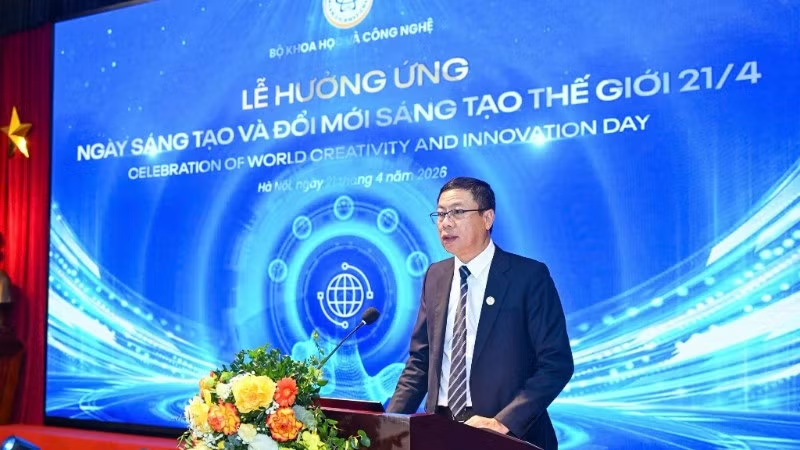
Attending the event were Vu Hai Quan, member of the Party Central Committee and Minister of Science and Technology; Ngo Dong Hai, member of the Party Central Committee and Deputy Head of the Central Propaganda and Mass Mobilization Commission; Pauline Tamesis, UN Resident Coordinator in Vietnam; representatives from embassies, and over 300 delegates representing departments of science and technology, research institutes, universities, and enterprises nationwide.
The activity in response to World Creativity and Innovation Day is not only participation in a UN global initiative but also an opportunity for Vietnam to affirm its determination to make it a pillar of the development model, driving growth based on productivity, enhancing national competitiveness, and sustainably improving people’s quality of life.
Spreading the spirit of innovation throughout society
This year’s response ceremony is held amid Vietnam’s increasingly complete, synchronous, and unified legal system on science, technology, and innovation; the foundations of the national innovation system are gradually taking shape; and the innovation startup ecosystem continues to expand and improve in quality.
According to the Ministry of Science and Technology, this is a favorable time to shift strongly from perfecting institutions to effective implementation, putting policies into practice, promoting substantive innovation, creating added value, and contributing directly to socio-economic growth.
The Ministry of Science and Technology has chosen two themes for World Creativity and Innovation Day 2026: “Innovation – Breakthrough actions, spreading results” and “Innovation – Faster and stronger transformation to turn ideas into value and aspirations into reality.”
These two themes emphasize the requirement to shift strongly from awareness to action, creating concrete results capable of deep and broad dissemination in society, while also demanding acceleration, improving implementation capacity, and shortening the journey from idea to application and commercialization.
Deputy Minister of Science and Technology Le Xuan Dinh stated: Recently, Vietnam’s policy and legal system on science, technology, and innovation has been completed. Many important mechanisms and policies have been issued by the National Assembly and Government, contributing to forming foundational conditions for the national innovation system. The innovation startup ecosystem continues to develop; innovation centers, investment funds, and support programs for enterprises, institutes, schools, and people to implement innovation have been and are being implemented.
According to Deputy Minister Le Xuan Dinh, Vietnam is also witnessing significant progress in research capacity, technology infrastructure, and the economy’s ability to innovate. The strategic technology development program has been implemented, focusing on foundational fields such as artificial intelligence, semiconductors, big data, biotechnology, new materials, and new energy. This shows that our development thinking is shifting strongly from broad-based to focused, from passive reception to proactive mastery of technology.
Connecting entities in the innovation ecosystem
A key content of this year’s event is promoting the role of entities in the national innovation system. Within the program framework, a Forum on Developing the Innovation Center System took place, creating a space for experts, managers, and enterprise representatives to exchange ideas on organizational models, operational mechanisms, and policies for developing innovation centers in Vietnam.
Associate Professor Dr. Lam Quang Vinh, Head of the Department of Science and Technology (Vietnam National University, Ho Chi Minh City), shared initial experiences in implementing the Innovation Center model at Vietnam National University, Ho Chi Minh City. He emphasized the establishment and operation of a strategic innovation advisory council linking the system to jointly solve problems around the “three houses” axis: state-school-enterprise.
According to him, it is necessary to build cooperation and benefit-sharing mechanisms in applied research and innovation; continuously update international experience; promote the decisive and accompanying role of leaders; and simultaneously build a team within the ecosystem and remove institutional barriers to unlock resources.