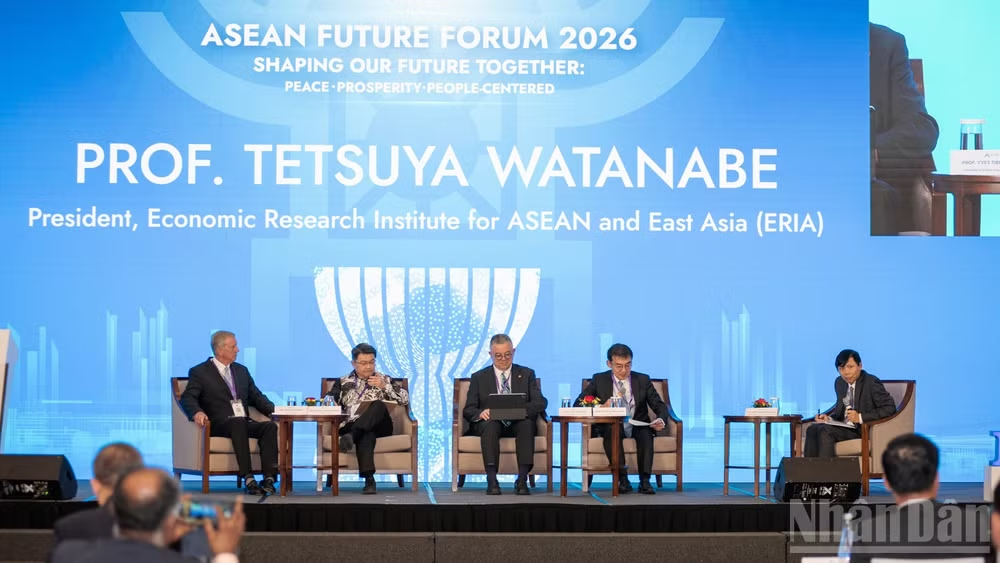
On the morning of June 9, immediately following the third ASEAN Future Forum, the first plenary session took place with the theme “Resilience and Unity in a Changing World.”
The two main speakers of this working session were: Member of the Party Central Committee, Deputy Minister of Foreign Affairs of Vietnam Nguyen Manh Cuong; Dr. Marty Natalegawa, former Minister of Foreign Affairs of Indonesia.
In addition, the discussion session also featured four other speakers: Professor Tetsuya Watanabe, Chairman of the Economic Research Institute for ASEAN and East Asia (ERIA); Mr. Yves Tiberghien, Professor of Political Science at the University of British Columbia (Canada); Mr. Kuik Cheng-Chwee, Professor of International Relations at the Institute of Malaysian and International Studies (IKMAS), National University of Malaysia (UKM); Mr. Adam Schwarz, Managing Director of Asia Group Advisors.
Associate Professor, Dr. Dang Dinh Quy, former Deputy Minister of Foreign Affairs, moderated the session.
Opening the discussion, Dr. Marty Natalegawa, former Minister of Foreign Affairs of Indonesia, stated that ASEAN cannot be passive but must continuously strive to maintain its role through diplomatic initiatives, leveraging the region’s diversity to create a sustainable source of strength rather than allowing itself to be divided.
Based on this mechanism, Mr. Marty Natalegawa recommended that ASEAN can dynamically promote stability, while enhancing its capacity to respond to regional crises and strengthening resilience against external geopolitical shocks.
To proactively manage regional issues, Dr. Marty Natalegawa proposed that ASEAN needs a comprehensive, specific, and mutually beneficial security framework that avoids displacing people or exposing them to the impacts of conflicts, health crises, natural disasters, and so on.
According to the former Indonesian Foreign Minister, through maintaining dialogue and cooperation, ASEAN can continue to expand its “circle of friendship,” reinforce strategic stability, and affirm its independent role in a rapidly changing world.
During the discussion on resilience and unity, Vietnamese Deputy Minister of Foreign Affairs Nguyen Manh Cuong focused on analyzing the concept of “cooperative resilience” after posing the question: “What constitutes the resilience strength of a nation?”
Deputy Minister Nguyen Manh Cuong stated that the answer changes daily with shifts in the international environment. For decades, integration has been the path to growth, stability, and prosperity.
However, the world faces a paradox: the deeper and wider the connections, the more vulnerable countries become. Looking at the Covid-19 pandemic, supply chain disruptions, tariff tools, and the development of science and technology, it is clear that factors that once created connections, if not effectively governed and managed, risk turning into risks.
According to the Deputy Minister, this paradox does not deny the value of the integration process, but it requires ASEAN to reconsider the concept of resilience in a new context. “Resilience is not about isolating or closing ourselves off, but about developing internal strength while expanding connections and building more diverse cooperation networks. Resilience and cooperation always go hand in hand,” the Deputy Minister affirmed.
From that perspective, Deputy Minister Nguyen Manh Cuong stated that countries, especially small and medium-sized ones, need to avoid an isolationist mindset because true autonomy does not come from standing outside cooperation networks but from the ability to participate, contribute, and make choices within regional and international cooperation structures. The Deputy Minister emphasized that the quality of cooperation should be prioritized over merely focusing on the number of established mechanisms.
Cooperation networks also need to be expanded in a multi-layered and inclusive direction, involving businesses, research institutes, local governments, youth, and political-social organizations. Countries also need to be more proactive in shaping the agenda, actively contributing to efforts to maintain peace and stability, as well as promoting regional cooperation.
In the in-depth discussion part of the working session, Professor Tetsuya Watanabe noted that ASEAN needs a new approach to economic development, where strengthening industrial cooperation at the regional level should be seen as a priority.
He presented the view that
![[Video] Bế mạc Kỳ họp thứ Nhất, Quốc hội khóa XVI – hoàn thành khối lượng công việc lớn](https://asiacity.news/wp-content/uploads/2026/04/3-6266-150x150.jpg)