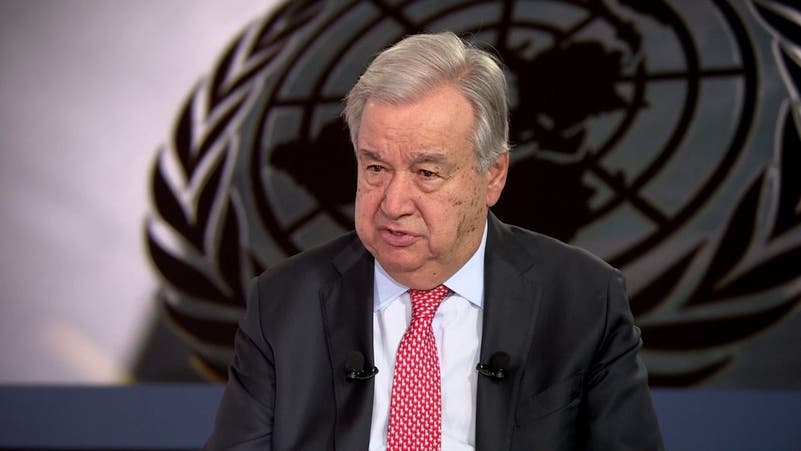
The United Nations Secretary-General, Antonio Guterres, on Thursday accused the Rapid Support Forces of committing atrocities in Sudan. During an interview, from his office in Riyadh, he announced that both parties to the conflict in Sudan—the army and the Rapid Support Forces—will meet in Geneva, without specifying a date for this anticipated meeting.
The UN Secretary-General, during his remarks, touched on developments in the region, particularly in Yemen, Sudan, and Gaza. He said that what is happening in Yemen’s Hadramawt is a dangerous development. He also expressed his deep gratitude to the Kingdom of Saudi Arabia for its efforts in peace diplomacy.
Guterres stated that the developments in Yemen’s Hadramawt are a serious escalation, and considered the Houthi detention of UN staff unacceptable, saying his priority is their release.
In recent years, the Houthis have carried out several waves of arrests, and they continue to detain 59 UN employees, all of Yemeni nationality, who are deprived of any contact with the outside world.
The Houthis justified these detentions on charges of spying for the United States and Israel, but the United Nations has denied the accusations, affirming that it is impermissible to prosecute its staff based on their official activities.
Regarding the Sudanese crisis, Guterres said in his remarks: “We are talking with all Sudanese parties.” He added, “We will hold meetings in Geneva with both sides,” as part of efforts aimed at ending the war that has been ongoing for two years in this Arab country.
He described the suffering of the Sudanese as unprecedented.
Guterres called in his remarks for “accountability for those responsible for bombing our missions in El Fasher,” and accused the “Rapid Support Forces” of committing atrocities.
He continued, saying, “The war in Sudan is terrible and must stop.”
The world’s attention is focused on the war in Sudan. The conflict sparked international condemnation in October, following reports of mass atrocities, after the Rapid Support Forces seized control of El Fasher, the capital of North Darfur and the army’s last stronghold in western Sudan, following a grueling 18-month siege.
Guterres also said that the United Nations has received promises to allow it access to the stricken city.
Guterres expressed the UN’s readiness “to provide whatever is asked of us regarding Gaza,” and said, “We offer our services for cooperation on Gaza.”
Guterres expressed his deep gratitude to the Kingdom of Saudi Arabia for its efforts in peace diplomacy and the humanitarian aid it sends to various regions of the world.
Guterres said he discussed reforms at the United Nations with Saudi Crown Prince Mohammed bin Salman, appreciating “Saudi Arabia’s deep cooperation” with the organization.
Guterres stressed in his remarks the need to reform the Security Council, pointing out that the council “does not reflect the reality of the world today.”
He said, “UN organizations are doing everything they can to save people despite the lack of resources,” and regretted that “money is being moved from aid to defense budgets.”
Riyadh
Riyadh is the capital and largest city of Saudi Arabia, located in the heart of the Arabian Peninsula. Its history dates back to the 18th century as a small walled settlement, but it grew into a major political and economic hub after becoming the center of the Saudi state in the early 20th century. Today, Riyadh is a modern metropolis known for its skyscrapers, government institutions, and role as a gateway to Islamic holy sites.
Geneva
Geneva is a major global city in Switzerland, known as a hub for international diplomacy and home to the European headquarters of the United Nations. Historically, it gained prominence in the 16th century as a center of the Protestant Reformation under John Calvin. Today, it is celebrated for its humanitarian role, picturesque lakeside setting, and diverse cultural institutions.
Yemen
Yemen is a country in the Arabian Peninsula with a rich history as a center of ancient trade, particularly for frankincense and myrrh. It was home to the legendary Kingdom of Sheba and later became a key region in the Islamic world. In modern times, Yemen has faced significant challenges, including political instability and a devastating civil war that began in 2014.
Hadramawt
Hadramawt is a historical region in southern Yemen, renowned for its ancient kingdoms and the distinctive mud-brick skyscrapers of cities like Shibam and Tarim. It was a key hub on the frankincense trade route and later became a center of Islamic scholarship and Sufi learning. The region’s history stretches back to the Hadramite Kingdom (circa 1000 BCE), and it maintained semi-autonomy under various empires until becoming part of modern Yemen.
Sudan
Sudan is home to more pyramids than Egypt, with the ancient Nubian kingdom of Kush building hundreds of royal tombs at sites like Meroë, which served as a major center of power and trade from around 800 BCE to 350 CE. Despite its rich history, including the later spread of Islam and colonial rule under the Anglo-Egyptian Condominium, Sudan has faced modern challenges such as civil wars and the 2011 secession of South Sudan. Today, its cultural heritage, including the UNESCO-listed archaeological sites and diverse ethnic traditions, remains a testament to its complex and enduring legacy.
El Fasher
El Fasher is the capital city of North Darfur in Sudan, historically serving as the seat of the Sultanate of Darfur before its incorporation into Anglo-Egyptian Sudan in 1916. It has long been a significant trade and administrative center in the region. In recent years, the city has faced severe challenges due to the ongoing conflict in Darfur, including displacement and humanitarian crises.
North Darfur
North Darfur is a region in western Sudan known for its arid landscape and historical significance as part of the Fur Sultanate, which flourished from the 16th to early 20th centuries. In modern times, it has been heavily impacted by the Darfur conflict that began in 2003, leading to widespread displacement and humanitarian crises. The area remains culturally diverse, home to various ethnic groups such as the Fur, Zaghawa, and Arab tribes.
Gaza
Gaza is a densely populated Palestinian city on the eastern coast of the Mediterranean Sea, with a history spanning over 3,000 years as a key trade and cultural hub. It has been ruled by numerous empires, including the Philistines, Romans, Byzantines, and Ottomans, and was a notable center of learning during the Islamic Golden Age. In modern times, Gaza has become the focal point of the Israeli-Palestinian conflict, enduring significant destruction and humanitarian crises, particularly following the 2023-2025 war.