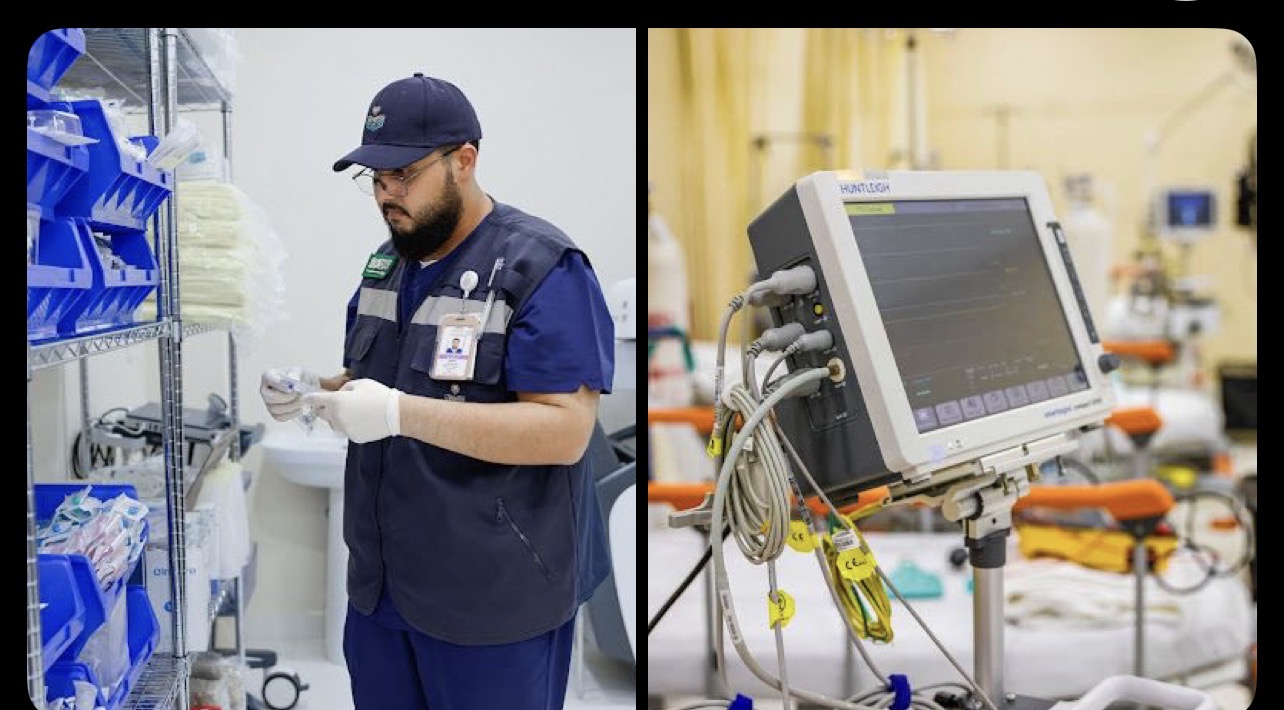
The General Administration of Medical Services of the Ministry of Interior is participating during this year’s Hajj season through the field hospital in the holy sites, as part of the health services provided to the guests of the Most Merciful. This is achieved through comprehensive medical preparations and specialized staff working around the clock to ensure rapid response to emergency cases and provide necessary health care to pilgrims.
The field hospital includes several medical departments equipped with the latest technologies, including intensive care, operating rooms, isolation units, and heat stress units. It also provides modern medical devices and supplies that contribute to raising the efficiency of therapeutic services and dealing with various health conditions according to the highest medical standards.
The administration has also strengthened the hospital with specialized medical, nursing, and technical staff, working within an integrated field system aimed at enhancing health preparedness in the holy sites and providing immediate medical care to pilgrims to ensure their safety while performing their rituals.
The medical preparations included activating telemedicine technology, which allows remote medical consultations and supports field teams with rapid diagnosis and appropriate treatment decisions, thereby enhancing the efficiency of medical performance and raising the quality of health services provided.
The participation also included operating a mobile field clinic equipped with the latest medical devices and technologies, aimed at supporting rapid intervention and reaching cases at the pilgrims’ locations, enhancing field response speed and keeping pace with the massive crowds in the holy sites during the Hajj season.
These efforts come within the framework of services provided by various government sectors to serve the guests of the Most Merciful, in implementation of the directives of the wise leadership to provide the highest levels of health, security, and organizational care for pilgrims, enabling them to perform their rituals with ease and tranquility.
Holy Sites
“Holy sites” refer to locations of profound religious significance, often associated with pivotal events in a faith’s history or the presence of a divine figure. These places, such as Jerusalem’s Western Wall, Mecca’s Kaaba, or Varanasi’s ghats, have served as centers for pilgrimage, worship, and spiritual reflection for centuries. Their histories are deeply intertwined with the development of major world religions, reflecting layers of tradition, conflict, and devotion.
Field Hospital
A field hospital is a temporary medical facility often set up near combat zones or disaster areas to provide urgent care to the wounded. Historically, they have been used in major conflicts like the American Civil War and World Wars I and II, evolving from basic tents to advanced mobile units with surgical capabilities. These hospitals play a critical role in saving lives by offering rapid, on-site treatment before patients are transferred to permanent facilities.
Holy Sites
Holy sites are locations of profound religious significance, often associated with pivotal events in a faith’s history or the life of its founder. These places, such as Jerusalem’s Western Wall, Mecca’s Kaaba, or Varanasi’s ghats, serve as focal points for pilgrimage, prayer, and spiritual reflection across diverse traditions. Their histories are deeply layered, with many sites having been built, destroyed, and rebuilt over millennia, reflecting centuries of devotion, conflict, and cultural exchange.
Mecca’s Kaaba
The Kaaba, located in Mecca, Saudi Arabia, is the most sacred site in Islam, believed to have been built by the Prophet Abraham and his son Ishmael as a monotheistic house of worship. For centuries, it has served as the qibla, the direction Muslims face during prayer, and is the focal point of the Hajj pilgrimage, which all able Muslims are required to undertake at least once in their
Holy Sites
The term “Holy Sites” typically refers to locations of profound religious significance, such as Jerusalem’s Western Wall, the Church of the Holy Sepulchre, and the Dome of the Rock. These sites have deep historical roots, often dating back thousands of years, and are central to Judaism, Christianity, and Islam. Their shared and contested histories have made them focal points of pilgrimage, devotion, and geopolitical tension in the region.
Jerusalem’s Western Wall
The Western Wall, also known as the Wailing Wall, is a remnant of the retaining wall that surrounded the Second Temple of Jerusalem, built by Herod the Great around 20 BCE. It is the holiest site where Jews are permitted to pray, as the Temple itself was destroyed by the Romans in 70 CE. Today, it remains a profound symbol of Jewish faith and resilience, attracting millions of visitors and worshippers from around the world.
Mecca’s Kaaba
The Kaaba, located in the sacred city of Mecca, Saudi Arabia, is a cube-shaped structure that Muslims consider the “House of God” and the most sacred site in Islam. According to Islamic tradition, it was originally built by the prophet Abraham and his son Ishmael, and it has served as a focal point for prayer and pilgrimage for centuries. Today, it is the direction (qibla) that Muslims around the world face during their daily prayers and the central destination of the Hajj pilgrimage.
Varanasi’s ghats
Varanasi’s ghats are a series of steps leading down to the Ganges River, serving as the spiritual and cultural heart of the ancient city. Dating back thousands of years, these sacred riverfronts are central to Hindu rituals, including daily prayers, cremations, and pilgrimages, with the most famous being the Dashashwamedh and Manikarnika Ghats. The ghats have been continuously rebuilt and expanded over centuries, reflecting the enduring religious significance and historical layers of one of the world’s oldest inhabited cities.
Field Hospital
A field hospital is a temporary medical facility established near a combat zone or disaster area to provide immediate care to the wounded and sick. Its history dates back to ancient times, but it became more formally organized during the Napoleonic Wars and the Crimean War, with figures like Florence Nightingale revolutionizing its practices. Field hospitals have since evolved into highly mobile units, crucial for stabilizing patients before evacuation to more permanent facilities.
Related news
The details
The Medina Region Secretariat is organizing divers...