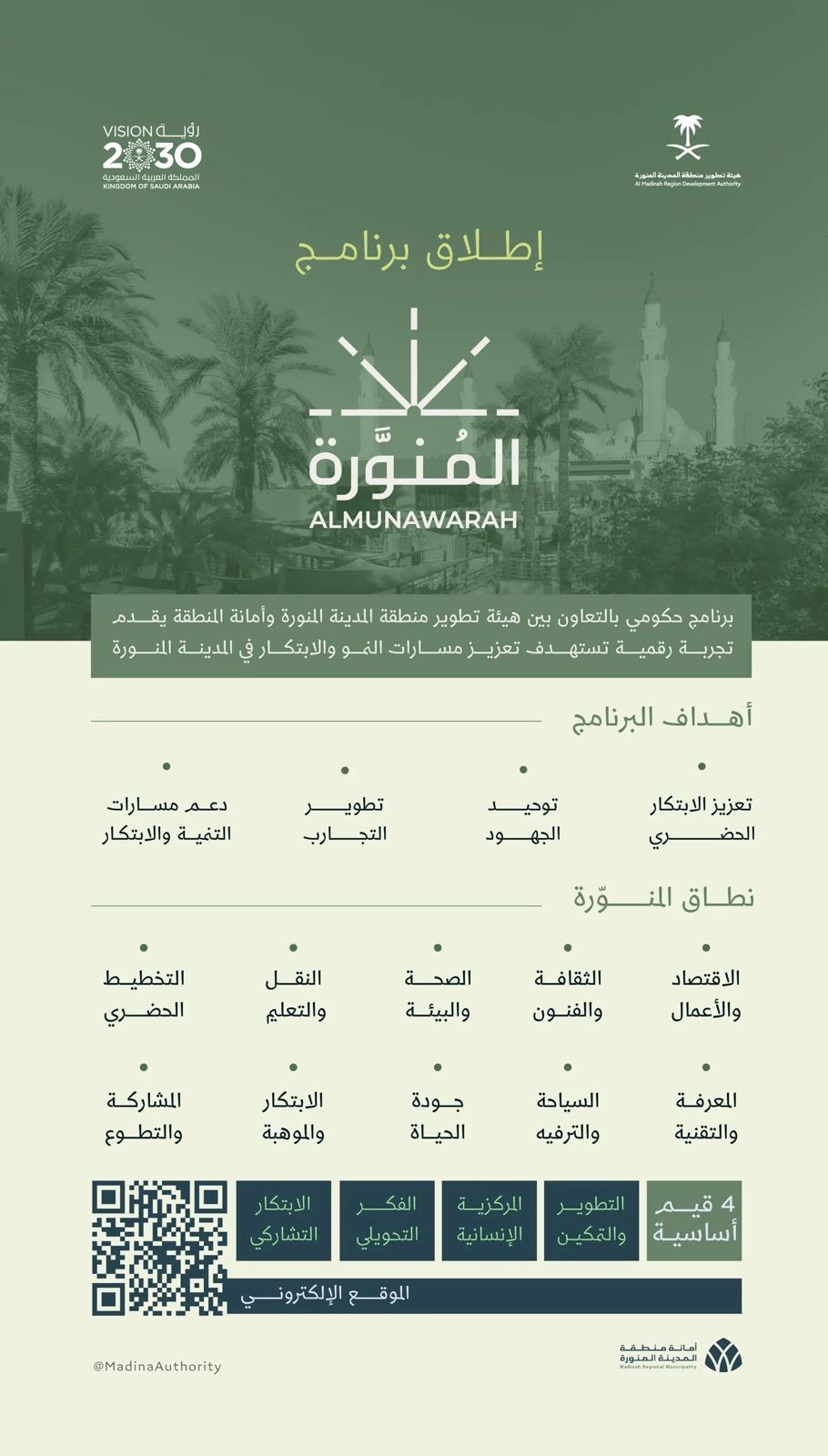
The Medina Region Development Authority has launched the activities of the “Al-Munawwarah” program, organized in partnership with the Medina Municipality. The program aims to develop an urban innovation system that contributes to finding practical solutions to developmental challenges and transforming creative ideas into applicable initiatives and projects, thereby enhancing the quality of life for residents and visitors. The launch of the program is part of efforts to develop Medina as a model for cities that combine rich cultural heritage and sustainable innovation, by building an integrated environment that supports the development of innovative solutions and activates partnerships between government entities, the private sector, academic institutions, and entrepreneurs. The “Al-Munawwarah” program is based on the concept of applied innovation, working to attract innovative ideas and initiatives and develop prototypes for them, in preparation for testing and implementing them in the urban reality. This contributes to developing services and improving the urban environment in Medina. The program focuses on enhancing community participation in designing and developing public spaces, activating initiatives that contribute to developing the urban environment and the knowledge economy, in addition to supporting innovation in the fields of technology, health, urban culture, and environmental sustainability. The program operates through a set of initiatives and partnerships aimed at supporting startups and innovative initiatives and developing innovative urban experiences, which enhances Medina’s position as a knowledge center for urban innovation. The “Al-Munawwarah” program is part of the ongoing developmental efforts in the Medina region, aligning with the objectives of Saudi Vision 2030 in developing the Kingdom’s cities, enhancing the quality of life within them, and building sustainable urban environments.

Medina

The Medina refers to the historic old city center found in many North African towns, most famously in Fez, Marrakech, and Tunis. These walled districts, often dating back to the medieval period, are characterized by a dense maze of narrow streets, bustling souks (markets), mosques, and traditional houses. They were typically the original urban core, built during the early Islamic expansion, and many are now UNESCO World Heritage Sites for their preserved architecture and living cultural heritage.

Al-Munawwarah program

“Al-Munawwarah” is a common Arabic name for the city of Medina in Saudi Arabia, meaning “The Enlightened City.” It is one of Islam’s two holiest cities, serving as the site of the Prophet Muhammad’s migration (Hijrah) and later burial. The term “Al-Munawwarah program” likely refers to a specific educational, cultural, or religious initiative named in honor of the city.

Medina Region Development Authority

The Medina Region Development Authority (MRDA) is a government agency in Saudi Arabia established to oversee and implement comprehensive urban, economic, and social development plans for the Medina Region. It was formed to strategically manage the growth and preservation of the region, which is home to Islam’s second holiest city, Al-Madinah Al-Munawwarah. The authority focuses on projects that enhance infrastructure, tourism, and quality of life while respecting the area’s profound religious and cultural heritage.

Medina Municipality

The Medina Municipality is the local governing body of Medina, the second-holiest city in Islam, located in Saudi Arabia. Historically, the city is profoundly significant as the site of the Prophet Muhammad’s migration (Hijrah) and the establishment of the first Muslim community, with his mosque (Al-Masjid an-Nabawi) at its heart. Today, the municipality manages the city’s services and infrastructure, balancing the

Medina

The Medina refers to the historic old city center found in many North African towns, most famously in Fez, Marrakech, and Tunis. These walled districts, often dating back to the medieval period, are characterized by a dense maze of narrow streets, bustling souks (markets), mosques, and traditional houses. They were typically established as the original urban core and remain vibrant centers of commerce, craftsmanship, and daily life, with many designated as UNESCO World Heritage Sites for their cultural and architectural significance.

Al-Munawwarah

Al-Munawwarah (Arabic: ٱلْمُنَوَّرَة), meaning “The Enlightened City,” is the traditional name for the city of Medina in Saudi Arabia. It is Islam’s second holiest city, most famous as the site of the Prophet Muhammad’s migration (Hijrah) in 622 CE and his final resting place at Al-Masjid an-Nabawi (The Prophet’s Mosque). The city served as the capital of the early Islamic Caliphate and remains a central pilgrimage destination and a major religious and scholarly center.

Al-Masjid an-Nabawi

Al-Masjid an-Nabawi, or the Prophet’s Mosque, is one of the largest and most important mosques in Islam, located in Medina, Saudi Arabia. It was originally built by the Prophet Muhammad in 622 CE after his migration from Mecca, and it houses his tomb. The mosque has been significantly expanded and renovated numerous times throughout history, evolving from a simple mud-brick structure into its current vast and ornate form.

Fez

Fez is a historic city in northern Morocco, founded in the 8th–9th centuries and long serving as a capital of the country. It is renowned for its well-preserved medieval medina, Fes el-Bali, a UNESCO World Heritage site, and for housing the University of al-Qarawiyyin, founded in 859 and considered one of the oldest continuously operating universities in the world.

Marrakech

Marrakech is a historic city in western Morocco, founded in 1062 by the Almoravid dynasty. It served as a capital of the empire and is famed for its vibrant medina, a UNESCO World Heritage site, and iconic landmarks like the Koutoubia Mosque and the bustling Jemaa el-Fnaa square.

Tunis

Tunis is the capital and largest city of Tunisia, located on the country’s northeastern coast. Its history dates back to ancient Berber settlements, but it rose to prominence in the medieval period as the heart of the powerful Hafsid dynasty and a major center of the Islamic world. Today, the city is known for its historic medina—a UNESCO World Heritage site—which contrasts with the modern Ville Nouvelle district established during the French protectorate.

UNESCO World Heritage Sites

UNESCO World Heritage Sites are landmarks or areas selected by the United Nations for having outstanding cultural, historical, scientific, or natural significance. The program was established by UNESCO in 1972 through an international treaty to protect and preserve humanity’s most valuable treasures for future generations. These sites, which include places like the Great Wall of China and the Galápagos Islands, represent a shared global heritage.

Saudi Vision 2030

“Saudi Vision 2030” is a strategic framework launched in 2016 to reduce Saudi Arabia’s economic dependence on oil and diversify its economy. It outlines ambitious goals for developing public service sectors, promoting cultural and entertainment projects, and increasing private sector investment to transform the nation’s future.

Related news

Municipality approves housing project and offers 6 investment opportunities

The Medina Region Secretariat has approved the imp...

The Medina Municipality continues its work to improve the urban landscape.

The Medina Municipality removed over 120,000 cubic...

“The Green City” initiative aims to plant over two million trees in Medina.

The Medina Region Municipality has launched the "G...

The Medina Municipality approves an opportunity to implement a commercial project.

The Medina Region Municipality has approved the im...