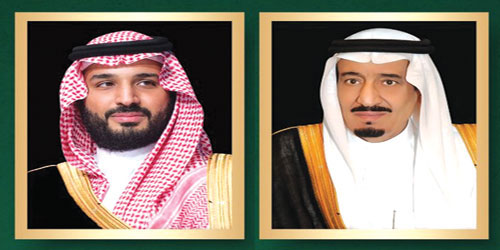
Saudi Arabia deposits an additional $3 billion into Pakistan’s Central Bank.
In Today’s Edition
The King Abdulaziz Foundation has released a new episode in its “Men of King Abdulaziz” series, as part of its oral history initiative…
The medical and surgical team of the Saudi Conjoined Twins Program successfully performed an urgent surgical operation yesterday to separate conjoined twins…
Riyadh was never just blocks of cement or a network of intersecting roads, but on the fifteenth of April, in…
For three days, Jeddah borrowed an exceptional passport stamped by Effat University with a “The Whole World” visa, after launching the festival…
The White House expressed optimism about reaching an agreement with Iran, confirming that Washington will work to ensure Tehran does not possess…
The U.S. President announced an agreement to begin a temporary ten-day truce between Lebanon and Israel…
The U.S. Secretary of Defense stated in a press briefing at the Pentagon that U.S. forces in the Middle East are prepared…
The King Abdulaziz Foundation (also known as Dārat al-Malik ʿAbd al-ʿAzīz) is a major cultural and research institution in Riyadh, Saudi Arabia, established in 1985. It is dedicated to preserving and documenting the modern history of Saudi Arabia, with a particular focus on the life and era of the kingdom’s founder, King Abdulaziz Al Saud. The foundation operates a museum, library, and archive, and supports scholarly research and publications on Arabian
&
King Abdulaziz Foundation
The King Abdulaziz Foundation, also known as Dārat al-Malik ʿAbd al-ʿAzīz, is a major cultural and research institution in Riyadh, Saudi Arabia, established in 1985. It was founded to preserve and promote the national heritage of Saudi Arabia, with a particular focus on the life and era of the kingdom’s founder, King Abdulaziz Al Saud. The foundation operates a museum, archives, and a library, and it supports historical research and cultural programs.
Riyadh
Riyadh is the capital and largest city of Saudi Arabia, serving as the nation’s political, financial, and administrative center. Historically a walled oasis town and the historic seat of the Al Saud dynasty, it transformed dramatically in the 20th century after the discovery of oil, evolving from a traditional Najdi settlement into a modern global metropolis.
Jeddah
Jeddah is a major port city on Saudi Arabia’s Red Sea coast, historically serving as the gateway for Muslim pilgrims traveling to Mecca. Its historic district, Al-Balad, features centuries-old coral stone houses and is a UNESCO World Heritage Site, reflecting the city’s long-standing role as a vibrant commercial and cultural crossroads.
Effat University
Effat University is a private, non-profit women’s university located in Jeddah, Saudi Arabia. It was founded in 1999 by Queen Effat Al-Thunayan Al-Saud, a pioneering advocate for women’s education, making it one of the first private institutions of higher education for women in the country. The university is known for its focus on innovative academic programs and empowering women to become leaders in various professional fields.
White House
The White House is the official residence and workplace of the President of the United States, located in Washington, D.C. It was designed by James Hoban, its cornerstone was laid in 1792, and it has been the executive residence of every U.S. president since John Adams in 1800. The building, famously burned by British forces in 1814 and subsequently rebuilt, stands as a powerful symbol of the U.S. government and its history.
Pentagon
The Pentagon is the headquarters of the United States Department of Defense, located in Arlington, Virginia. Constructed during World War II and completed in 1943, it was built rapidly to consolidate the nation’s military offices. It remains one of the world’s largest office buildings and a global symbol of the U.S. military.
Lebanon
Lebanon is a country on the eastern shore of the Mediterranean Sea, historically known as the heart of Phoenician civilization, a major maritime and trading culture from around 3200 BC. Its rich history includes successive rule by various empires and it is renowned for ancient sites like the Roman ruins at Baalbek and the well-preserved city of Byblos, one of the oldest continuously inhabited cities in the world. Modern Lebanon is also noted for its diverse cultural and religious heritage.
Israel
Israel is a modern nation-state established in 1948 in the historical region known as the Land of Israel, an area with profound significance for Judaism, Christianity, and Islam due to its millennia of history. It is home to numerous ancient cultural and religious sites, including Jerusalem’s Western Wall, the Church of the Holy Sepulchre, and the Al-Aqsa Mosque complex. The region has been a center of human civilization for thousands of years, ruled by a succession of ancient kingdoms and empires, before becoming the focus of the modern Zionist movement and the subsequent establishment of the State of Israel.