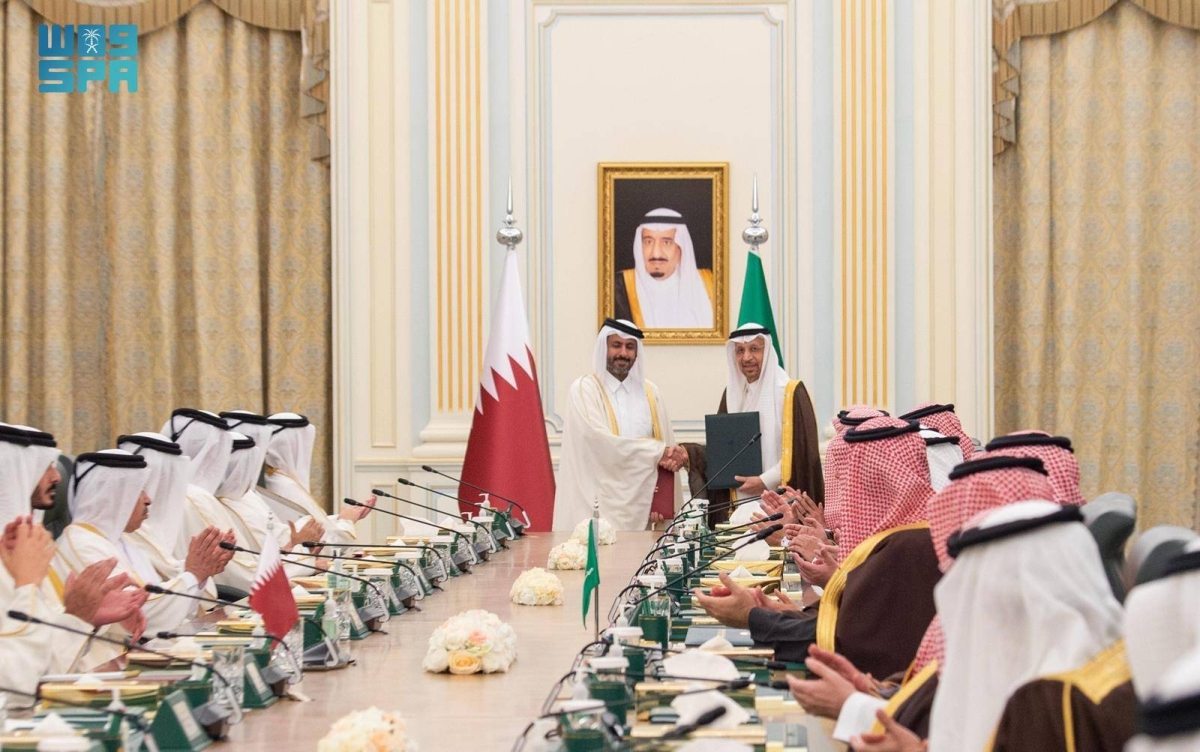
Crown Prince and Prime Minister Mohammed bin Salman bin Abdulaziz Al Saud of Saudi Arabia and Sheikh Tamim bin Hamad Al Thani, the Emir of the State of Qatar, witnessed the signing of an agreement to implement a high-speed electric passenger train project between the Kingdom of Saudi Arabia and the State of Qatar. This step reflects the depth of fraternal and historical relations between the two brotherly countries.
The agreement was signed by the Minister of Transport and Logistics, Engineer Saleh Al-Jasser, and Sheikh Mohammed bin Abdullah Al Thani, the Minister of Transport of the State of Qatar, as part of the Saudi-Qatari Coordinating Council’s proceedings.
The high-speed train project between the two countries is a strategic step within their efforts to enhance cooperation and developmental integration, cement sustainable development, and their shared commitment towards broader horizons of development and prosperity in the region.
The high-speed train will extend over a distance of 785 km, connecting the two capitals, Riyadh and Doha, passing through major stations including the cities of Al-Hofuf and Dammam, and linking King Salman International Airport and Hamad International Airport. The train will form a new artery for fast and sustainable mobility, improving the regional travel experience with speeds exceeding 300 km/h, contributing to reducing travel time to approximately two hours between the two capitals. This will support mobility and enhance commercial and tourist movement, supporting economic growth and improving quality of life.
The high-speed train will serve more than 10 million passengers annually, enabling travelers to discover the landmarks of Saudi Arabia and Qatar with ease. The project will also contribute to providing over 30,000 direct and indirect jobs.
Upon completion, the project is estimated to have an economic impact of approximately 115 billion Saudi Riyals on the GDP of both countries, making it one of the most important strategic projects supporting regional development and cementing interconnection and integration among the Gulf Cooperation Council states through an advanced railway network.
The project is set to be completed in 6 years, God willing, according to the highest global standards of quality and safety, using the latest railway technologies and smart engineering to ensure safe and smooth operation. This will achieve environmental sustainability, reduce carbon emissions, and enhance efforts to support the transition towards more efficient and innovative modes of transport for smart and sustainable mobility in the region.
The “Saudi Arabia – Qatar High-Speed Train” Project
- The Saudi-Qatar High-Speed Train project enjoys direct patronage and attention, reflecting its strategic status as one of the most prominent integration projects between the two brotherly countries.
- This project embodies the vision of the leaderships in Saudi Arabia and the State of Qatar to create a more interconnected and prosperous future, serving as a true model for sustainable development. It contributes to strengthening the connection between citizens and facilitating their lives, as travel between the two countries will become faster, more comfortable, and safer.
- The signing ceremony was attended by the leaderships, reflecting unlimited support for the project and its strategic importance as an icon for Gulf integration and a symbol of the unity of future vision between the Kingdom and Qatar.
- The announcement of the Saudi-Qatar High-Speed Train project marks a historic moment confirming the depth of Saudi-Qatari relations and cementing bilateral cooperation in the transport sector as a symbol of the unity of future vision in the region. It is a qualitative project embodying the integration between the two countries in developing a modern and sustainable transport system.
- The Saudi-Qatar High-Speed Train project between Saudi Arabia and the State of Qatar will connect Riyadh and Doha via a 785 km railway network, including 5 main stations. It will contribute to supporting modern transport infrastructure between the two countries, enhancing economic, social, and tourism links.
- The Saudi-Qatar High-Speed Train project is a practical embodiment of Saudi Vision 2030 and Qatar National Vision 2030, reflecting the commitment of both countries to developing modern and sustainable infrastructure that supports economic growth, enhances quality of life, and provides advanced transport options. This project will contribute to achieving economic diversification, promoting tourism, and raising the efficiency of the transport sector, to be a pivotal element in building a more connected and prosperous future for the peoples of both countries.
- This project is expected to benefit more than 10 million passengers annually, serving as a strong economic and tourism driver by facilitating travel between the two countries, enhancing trade and investment, and providing new opportunities in the transport, hospitality, and services sectors. It also supports tourism growth by enabling travelers to easily explore the landmarks of Saudi Arabia and Qatar, contributing to increasing visitor numbers and encouraging short, frequent trips between the two capitals.
- The Saudi-Qatar High-Speed Train project reflects the depth of historical and cultural relations between the two peoples. It is not merely an infrastructure project but a symbol that unites shared values
Riyadh
Riyadh is the capital and largest city of Saudi Arabia, historically a significant oasis settlement and the ancestral home of the Al Saud dynasty. It transformed from a walled desert town into a modern metropolis following the discovery of oil in the 20th century, which fueled its rapid economic and infrastructural growth. Today, it serves as the nation’s political, financial, and administrative center, while also preserving historical sites like the Masmak Fortress, which symbolizes the 1902 capture that led to the founding of the modern Saudi state.Doha
Doha is the capital city of Qatar, a modern metropolis that transformed from a small pearl fishing and trading village into a major global hub following the discovery of oil and natural gas in the mid-20th century. Today, it is known for its striking futuristic skyline, world-class museums like the Museum of Islamic Art, and its role as a center for international diplomacy and commerce in the Middle East.Al-Hofuf
Al-Hofuf is a historic oasis city in eastern Saudi Arabia, best known as the capital of the Al-Ahsa region, a UNESCO World Heritage site. Its history dates back thousands of years, with its prosperity historically linked to its vast date palm groves and freshwater springs. The city is home to significant landmarks like the iconic Ibrahim Palace (Qasr Ibrahim), an Ottoman-era fortress, reflecting its long role as a vital administrative and agricultural center.Dammam
Dammam is a major port city on Saudi Arabia’s east coast and the capital of the Eastern Province. It grew from a small fishing village into a key administrative and economic hub following the discovery of oil in the region in the 1930s. Today, it forms the core of the Dammam Metropolitan Area, a vital center for the Saudi oil industry, commerce, and transport.King Salman International Airport
King Salman International Airport is a major new airport project currently under construction in Riyadh, Saudi Arabia. Upon its planned completion around 2030, it is set to become one of the world’s largest airports, designed to transform Riyadh into a global aviation and logistics hub as part of the Kingdom’s Vision 2030 economic diversification plan.Hamad International Airport
Hamad International Airport is Qatar’s main international airport, which opened in 2014 to replace the older Doha International Airport. It was built to accommodate the rapid growth of Qatar Airways and to serve as a major global transit hub ahead of the 2022 FIFA World Cup. The airport is renowned for its modern architecture, luxury amenities, and the iconic “Lamp Bear” sculpture by Urs Fischer in its central terminal.Saudi Vision 2030
“Saudi Vision 2030” is a strategic framework launched in 2016 to reduce Saudi Arabia’s dependence on oil, diversify its economy, and develop public service sectors such as health, education, infrastructure, recreation, and tourism. It is not a physical place but a national transformation plan, historically rooted in the need to modernize the kingdom’s economy and society for a sustainable post-oil future.Qatar National Vision 2030
The Qatar National Vision 2030 is not a physical site but a strategic development framework launched in 2008 to guide the nation’s future. It aims to transform Qatar into an advanced, sustainable society by 2030, pivoting its economy away from hydrocarbon dependence and focusing on four key pillars: human, social, economic, and environmental development. The vision serves as the blueprint for major national projects and reforms, shaping the country’s modern identity and infrastructure.