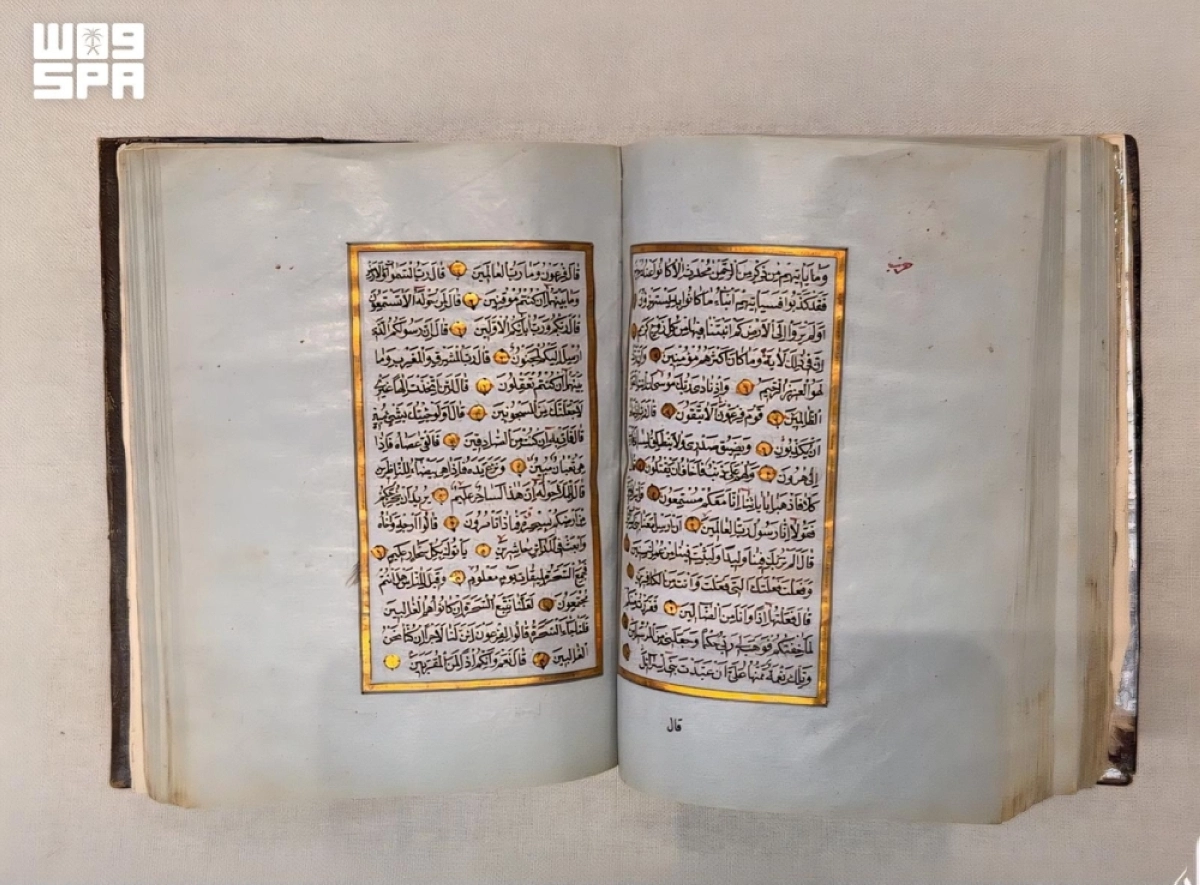
The Holy Quran Museum in the Hira Cultural District of Mecca showcases a collection of rare and valuable Quranic artifacts that document Muslims’ care for the Book of God throughout the ages. Among the highlights is a rare Quran manuscript dating back to 1259 AH (1843 CE), serving as a historical witness to the beauty of Quranic calligraphy and ornamentation.
The manuscript is distinguished by its precise writing in black ink with full diacritical marks, while its pages are adorned with gold borders and gold verse separators, along with intricate floral decorations that highlight the level of Quranic gilding and embellishment art achieved during that historical period.
The manuscript shows special attention to Quranic divisions, as its pages include markers for parts and sections, reflecting the scribes’ and scholars’ focus on facilitating recitation, review, and memorization, while also preserving the aesthetic and artistic aspects of the Holy Quran.
Accompanying information indicates that the manuscript later underwent restoration and binding work to protect it from deterioration, a step that contributed to sustaining this rare Quranic artifact and preserving it as a testament to a cultural and civilizational heritage spanning over a century and a half. This manuscript is displayed as part of the knowledge and cultural content offered by the Holy Quran Museum in the Hira Cultural District, which allows visitors and pilgrims to view diverse examples of historical Quran manuscripts and rare manuscripts, and to learn about the stages of Quranic writing, copying, and ornamentation across different Islamic eras. The museum stands as a prominent cultural and knowledge destination in Mecca, helping to highlight the historical efforts made by Muslims in serving and caring for the Holy Quran, and enhancing awareness of the value of Islamic heritage related to the Book of God, through modern museum displays and interactive educational experiences that enrich visitors’ experiences and deepen their connection to the history of the Holy Quran.