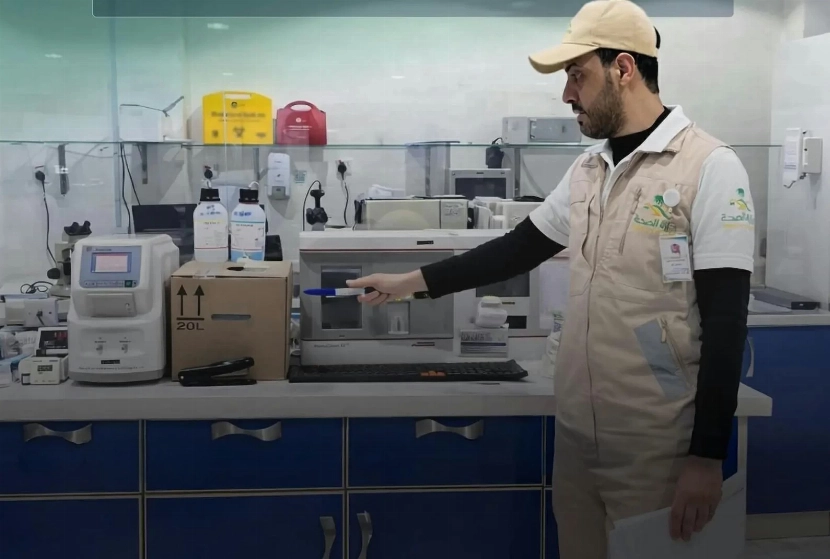
The Ministry of Health has launched a campaign titled “Ensuring the Reliability of Expatriate Worker Examinations” to guarantee the reliability and accuracy of medical test results for expatriate workers, enhance compliance with approved health regulations in Saudi Arabia, and protect public health in line with the goals of the Health Sector Transformation Program under Vision 2030, aiming for an advanced health system that meets the best global standards in oversight and quality, and contributes to strengthening the reliability of provided health services.
The campaign aims to ensure the accuracy and validity of medical test results for expatriate workers, verify that health facilities adhere to approved examination protocols and procedures, ensure the use of calibrated and certified laboratory equipment that is regularly maintained, confirm the competence and qualifications of technical staff performing the tests, and prevent any practices that compromise the integrity of results or involve manipulation.
The campaign also focuses on verifying compliance with electronic linkage and reporting through approved systems, raising the level of oversight on worker examination centers, thereby enhancing result reliability and reducing violations, while contributing to protecting the community from infectious diseases and ensuring public health safety.
Penalties for Violators: Fines and Closure
The “Ensuring the Reliability of Expatriate Worker Examinations” campaign is part of the supervision of private health institutions providing expatriate worker examination services, as stipulated by the Private Health Institutions Law and its executive regulations.
Penalties for violations include a fine of up to 100,000 riyals, closure of the health institution for 60 days, and license revocation. The Ministry emphasized the continuation of its oversight efforts to ensure health facilities comply with approved professional and regulatory standards, thereby enhancing the quality of health services and preserving community safety.
Saudi Arabia
Saudi Arabia is a country in the Middle East known for its vast deserts, rich oil reserves, and deep Islamic heritage. It is the birthplace of Islam, home to the holy cities of Mecca and Medina, and has a history that includes ancient trade routes and the unification of the kingdom under King Abdulaziz Al Saud in 1932. Today, it is undergoing rapid modernization through its Vision 2030 plan, which aims to diversify its economy and open up its culture to the world.
Health Sector Transformation Program
The Health Sector Transformation Program is a key initiative under Saudi Arabia’s Vision 2030, aimed at restructuring the country’s healthcare system to improve quality, accessibility, and efficiency. Launched in 2018, the program seeks to privatize health services, enhance preventive care, and establish a unified electronic health record system. It represents a major shift from a government-dominated model to a more competitive, patient-centered approach, building on the historical foundation of free public healthcare in the kingdom.
Vision 2030
Vision 2030 is a strategic framework launched in 2016 by Saudi Arabia to reduce its dependence on oil, diversify its economy, and develop public service sectors such as health, education, infrastructure, and tourism. The plan aims to transform the country into a global investment powerhouse and open it up to international visitors, marking a historic shift from its traditionally conservative and oil-centric economy. Key initiatives include the giga-projects like NEOM and the Red Sea Project, as well as social reforms that have expanded entertainment and women’s rights.
Mecca
Mecca, located in Saudi Arabia, is the holiest city in Islam, serving as the birthplace of the Prophet Muhammad in 570 CE. It is home to the Great Mosque of Mecca, which contains the Kaaba, the
Mecca
Mecca, located in western Saudi Arabia, is the holiest city in Islam and the birthplace of the Prophet Muhammad. It is home to the Masjid al-Haram, which contains the Kaaba, the sacred structure toward which Muslims around the world pray. Historically, Mecca has been a major center for trade and pilgrimage for centuries, and today it is the destination of the annual Hajj pilgrimage, a religious duty for all able-bodied Muslims.
Medina
Medina, located in western Saudi Arabia, is the second holiest city in Islam, after Mecca. It is historically significant as the city where the Prophet Muhammad migrated in 622 CE (the Hijra) and established the first Muslim community, and it houses the Al-Masjid an-Nabawi (the Prophet’s Mosque), which contains his tomb. Today, Medina remains a major pilgrimage destination, drawing millions of Muslims each year to visit its sacred sites.
NEOM
NEOM is a planned megacity and economic zone in northwestern Saudi Arabia, part of the country’s Vision 2030 initiative to diversify its economy beyond oil. Announced in 2017 by Crown Prince Mohammed bin Salman, it aims to be a high-tech, sustainable urban area powered entirely by renewable energy, featuring futuristic projects like “The Line,” a linear city. While still under construction, NEOM represents an ambitious effort to create a new model for urban living and global investment.
Red Sea Project
The Red Sea Project is a luxury tourism development along Saudi Arabia’s western coast, launched in 2017 as part of Vision 2030 to diversify the economy. It aims to transform over 90 pristine islands, volcanic landscapes, and desert dunes into an exclusive, eco-friendly destination, with a focus on regenerative tourism. The project’s history includes plans for a zero-carbon footprint, protection of coral reefs, and preservation of cultural heritage sites like the ancient Nabataean city of Hegra.