The King Abdulaziz and His Companions Foundation for Giftedness and Creativity “Mawhiba” announced the results of the National Science and Mathematics Olympiad “Nasmo” finals, which it organizes in partnership with the Ministry of Education. The final stage was held in person in Riyadh from May 16 to 19, 2026, as part of a national track aimed at preparing and qualifying gifted students to represent the Kingdom in international scientific forums.
“Mawhiba” stated that 864 male and female students from various regions of the Kingdom participated in the olympiad finals. Among them, 223 students qualified for the Mawhiba International Olympiad program, including 44 for the mathematics team, 34 for the informatics team, 42 for the physics team, 36 for the science team, 35 for the biology team, and 32 for the chemistry team.
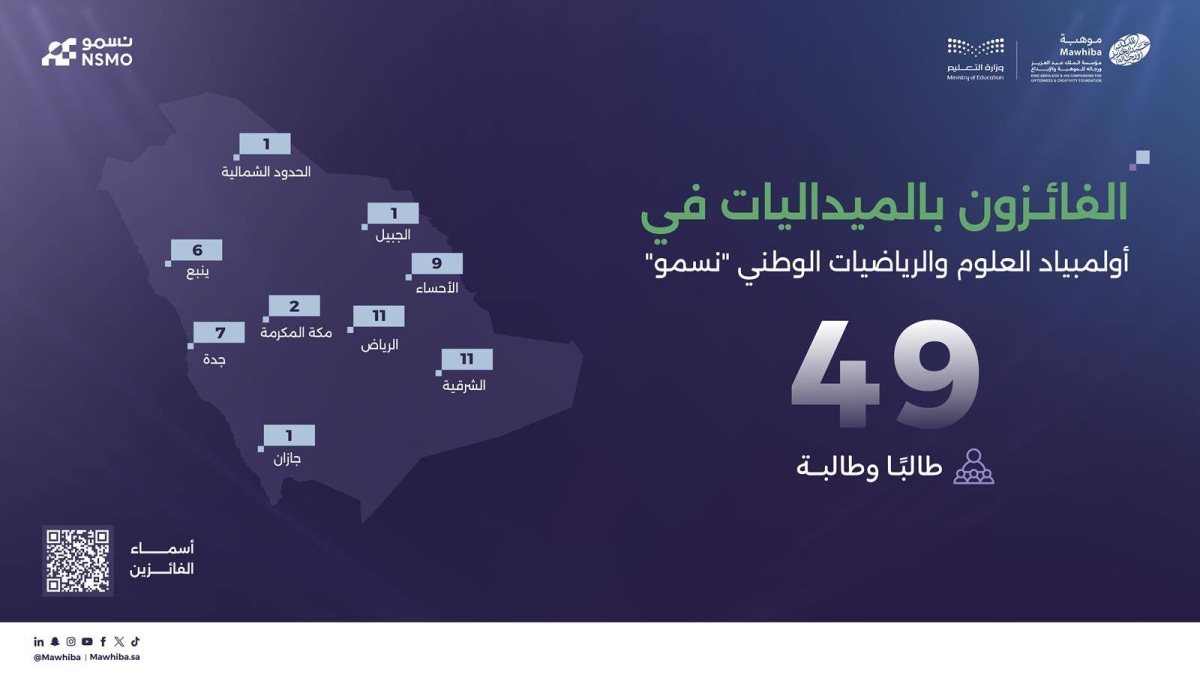
A total of 49 students won olympiad medals, distributed as 8 gold medals, 17 silver medals, and 24 bronze medals, following a competitive journey that began in schools, then at the city and governorate levels, culminating in the national team competition for education departments and the olympiad finals in Riyadh.
Students from the General Administration of Education in the Riyadh region and the General Administration of Education in the Eastern region won the largest share of medals, with 11 medals each. This was followed by the General Administration of Education in Al-Ahsa Governorate with 9 medals, then the General Administration of Education in Jeddah Governorate with 7 medals, and the General Education Administration at the Royal Commission in Yanbu with 6 medals. The General Administration of Education in the Makkah region achieved 2 medals, while the General Administration of Education in the Northern Borders region, the General Administration of Education in the Jazan region, and the General Education Administration at the Royal Commission in Jubail each received one medal.
Gold medals were achieved in physics by student Hussein Mohammed Al-Khamis from Al-Ahsa Education, in biology by student Saja Hamed Al-Ghamwi from Jeddah Education, in chemistry by student Layan Fahd Abu Al-Naja from Eastern Province Education, in science by student Saad Fayez Al-Shehri from Jeddah Education, in mathematics 2 by student Ammar Mohammed Al-Dawood from Riyadh Education, in mathematics 1 by student Ali Mohammed Al-Saleh from Al-Ahsa Education, in informatics 2 by student Mohammed Abdulaziz Al-Mulhim from Al-Ahsa Education, and in informatics 1 by student Rakan Khaled Al-Sharif from Riyadh Education.
The implementation of the final stage of the olympiad, which saw competition among 864 male and female students from various regions of the Kingdom, involved 18 coordinators from education departments and royal commissions, 25 members of scientific teams tasked with preparing scientific materials and tests, in addition to 28 supervisors and 90 team leaders from various education departments. “Mawhiba” stated that students’ preparations for the final stage were conducted through a set of knowledge tools provided by the Nasmo Olympiad library, which includes 16 training packages distributed across 8 scientific tracks in both Arabic and English, in addition to more than 200 training videos that provide simplified scientific content supporting understanding and practical application.
The “Nasmo” Olympiad is the first and largest annual national competition specialized in the fields of science and mathematics, targeting students from the first intermediate grade to the first secondary grade. It goes through gradual stages starting from school, then at the city and governorate levels, leading to the national team competition for education departments and the olympiad finals in Riyadh, with the aim of discovering, empowering, and preparing gifted students for international competition. The first stage of the olympiad recorded the participation of 99,179 male and female students, representing 8,356 schools in 47 cities and governorates distributed across 16 educational regions, under the supervision of about 800 male and female teachers, in a scene reflecting the breadth of the participation base and the presence of scientific ambition among students.