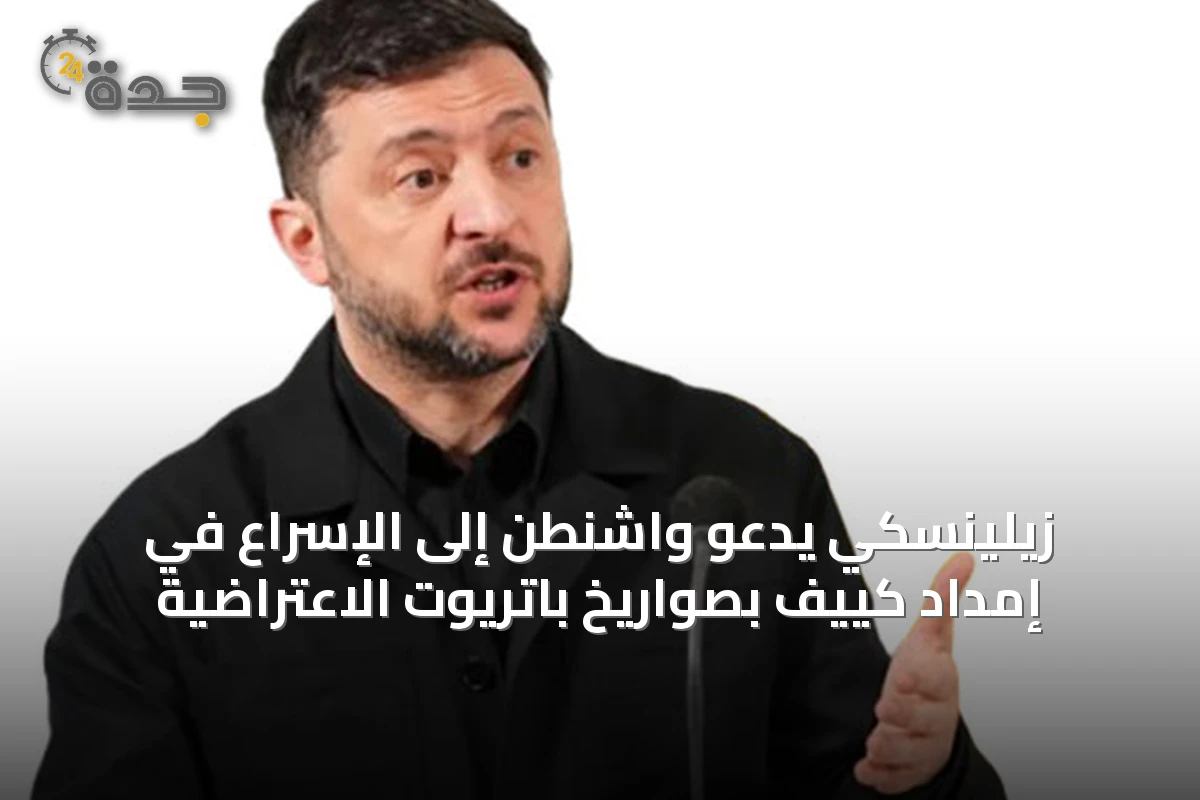
Ukrainian President Volodymyr Zelensky called on his U.S. counterpart Donald Trump to accelerate the supply of interceptor missiles and air defense systems to Kyiv, amid escalating Russian attacks and Moscow’s use of advanced ballistic missiles in the latest wave of strikes targeting Ukrainian territory.
Urgent message to Trump
Zelensky revealed in a message to Trump that Russia launched two intermediate-range ballistic missiles of the Oreshnik type during the recent attack on Ukraine, noting that the pace of delivery of air defense systems is no longer sufficient to counter the growing threats.
Need for advanced systems
The Ukrainian president urged the United States to provide more Patriot PAC-3 missiles and additional systems capable of intercepting ballistic missiles, stressing that his country relies “almost entirely” on U.S. support to counter Russian missile attacks.
Zelensky said Kyiv needs “this vital tool for protection against Russian terrorism,” referring to U.S. air defense systems, as intense Russian shelling of Ukrainian cities and infrastructure continues.
Fiercest attack since the war began
The Ukrainian request comes days after one of the fiercest Russian attacks since the war began more than four years ago, with Moscow using about 600 drones, along with 35 ballistic missiles and 50 cruise missiles, according to Ukrainian authorities.
Zelensky announced last Sunday that Russia targeted the city of Bila Tserkva in the Kyiv region with an Oreshnik missile, marking the third declared use of this type of missile since the start of the war.
Oreshnik missile: A hypersonic threat
The Oreshnik missile is one of Russia’s newest hypersonic weapons, capable of carrying nuclear or conventional warheads, and features speeds of up to ten times the speed of sound, according to previous statements by Russian President Vladimir Putin.
The Russian military deployed this missile last year in Belarus, an ally of Moscow that shares borders with Poland, Lithuania, Latvia, and Ukraine, raising growing Western concerns about the expansion of Russian threats in Eastern Europe.
Russia has used this missile twice since the war began in February 2022: first in November 2024 against a military factory, and second in January 2026 against an aerospace center near NATO borders, without loading nuclear warheads in either instance.
Putin said the Oreshnik missile, which means “hazel tree” in Russian, is capable of penetrating fortified underground bunkers several stories deep, making it among Russia’s most advanced and dangerous weapons.
Patriot PAC-3
The Patriot PAC-3 (Patriot Advanced Capability-3) is a modern, ground-based air defense system developed by the United States, primarily designed to intercept and destroy incoming tactical ballistic missiles, cruise missiles, and aircraft. It is an upgraded version of the original Patriot system, which was first deployed in the 1980s and saw extensive use during the Gulf War. The PAC-3 variant, introduced in the early 2000s, uses hit-to-kill technology for greater accuracy and has been deployed in several conflicts, including the Iraq War and for defense in regions like the Middle East and Europe.
Bila Tserkva
Bila Tserkva is a historic city in central Ukraine, founded in 1032 as a fortress named Yuriev. Its modern name, meaning “White Church,” derives from a white stone church built in the 11th century. The city is known for its well-preserved 18th-century Arboretum “Olexandria” and played a significant role in the region’s trade and Cossack history.
Kyiv region
Oreshnik
Oreshnik is a historical village in Bulgaria, known for its well-preserved medieval architecture and cultural heritage. The site features a unique fortress and traditional Bulgarian houses, reflecting the region’s history during the Second Bulgarian Empire. Today, it serves as a popular tourist destination, offering insights into the country’s medieval past and local traditions.
Patriot PAC-3
The Patriot PAC-3 (Patriot Advanced Capability-3) is a modernized, highly advanced air defense missile system developed by the United States. Originally derived from the MIM-104 Patriot system of the Cold War era, the PAC-3 variant was introduced in the early 2000s and is designed to intercept and destroy incoming tactical ballistic missiles, cruise missiles, and aircraft using hit-to-kill technology. It has been deployed in multiple conflicts, most notably during the 2003 invasion of Iraq and in recent years to defend against rocket and missile attacks in the Middle East.
Bila Tserkva
Bila Tserkva is a historic city in central Ukraine, founded in 1032 as a Kyivan Rus’ fortress named Yuriev. It later received its current name, meaning “White Church,” after a prominent white stone church built there. The city is known for its beautiful Arboretum Oleksandriya, a 19th-century landscape park, and played a significant role in the region’s Cossack history.
Kyiv region
The Kyiv region, centered around Ukraine’s capital, has been a historical and cultural heartland since the times of Kyivan Rus’ in the 9th century. It is home to numerous UNESCO World Heritage sites, such as the Saint Sophia Cathedral and the Kyiv Pechersk Lavra (Monastery of the Caves), which reflect centuries of Orthodox Christian and Eastern European heritage. Today, the region remains a vital political, economic, and cultural hub, though it has faced significant challenges due to the ongoing war with Russia.
Belarus
Belarus is a landlocked country in Eastern Europe with a rich and complex history, having been part of the Grand Duchy of Lithuania, the Polish-Lithuanian Commonwealth, and the Russian Empire. In the 20th century, it became a Soviet republic and suffered heavily during World War II, before declaring independence in 1991. Today, Belarus is known for its preserved Soviet-era architecture, vast forests, and cultural traditions like the Slutsk sashes.
Poland
Poland is a Central European country with a rich and turbulent history, having been a major power in the 16th century before being partitioned and disappearing from the map for 123 years. It regained independence in 1918, only to suffer devastating occupation during World War II, including the Holocaust and the destruction of its capital, Warsaw. Today, Poland is known for its resilient culture, historic sites like the medieval Old Town of Kraków and the Wieliczka Salt Mine, and its role as a key member of the European Union.
Lithuania
Lithuania is a Baltic country in Northern Europe with a rich history, having been a powerful medieval grand duchy that once stretched from the Baltic to the Black Sea. It later united with Poland to form the Polish-Lithuanian Commonwealth, a major European power, before being absorbed by the Russian Empire. After regaining independence in 1918 and again in 1990 from the Soviet Union, Lithuania is now a modern republic known for its vibrant culture, medieval architecture, and UNESCO World Heritage sites like the Hill of Crosses.
Latvia
Latvia is a Baltic nation in Northern Europe with a rich history shaped by various rulers, including German, Polish, Swedish, and Russian empires, before declaring independence in 1918. It was later occupied by the Soviet Union during World War II and regained its independence in 1991. Today, Latvia is known for its stunning medieval architecture, such as Riga’s Old Town, and its vibrant cultural traditions like the Song and Dance Festival.