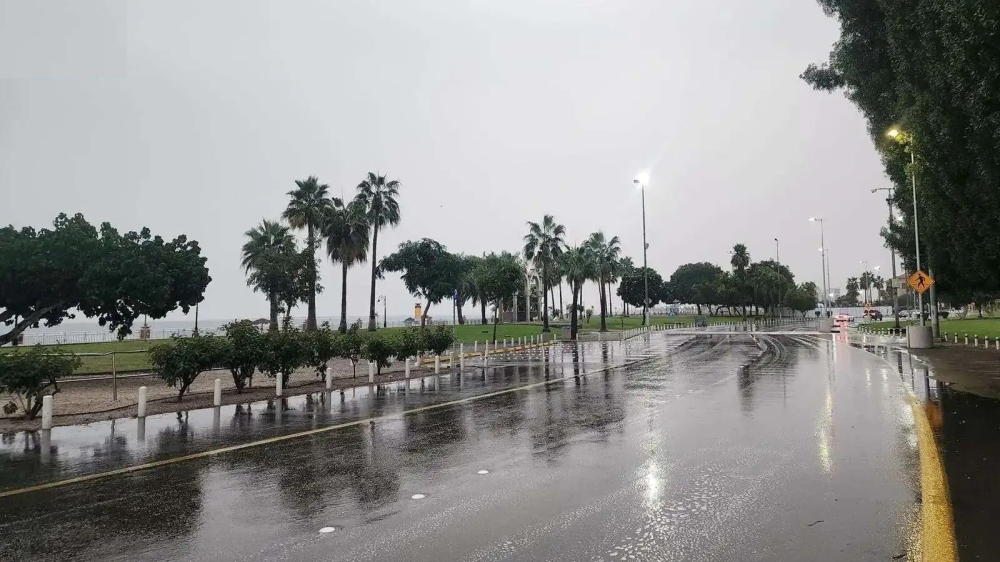
Thunderstorms and dust-raising winds today, Monday… Find out where they will occur.
The National Center of Meteorology expects in its weather report for today, Monday, across the Kingdom’s regions, that conditions are favorable for thunderstorms in parts of the Northern Borders, Al-Jawf, Tabuk, Hail, Al-Madinah Al-Munawwarah, Makkah Al-Mukarramah, and Al-Baha regions.
Meanwhile, active winds raising dust and sand will affect parts of those regions, as well as parts of the Riyadh and Al-Qassim regions.
The formation of fog is also not ruled out over parts of the Eastern Region and parts of the southwestern highlands of the Kingdom.
Red Sea
Surface winds: Southeasterly to southwesterly over the northern and central parts at speeds of 10-25 km/h, and southerly to southeasterly over the southern part at speeds of 20-45 km/h, reaching up to 55 km/h towards the Bab el-Mandeb Strait.
Wave height: From half a meter to one meter over the northern and central parts, and from one to two meters over the southern part, reaching over two and a half meters towards the Bab el-Mandeb Strait.
Sea state: Slight waves over the northern and central parts, moderate waves over the southern part, becoming rough towards the Bab el-Mandeb Strait.
Arabian Gulf
Surface winds: Northeasterly to northwesterly over the northern and central parts, and southwesterly to northwesterly over the southern part at speeds of 10-25 km/h.
Wave height: From half a meter to one meter.
Sea state: Slight waves.
Northern Borders
The Northern Borders region is a vast administrative area in Saudi Arabia, historically significant as a crossroads for ancient trade routes and home to archaeological sites like the pre-Islamic Rajajil standing stones. Its modern development is closely tied to the establishment of the Saudi state and its strategic location bordering Jordan and Iraq. Today, it is known for its desert landscapes, agricultural projects, and cultural heritage tied to Bedouin traditions.
Al-Jawf
Al-Jawf is a historical region in northwestern Saudi Arabia, known for its ancient oasis settlements and archaeological significance. It was home to the early kingdoms of Dadan and Lihyan, and later the Nabateans, serving as a crucial crossroads for frankincense trade routes. Key sites in the region include the ruins of the Marid Fortress and the carved tombs of Dedan.
Tabuk
Tabuk is a historic city in northwestern Saudi Arabia, best known for the site of the **Tabuk Fortress (Tabuk Castle)**. This Ottoman-era fortress, originally believed to date from around 1559, was a strategic station on the Levantine pilgrimage route and is associated with the Expedition of Tabuk led by the Prophet Muhammad in 630 CE. Today, it stands as a restored museum showcasing the region’s rich archaeological and Islamic history.
Hail
Hail is a historic region and city in northern Saudi Arabia, known for its central role in the traditional Najdi culture and as the historic seat of the influential Al Rashid dynasty in the 19th and early 20th centuries. It served as a major hub for trade and pilgrimage caravans crossing the Arabian Peninsula and is famed for its preserved desert fortresses, most notably **Barzan Palace** and **A’arif Fort**, which reflect its historical significance.
Al-Madinah Al-Munawwarah
Al-Madinah Al-Munawwarah (often called Medina) is a city in western Saudi Arabia of profound religious significance in Islam. It is the site where the Prophet Muhammad migrated to in 622 CE (an event known as the Hijrah), marking the beginning of the Islamic calendar, and it became the capital of the early Muslim community. The city is most famous for housing Al-Masjid an-Nabawi (the Prophet’s Mosque), which contains Muhammad’s tomb and is one of the two holiest sites in Islam.
Makkah Al-Mukarramah
Makkah Al-Mukarramah (often called Mecca) is the holiest city in Islam, located in present-day Saudi Arabia. It is the birthplace of the Prophet Muhammad and the site of the Kaaba, the most sacred shrine in Islam, which Muslims believe was originally built by the Prophet Abraham and his son Ishmael. Every year, millions of Muslims perform the Hajj pilgrimage to the city, a mandatory religious duty that dates back to the 7th century.
Al-Baha
Al-Baha is a scenic mountainous region in southwestern Saudi Arabia, historically significant as a crossroads for ancient trade routes and home to indigenous tribes like the Ghamid and Zahran. Its history is reflected in numerous stone-built villages and archaeological sites, such as the pre-Islamic fortresses at Zee Ain and the traditional Asiri mud-walled architecture. Today, it is known for its cool climate, dense forests, and as a growing tourist destination within the Kingdom.
Bab el-Mandeb Strait
The Bab el-Mandeb Strait is a crucial maritime chokepoint connecting the Red Sea to the Gulf of Aden and the Indian Ocean. Its name, meaning “Gate of Tears” in Arabic, is traditionally linked to the dangers of its narrow passage or to historic migrations. Strategically vital for global trade for millennia, it has been controlled by various regional powers and remains geopolitically significant today.