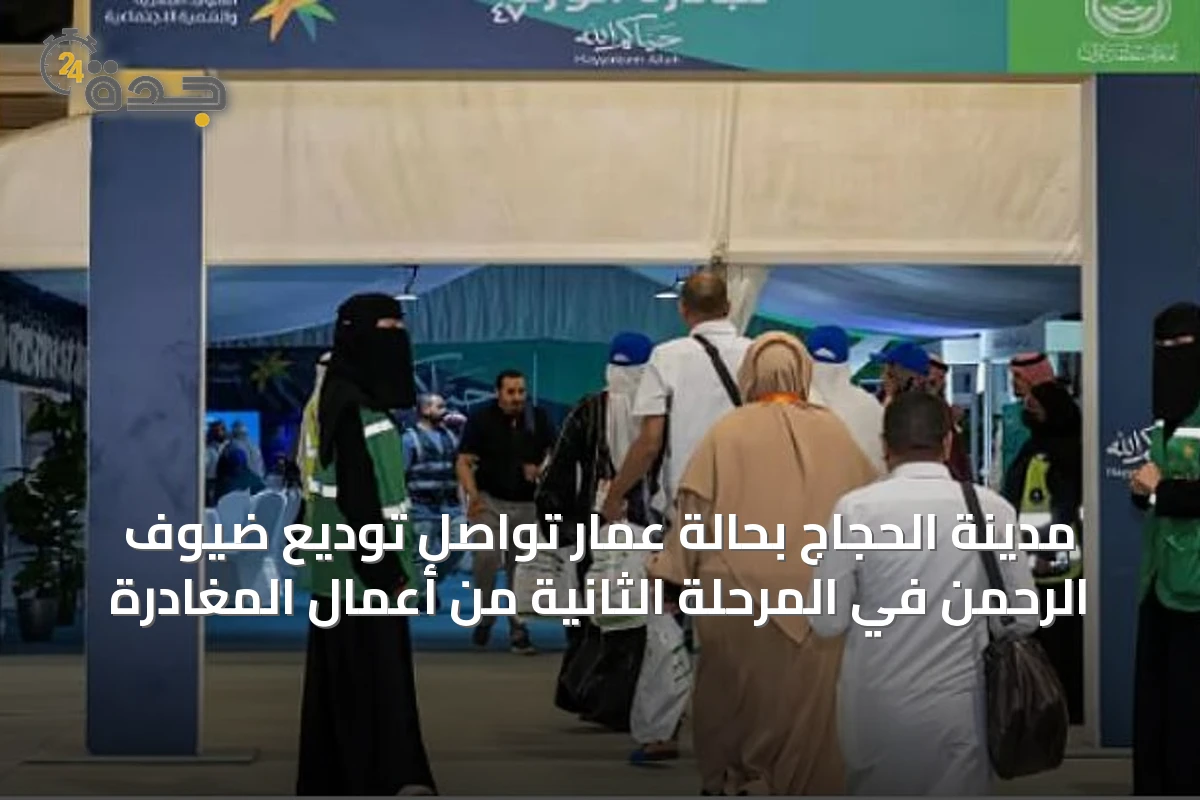
Under the follow-up of Prince Fahd bin Sultan bin Abdulaziz, Governor of the Tabuk Region and General Supervisor of Hajj affairs in the region, the Pilgrims’ City at the Halat Ammar border crossing continues implementing its second and final phase, concluding the journey of the guests of the Most Merciful who performed the Hajj rituals this year, within an integrated system of services and facilities that accompanied them from their arrival in the Kingdom until their departure to their home countries.
Continuous Departure Movement
The Pilgrims’ City is witnessing a continuous movement of pilgrims returning to their homelands after God blessed them with performing the rituals. Government and service agencies are working together in an integrated system aimed at facilitating procedures and providing necessary services with ease and smoothness, extending the success achieved during the reception phase when pilgrims arrived through the city and then to the holy sites.
Praise from the Guests of the Most Merciful
Several departing guests of the Most Merciful praised the facilities provided to them at the Pilgrims’ City in Halat Ammar during both the arrival and departure phases, commending the good organization and speed of completing procedures. They also expressed their happiness at receiving the gift of the Custodian of the Two Holy Mosques, consisting of a copy of the Holy Quran, praying to God to preserve the Kingdom and its leadership and to continue blessing it with security, safety, and stability.
Egyptian pilgrim Zainab Muhammad Abdel Hamid expressed her deep gratitude for the warm reception and generous hospitality she found from her arrival until her departure from the Halat Ammar border crossing, noting that movement between the holy sites was smooth and seamless, whether in Arafat, Muzdalifah, or during other transfers, which contributed to performing the rituals with ease and reassurance.
As for pilgrim Muhammad Ibrahim from Egypt, he confirmed that his spiritual journey was characterized by high smoothness and excellent organization, noting that the farewell feelings were very touching after the pilgrims’ attachment to the holy places over the past days, especially when bidding farewell to Mecca and performing the farewell circumambulation, moments he described as filled with emotions and tears.
Organization Reflecting Care
Pilgrim Essam Ammar said that what he witnessed in terms of the level of organization and services at the Pilgrims’ City in Halat Ammar reflects the extent of care that the Kingdom of Saudi Arabia provides to the guests of the Most Merciful, explaining that departure procedures were completed quickly and easily, with a comprehensive presence of working agencies that were keen to meet the pilgrims’ needs and provide the necessary facilities until the moment of their departure.
The Custodian of the Two Holy Mosques’ Gift Gives the Journey Additional Meaning
For his part, Egyptian pilgrim Muhammad Bakr expressed his happiness at receiving the gift of the Custodian of the Two Holy Mosques of the Holy Quran, saying: “Hajj is a great spiritual journey in itself, but to leave carrying a Quran gifted by the Custodian of the Two Holy Mosques gives the journey additional meaning and great moral value, and this Quran will remain among the most beautiful things we keep as a souvenir of these blessed days.” He praised the integrated services and facilitated facilities he found at the Pilgrims’ City in Halat Ammar, confirming that the good organization and speed of completing procedures reflected the extent of care the Kingdom provides to the guests of the Most Merciful.