Kenya allows US Ebola isolation facility
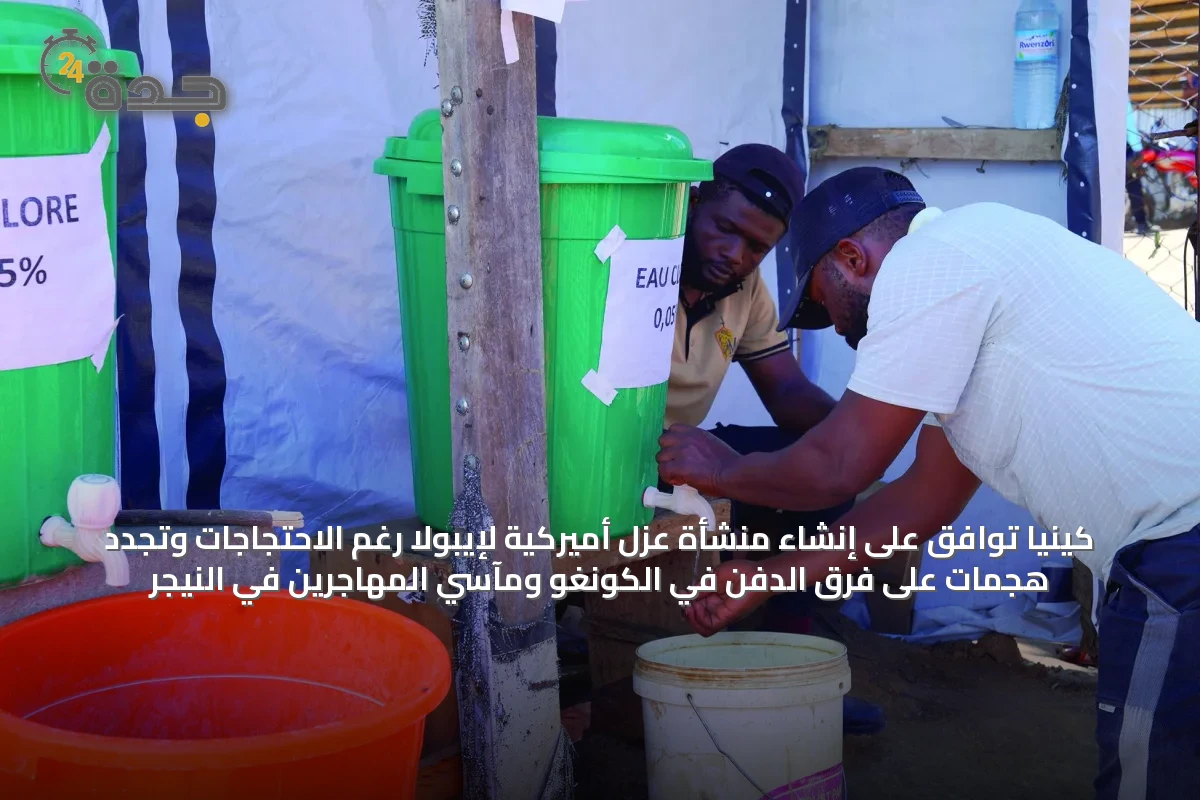
The Kenyan government confirmed yesterday its approval for the United States to establish a quarantine facility dedicated to Ebola within the country, despite widespread internal objections.
Kenyan President William Ruto stated during a press conference held during a state visit to South Africa that his country is doing the right thing and does not fear any contradiction in that statement.
Ruto added that it would be very unfortunate if the Americans requested to build such a facility at their own expense and Kenya refused, as it would make the country appear inhumane.
However, the US government continues to build the Ebola quarantine unit inside a Kenyan airbase, despite a Kenyan court order to suspend work and a wave of protests that resulted in at least two deaths in the town of Nanyuki in central Kenya.
The US embassy in Nairobi reported that it is cooperating with Kenyan authorities to address any concerns related to the project.
Renewed violence against teams burying Ebola victims in eastern Congo
In eastern Democratic Republic of Congo, attacks on response teams tasked with burying Ebola virus victims have resumed after residents assaulted a burial team in South Kivu province, raising fears of further spread of infection.
The attack occurred in the town of Katana, controlled by the “Congo River Alliance/March 23 Movement” rebels, about thirty kilometers north of the provincial capital Bukavu, according to the health ministry and a local hospital director who spoke to Reuters.
The targeted team specialized in “safe and dignified burial” and was trained to handle highly contagious corpses under strict protocols to prevent virus transmission.
According to a field report published Wednesday, local community members later handled the body, a high-risk practice that could lead to new chains of infection.
The health ministry and the hospital official did not specify the exact reason for the attack.
The incident highlights the level of mistrust and community resistance that continues to hinder response efforts, especially as residents are angry about strict medical protocols that conflict with local burial rituals; residents have launched at least four attacks against health centers in recent times.
While authorities seek to contain the spread of the “Bundibugyo” strain of the Ebola virus, several locals have questioned the causes of their relatives’ deaths.
The World Health Organization Director-General Tedros Adhanom Ghebreyesus urged residents during a visit to Congo earlier this week to follow “safe burial” procedures, warning that the bodies of Ebola victims are highly infectious.
He noted that the pain caused by losing a loved one is understandable, as is the importance of honoring them properly, but stressed the need to do everything possible to avoid losing others.
Epidemiologically, Congo has recorded 363 confirmed Ebola infections and 62 deaths since the announcement of the latest outbreak on May 15, which is the country’s seventeenth outbreak, according to the latest health ministry data.
Health authorities reported 19 new confirmed infections, including two deaths, in the latest update, while the infection has now spread to 17 of 36 health zones in Ituri province.
Recent days have seen a steady rise in infection numbers, with cases also recorded in seven health zones in North Kivu province and one health zone in South Kivu.
Despite these setbacks, the ministry noted some progress, stating that 32 contacts in the Rwampara area of Ituri were monitored for 21 days and found not to have Ebola.
The ministry also said officials in Goma, the capital of North Kivu, were preparing on Wednesday to discharge a patient who had recovered from the disease.
Freddy Kaniki, deputy coordinator of the “Congo River Alliance/March 23 Movement,” wrote on platform “X” on Wednesday that the patient had returned to her family.
Regarding global efforts, the World Health Organization acknowledged that it was slow to respond to the Ebola outbreak in Central Africa before response efforts gradually began.
Director-General Tedros Adhanom Ghebreyesus told journalists in Geneva: “We are still behind.”
He warned that contact tracing has only reached about 45 percent, and controlling the outbreak requires raising this rate to over 90 percent.
The Democratic Republic of Congo announced