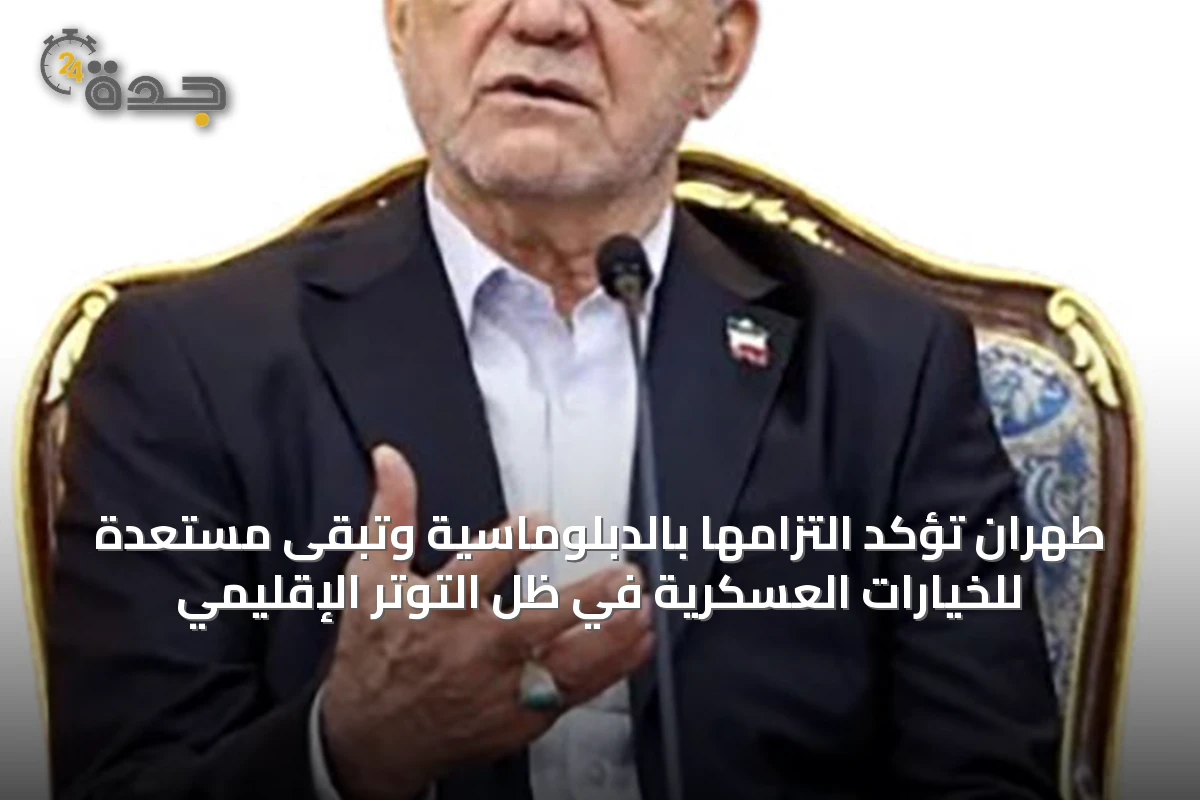
Iranian President Masoud Pezeshkian affirmed that the state is advancing on a diplomatic path aimed at ending the conflict in the Middle East region, but that does not mean abandoning any tools of military power or ceasing to defend its national interests. This statement came as part of Tehran’s effort to balance diplomatic efforts with field readiness amid escalating regional tensions.
Pezeshkian’s statements after the recent escalation
The President’s statements were issued in a post on platform X following a series of direct clashes between Iranian and Israeli forces, the first since the implementation of a ceasefire agreement two months ago. These events raised concerns about the potential collapse of the truce and the escalation of fighting on a wider scale.
In his statement, Pezeshkian described “defense and diplomacy as two pillars of national strength,” emphasizing that Iran has neither left the arena of conflict nor withdrawn from the negotiation table at the same time. He clarified that Tehran views the military and political tracks as integrated tools to protect its interests and enhance its position in negotiating sessions.
Cessation of military operations and declaration of calm
The President’s statements came hours after the Iranian armed forces announced the cessation of their operations directed against Israel. The central operations room of the armed forces, known as “Khatam al-Anbiya Headquarters,” reported that Iran carried out what it described as a “painful response” to the recent Israeli strikes, then declared the end of the military operation.
Despite the announcement of halting strikes, the military command affirmed that the calm would remain conditional on the cessation of any future Israeli attacks, warning that any new aggression, including operations in southern Lebanon, would be met with a harsher and stronger response.
Exchange of strikes between the two sides
The clashes began after Iran launched a missile attack on Israel in response to a bombing that targeted the southern suburb of Beirut, according to Iranian sources. Israel responded by targeting military sites and a petrochemical facility inside Iranian territory, and the exchange of strikes continued before the two sides moved towards announcements of calm.
Inclusion of any final agreement in Lebanon
Tehran acts on the basis that any final agreement to end the war must include a cessation of fighting in Lebanon, considering that regional issues are interconnected and cannot be addressed separately. In contrast, Israel prefers to handle the Iranian and Lebanese files independently, which is one of the most prominent points of disagreement hindering the negotiation process.
Observers indicate that Pezeshkian’s statements reflect Tehran’s desire to keep channels of dialogue open with the United States and international mediators, while simultaneously emphasizing that continuing negotiations does not preclude retaining deterrent options or accepting any regional changes imposed on the ground. The region awaits the outcomes of diplomatic efforts in terms of steps to solidify the truce and transform it into a more lasting agreement.
Khatam al-Anbiya Headquarters
Khatam al-Anbiya Headquarters is a major Iranian construction and engineering firm, originally established as a military-affiliated organization during the Iran-Iraq War in the 1980s. It is owned by the Islamic Revolutionary Guard Corps (IRGC) and has since expanded into large-scale infrastructure, oil, gas, and industrial projects both domestically and internationally. The headquarters is named after a religious term meaning “Seal of the Prophets,” reflecting its ideological roots.
Beirut
Beirut is the capital and largest city of Lebanon, with a history stretching back over 5,000 years. It was a major center of Phoenician, Roman, and Ottoman civilizations, and later became known as the “Paris of the Middle East” for its vibrant cultural and intellectual life. The city was heavily devastated by the Lebanese Civil War (1975–1990) and a massive port explosion in 2020, yet it remains a resilient hub of culture, commerce, and reconstruction.
<div class="my-4 p-4 rounded-lg shadow-md bg-blue
Khatam al-Anbiya Headquarters
The Khatam al-Anbiya Headquarters is the central command and logistical base of the Islamic Revolutionary Guard Corps (IRGC) in Iran, named after the Islamic concept of “Seal of the Prophets.” Established after the 1979 Iranian Revolution, it oversees the IRGC’s engineering, construction, and economic projects, including major infrastructure and defense initiatives. The headquarters has played a key role in Iran’s military and industrial development, particularly during and after the Iran-Iraq War.
Beirut
Beirut, the capital of Lebanon, is one of the world’s oldest continuously inhabited cities, with a history spanning over 5,000 years. It was a major center of the Roman and Byzantine empires, later becoming a key cultural and economic hub of the Ottoman Empire. Despite devastating damage during the Lebanese Civil War (1975–1990) and the 2020 port explosion, the city remains a resilient symbol of Middle Eastern culture, known for its vibrant arts scene and historic landmarks like the Roman Baths and the National Museum.
Lebanon
Lebanon is a country in the Middle East with a rich history dating back thousands of years, once home to the ancient Phoenician civilization known for its maritime trade and the creation of the alphabet. Its cultural sites, such as the ruins of Baalbek and the old city of Byblos, reflect influences from Roman, Ottoman, and French periods. Despite modern challenges, Lebanon remains known for its diverse heritage, vibrant cuisine, and resilient people.
Israel
Israel is a country in the Middle East with a rich and complex history, serving as the ancestral homeland of the Jewish people and a crossroads of major world religions, including Judaism, Christianity, and Islam. Modern Israel was established in 1948, following decades of Zionist movement and the British Mandate, and has since developed into a vibrant democracy with a dynamic culture and economy. The region hosts numerous historic and religious sites, such as Jerusalem’s Old City, the Western Wall, and the Dead Sea, reflecting millennia of civilization and conflict.
Iran
Iran, historically known as Persia, is a country in West Asia with a rich cultural heritage dating back thousands of years. It was home to one of the world’s oldest civilizations, the Elamites, and later became the center of the powerful Persian Empire under leaders like Cyrus the Great. Today, Iran is renowned for its stunning Islamic architecture, poetic traditions, and significant sites such as Persepolis and the ancient city of Isfahan.
United States
The United States is a vast, diverse nation in North America, originally formed by 13 British colonies that declared independence in 1776. Its history includes westward expansion, the Civil War over slavery, and emergence as a global superpower in the 20th century. Culturally, it is a melting pot of influences from around the world, known for landmarks like the Statue of Liberty, the Grand Canyon, and Hollywood.
Middle East
The Middle East is a historically and culturally rich region spanning from Egypt to Iran, often considered the cradle of civilization, where ancient empires like Mesopotamia, Persia, and Egypt flourished. It is the birthplace of three major religions—Judaism, Christianity, and Islam—and has been a crossroads for trade, culture, and conflict for millennia. Today, the region is known for its diverse societies, significant oil reserves, and ongoing geopolitical tensions.
Southern Lebanon
Southern Lebanon is a historically rich region known for its ancient Phoenician cities like Tyre and Sidon, which were major maritime powers in antiquity. In modern times, it has been a focal point of conflict, including Israeli occupations and Hezbollah’s strong presence, shaping its complex cultural and political landscape. The area also features fertile plains, olive groves, and significant archaeological sites that reflect its layered heritage.