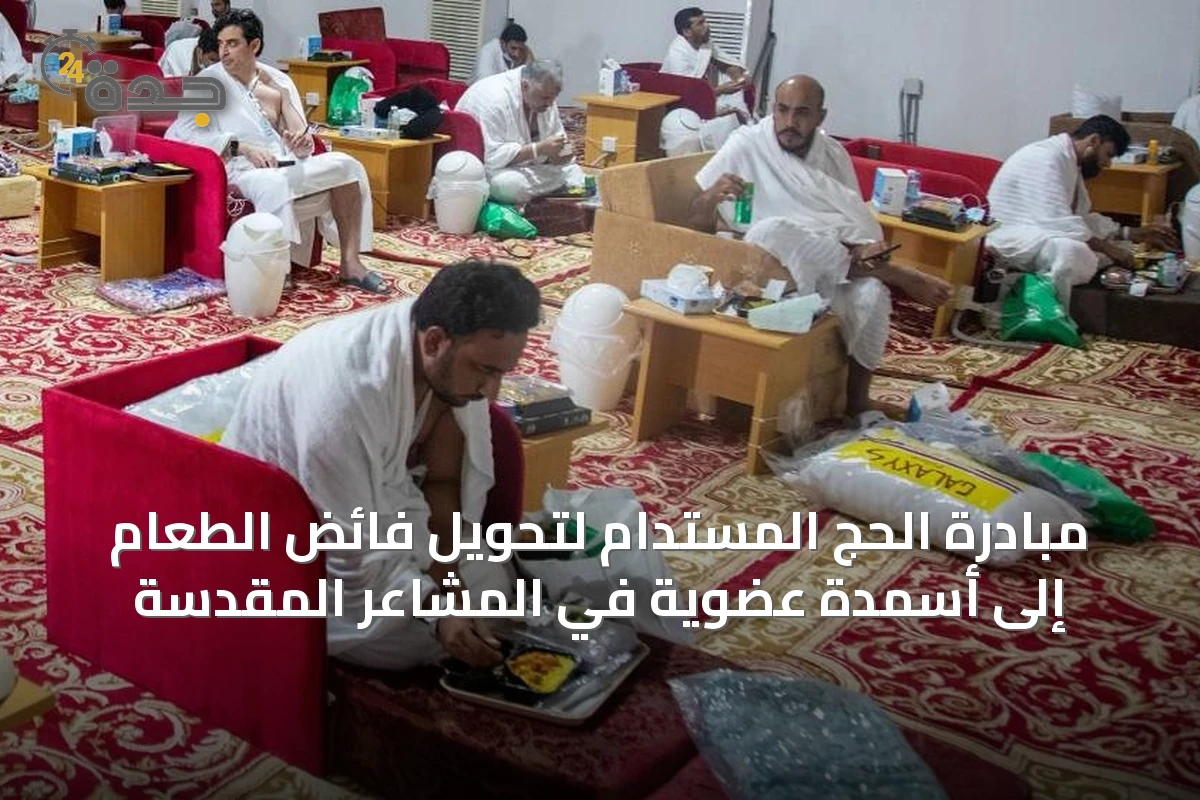
The “Sustainable Hajj Initiative” aims to address the problem of food waste during the Hajj season by providing a specialized device for recycling surplus food. This device is designed to reduce waste levels and carbon emissions, while preserving resources in the holy sites, creating a documented environmental and community impact, and turning excess into a lasting effect for years.
Supporting Vision 2030 and the Saudi Green Initiative
This initiative is part of a national project aligned with the Kingdom’s Vision 2030, in addition to the “Saudi Green Initiative” and the goals of serving the guests of God. It aims to make Mecca and the holy sites a global model in the fields of sustainability and circular economy.
Converting Surplus into Soil Conditioners
The initiative converts food surplus into soil conditioners and organic fertilizers, contributing to environmental service and enhancing sustainability. This process represents an opportunity to create a real impact during the region’s greatest season, showcasing a practical model of partnership and cooperation among entities and sectors supporting the initiative.
A Model of Partnership and Cooperation
The initiative highlights the importance of cooperation among various entities and sectors to activate the process of converting food surplus into organic fertilizers. This collaboration helps strengthen joint efforts to reduce waste and achieve environmental sustainability goals in the holy sites.
Future Prospects for the Initiative
By documenting the environmental and social impact of the initiative, it contributes to building a knowledge base that enhances the applications of the circular economy in major events in the future, and demonstrates the possibility of expanding this experience to include other areas within the Kingdom and beyond.
Mecca
Mecca, located in Saudi Arabia, is the holiest city in Islam, revered as the birthplace of the Prophet Muhammad. Its history dates back thousands of years, centered around the Kaaba, a sacred structure believed to have been built by Abraham and Ishmael. As the destination of the annual Hajj pilgrimage, Mecca has been a pivotal religious and cultural hub for Muslims worldwide since the 7th century.
Holy Sites
“Holy Sites” typically refers to locations of profound religious significance, such as the Church of the Holy Sepulchre in Jerusalem, the Kaaba in Mecca, and the Western Wall in Jerusalem. These sites have deep historical roots, often dating back thousands of years, and are central to the faiths of Christianity, Islam, and Judaism. They continue to serve as major pilgrimage destinations, drawing millions of visitors annually for worship and reflection.
Mecca
Mecca is the holiest city in Islam, located in western Saudi Arabia. It is the birthplace of the Prophet Muhammad and the site of the Kaaba, the sacred structure within the Masjid al-Haram mosque that Muslims face during prayer. Historically, Mecca has been a major center for pilgrimage for centuries, and it is the destination of the Hajj, a religious duty that all able Muslims must undertake at least once in their lifetime.
Holy Sites
“Holy Sites” typically refers to locations of profound religious significance, such as Jerusalem’s Western Wall, the Church of the Holy Sepulchre, and the Dome of the Rock. These sites have deep historical roots, dating back thousands of years, and are central to Judaism, Christianity, and Islam. They continue to serve as major pilgrimage destinations, symbolizing faith, heritage, and cultural intersection.
<div class="my-4 p-4 rounded-lg shadow-md bg
Mecca
Mecca is the holiest city in Islam, located in modern-day Saudi Arabia, and is the birthplace of the Prophet Muhammad. Its history as a religious center dates back to pre-Islamic times, but it became the focal point of the Muslim faith after the Prophet’s revelations and the establishment of the Kaaba as the qibla (direction of prayer). Today, millions of Muslims travel to Mecca each year for the Hajj pilgrimage, a key religious duty for those who are able.
Holy Sites
“Holy Sites” typically refers to locations of profound religious significance, such as Jerusalem’s Western Wall, the Church of the Holy Sepulchre, and the Dome of the Rock, each central to Judaism, Christianity, and Islam respectively. These ancient sites have been centers of worship, pilgrimage, and conflict for millennia, reflecting a complex history of shared sacred geography. Their enduring spiritual importance continues to draw millions of visitors and worshippers from around the world.
Kaaba
The Kaaba is a cube-shaped building located in the center of the Grand Mosque in Mecca, Saudi Arabia, and is the most sacred site in Islam. According to Islamic tradition, it was originally built by the Prophet Abraham and his son Ishmael as a house of monotheistic worship, and it has served as the direction of prayer (qibla) for Muslims worldwide for over 1,400 years. Pilgrims circle the Kaaba during the Hajj and Umrah pilgrimages, a practice that dates back to pre-Islamic times but was later purified by the Prophet Muhammad.
Masjid al-Haram
Masjid al-Haram, also known as the Grand Mosque, is the holiest site in Islam, located in Mecca, Saudi Arabia. It surrounds the Kaaba, which Muslims believe was built by the Prophet Abraham and his son Ishmael, and has been a place of pilgrimage for centuries. The mosque has undergone numerous expansions throughout history, most notably in recent decades to accommodate the millions of pilgrims who visit during the Hajj and Umrah.
Church of the Holy Sepulchre
The Church of the Holy Sepulchre in Jerusalem is one of Christianity’s most sacred sites, believed to encompass both the crucifixion and the tomb of Jesus Christ. Originally built by Emperor Constantine in the 4th century, it has been destroyed and rebuilt multiple times, with the current structure dating largely from the Crusader period. Today, it is jointly managed by several Christian denominations, reflecting centuries of complex religious history.
Western Wall
The Western Wall, also known as the Wailing Wall, is a sacred Jewish prayer site in Jerusalem’s Old City, and is the last remaining retaining wall of the Second Jewish Temple, which was destroyed by the Romans in 70 CE. For centuries, it has been a place of pilgrimage, mourning, and prayer for Jews worldwide, who come to place handwritten notes of wishes and pleas into its ancient stone crevices. Today, it remains one of Judaism’s holiest sites and a powerful symbol of Jewish resilience and faith.
Dome of the Rock
The Dome of the Rock is an iconic Islamic shrine located on the Temple Mount in Jerusalem, built between 687 and 691 CE by Caliph Abd al-Malik. It enshrines the Foundation Stone, a sacred site in Judaism, Christianity, and Islam, where Muslims believe the Prophet Muhammad ascended to heaven during the Night Journey. Its golden dome and intricate mosaics make it one of the oldest and most recognizable examples of early Islamic architecture.