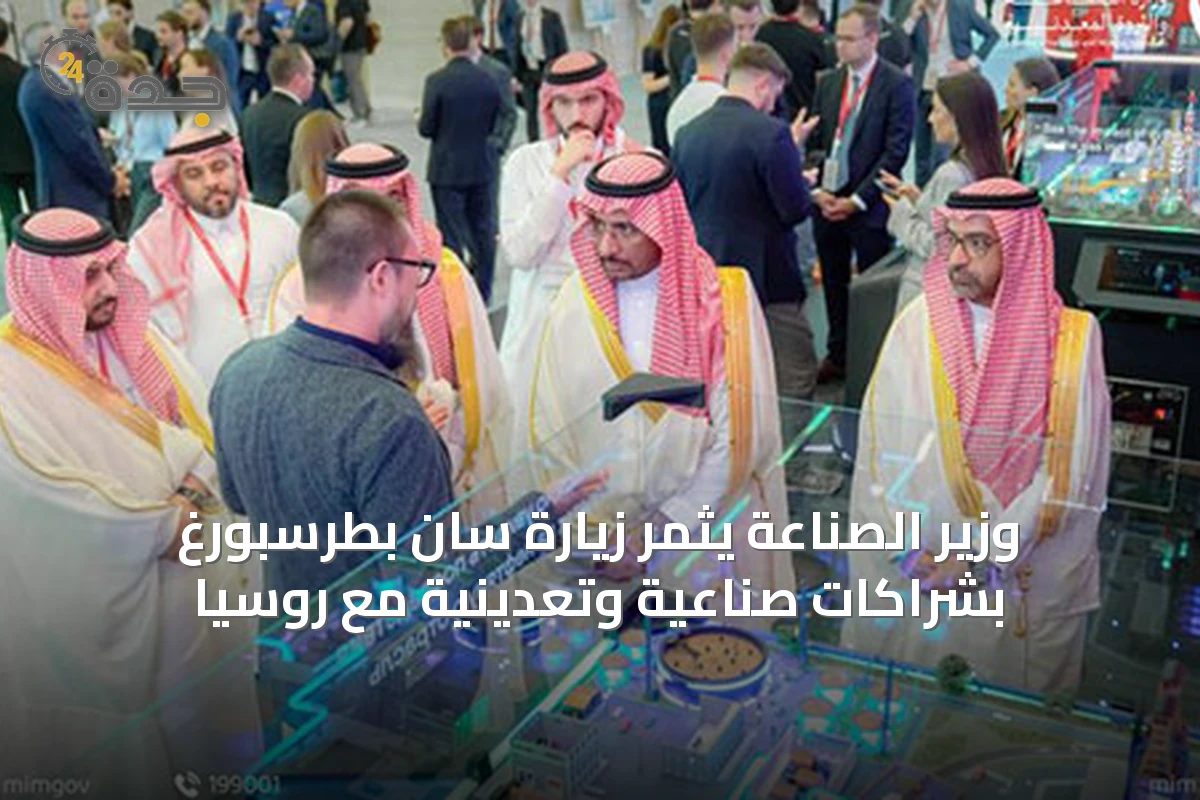
The Minister of Industry and Mineral Resources, Bandar bin Ibrahim Al-Khorayef, concluded his participation with the official Saudi delegation at the St. Petersburg International Economic Forum. The aim was to enhance the Kingdom’s presence in international economic forums, expand strategic partnerships in the industrial and mining sectors, and present available investment opportunities.
Minister participates in the St. Petersburg International Economic Forum
The minister took part in several panel discussions and forum events, where he met with Russian officials to explore ways to strengthen economic cooperation and attract mutual investments.
Technical visits and scientific cooperation
He visited the Russian Karpinsky Institute, where he learned about the latest methods in geological mapping and mineral resource exploration. He also inspected the Kronstadt Engineering Center and discussed with experts there the potential for knowledge exchange in industrial and technical fields.
Signing of a strategic partnership agreement
The minister witnessed the signing ceremony of a strategic cooperation document between the Saudi Authority for Industrial Cities and Technology Zones (Modon) and the Directorate of Entrepreneurship and Innovation Development in Moscow, aimed at enhancing bilateral cooperation between the two countries.
St. Petersburg
St. Petersburg, founded in 1703 by Tsar Peter the Great, served as the imperial capital of Russia for over two centuries. Known for its stunning baroque and neoclassical architecture, including the Winter Palace and the Hermitage Museum, the city was a center of cultural and political life. It was renamed Petrograd during World War I and Leningrad during the Soviet era, before reclaiming its original name in 1991.
St. Petersburg International Economic Forum
The St. Petersburg International Economic Forum (SPIEF) is a major annual global business event held in Russia since 1997, focusing on economic development, investment, and international cooperation. It originated as a platform to discuss Russia’s economic challenges and opportunities, and has since grown into a key venue for high-level political and corporate dialogue. The forum typically attracts world leaders, CEOs, and experts to address pressing global issues, though its prominence has been shaped by shifting geopolitical contexts.
Russian Karpinsky Institute
The Russian Karpinsky Institute, officially the A.P. Karpinsky Russian Geological Research Institute (VSEGEI), is a leading geological research center based in St. Petersburg, Russia. Founded in 1882 as the Geological Committee of Russia, it was later renamed in honor of the renowned geologist Alexander Karpinsky. The institute is renowned for its extensive work in regional geological mapping, mineral resource assessment, and the study of Russia’s vast geological heritage.
Kronstadt Engineering Center
The Kronstadt Engineering Center, located on Kotlin Island in the Gulf of Finland, is a historic facility that played a key role in the development and maintenance of the Russian Navy’s maritime engineering and technology. Established in the 19th century as part of the Kronstadt naval fortress, it served as a hub for designing, testing, and repairing naval equipment, including early submarine and torpedo systems. Today, the site stands as a testament to Russia’s naval engineering heritage, with some of its original workshops and structures preserved as part of the broader Kronstadt historical complex.
<h3 class="text-lg font-semibold mb-2 text-blue-800
St. Petersburg
St. Petersburg, founded in 1703 by Tsar Peter the Great, served as the imperial capital of Russia for over two centuries and is renowned for its grand architecture and canals. The city was the epicenter of the 1917 Russian Revolution, which led to the end of the Romanov dynasty. Today, it is a major cultural hub, home to world-famous landmarks like the Hermitage Museum and the Church of the Savior on Spilled Blood.
St. Petersburg International Economic Forum
The St. Petersburg International Economic Forum (SPIEF) is a major annual global conference held in Russia, focusing on economic, business, and geopolitical issues. Established in 1997, it has grown into a key platform for international dialogue, attracting world leaders, top executives, and experts to discuss investment opportunities and global challenges. The forum plays a significant role in shaping Russia’s economic policy and fostering international cooperation.
Russian Karpinsky Institute
The Russian Karpinsky Institute, officially known as the A.P. Karpinsky Russian Geological Research Institute (VSEGEI), is one of the world’s leading geological research centers. Founded in 1882 in St. Petersburg as the Geological Committee of Russia, it was later named after renowned geologist Alexander Karpinsky. The institute has played a key role in mapping Russia’s mineral resources and studying its geological structure for over a century.
Kronstadt Engineering Center
The Kronstadt Engineering Center is a historic site in Kronstadt, Russia, originally established in the 18th century as part of the city’s naval fortifications. It served as a hub for military engineering and shipbuilding innovations, playing a key role in the defense of St. Petersburg. Today, it stands as a monument to Russian maritime engineering heritage and is often included in tours of Kronstadt’s historic landmarks.
Winter Palace
The Winter Palace in St. Petersburg, Russia, served as the official residence of the Russian emperors from 1732 to 1917. Constructed between 1754 and 1762 in a lavish Baroque style, it was the site of the Bloody Sunday massacre in 1905 and later the storming by Bolsheviks in 1917, which marked a pivotal moment in the Russian Revolution. Today, it forms the main building of the State Hermitage Museum, housing one of the world’s largest and most prestigious art collections.
Hermitage Museum
The Hermitage Museum in Saint Petersburg, Russia, is one of the largest and oldest art museums in the world. Founded in 1764 by Catherine the Great, it began as a private collection of paintings housed in the Winter Palace, the former imperial residence. Today, the museum complex spans several historic buildings and holds over three million items, including masterpieces by Leonardo da Vinci, Rembrandt, and Picasso.