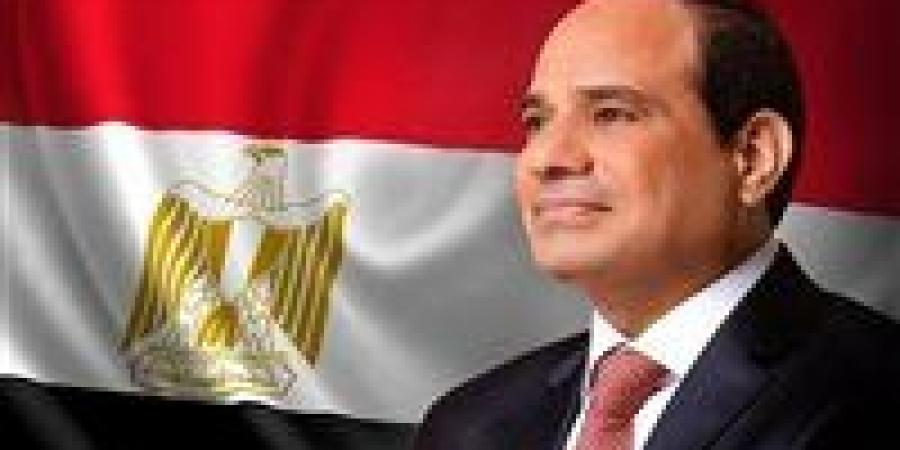
President Sisi’s Sinai Liberation Day speech demonstrates the strength of the Egyptian state.
The Will of a Generation Party: President Sisi’s Speech on Sinai Liberation Day Reflects the Strength of the Egyptian State
The Deputy Head of the Will of a Generation Party stated that President Abdel Fattah el-Sisi’s speech on the forty-fourth anniversary of the liberation of Sinai expressed a critical phase the Egyptian state is going through, where regional challenges intersect with international changes, requiring a clear address that strengthens confidence in state institutions, which was indeed achieved in the president’s speech.
The Will of a Generation Party: President Sisi’s Speech on Sinai Liberation Day Reflects the Strength of the Egyptian State
He explained that the Egyptian state has presented a unique model in handling the Sinai file by combining security decisiveness with a developmental vision, which led to fully restoring stability and creating an environment conducive to attracting investments and implementing major projects in various sectors.
He emphasized that the president’s speech reflected a deep understanding of the nature of the current stage, as it stressed the importance of preserving Egyptian national security and preventing any attempts to undermine the state’s stability or influence its independent national decision, noting that Egypt has become a key player in its regional environment thanks to its balanced policies.
The Deputy Head of the Will of a Generation Party added that the achievements in Sinai did not come from nothing, but were the result of careful planning and strong political will that managed to overcome challenges and impose a new reality based on development and stability.
He called on all Egyptians to draw inspiration from the spirit of the October victory and the memory of Sinai’s liberation, and to continue supporting state institutions and political leadership, affirming that the current stage requires comprehensive national awareness to face challenges and preserve the nation’s gains.
Sinai
Sinai is a mountainous desert region in Egypt, best known as the biblical site where Moses received the Ten Commandments on Mount Sinai. Historically, it has served as a crossroads for trade and conflict between Africa and Asia, and it was under Ottoman and British control before returning to Egyptian sovereignty. Today, it is a significant pilgrimage destination for Christians, Jews, and Muslims, as well as a popular tourist area for its Red Sea coral reefs and ancient monasteries like St. Catherine’s.
Egyptian State
The Egyptian State, one of the world’s oldest continuous civilizations, emerged around 3100 BCE with the unification of Upper and Lower Egypt under the first pharaoh. Renowned for its monumental achievements like the pyramids and hieroglyphic writing, it was a center of power and culture for millennia before being influenced by Persian, Greek, Roman, and Arab conquests. Today, Egypt is a modern republic in North Africa, known for its rich historical legacy and iconic sites along the Nile.
Sinai Liberation Day
Sinai Liberation Day, celebrated on April 25th in Egypt, marks the final return of the Sinai Peninsula to Egyptian sovereignty in 1982 after its occupation by Israel following the 1967 Six-Day War. The event commemorates the successful implementation of the 1979 Egypt-Israel Peace Treaty, which led to the phased withdrawal of Israeli forces. It is a national holiday honoring Egypt’s territorial integrity and the sacrifices made to reclaim the land.
October victory
The October Victory Monument, often associated with significant military triumphs in various countries, typically commemorates historical battles won during the month of October. One prominent example is the October Victory Monument in Ethiopia, which honors the victory of the Ethiopian army over Italian forces at the Battle of Adwa in 1896, though the battle actually occurred in March. The site serves as a symbol of national pride and resistance against colonialism, preserving the memory of those who fought for sovereignty.
<div class="
Sinai
Sinai is a mountainous peninsula in Egypt, historically significant as the region where, according to the Bible, Moses received the Ten Commandments at Mount Sinai. For centuries, it has been a crossroads for trade, pilgrimage, and conflict between Africa and Asia, home to the ancient St. Catherine’s Monastery, one of the oldest working Christian monasteries in the world. Today, it is known for its rugged desert landscapes and Red Sea coral reefs, attracting both religious pilgrims and tourists.
Egyptian State
The Egyptian state is a modern nation with a history stretching back over 5,000 years, centered along the Nile River. It is famous for its ancient civilization, which built the pyramids and developed one of the world’s first writing systems, hieroglyphics. Today, Egypt is a major political and cultural power in the Arab world and Africa, with its capital in Cairo.
Sinai Liberation Day
Sinai Liberation Day, celebrated annually on April 25th in Egypt, marks the complete withdrawal of Israeli forces from the Sinai Peninsula in 1982 following the 1979 Egypt-Israel Peace Treaty. The day commemorates Egypt’s successful efforts to reclaim its full sovereignty over the strategic region, which was occupied by Israel after the 1967 Six-Day War. It is a national holiday honoring the sacrifices made to restore Egyptian territorial integrity.
October victory
The October Victory, also known as the October Revolution, refers to a key event in Russian history in 1917 when the Bolshevik Party, led by Vladimir Lenin, overthrew the Provisional Government. This revolution established the world’s first communist state, the Russian Soviet Federative Socialist Republic, and set the stage for the formation of the Soviet Union in 1922. It is commemorated with monuments and museums in Russia, notably in St. Petersburg, where the historic storming of the Winter Palace took place.