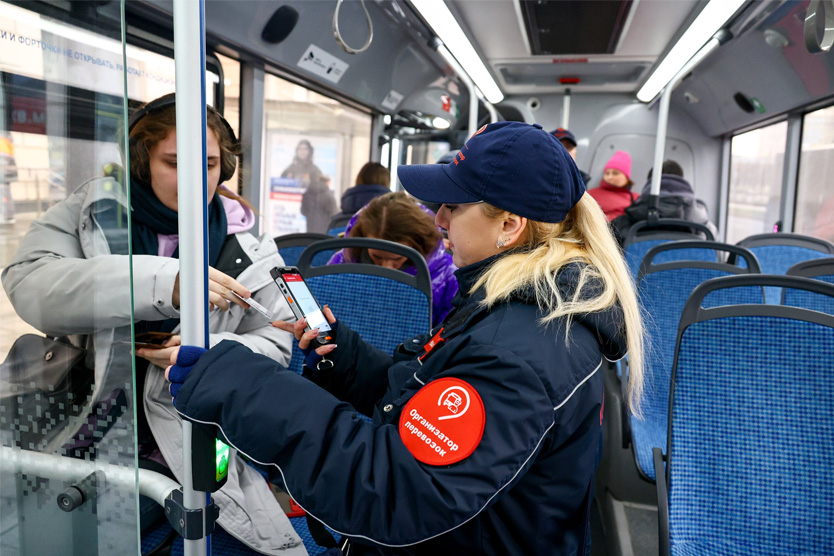
High fines, raids, and inspector immunity: how and why Moscow has intensified the crackdown on fare dodgers.
“Fare dodgers” are as old as public transport itself. Initially, money was collected on trams, and later on trolleybuses and buses, by conductors—one per carriage or cabin. But even 100 years ago, some people managed to ride without paying—sometimes with the knowledge of the transport workers: this is well described in the memoirs of Konstantin Paustovsky, who himself in his youth “ticketed” passengers on a tram.
“Today’s passenger,” said Babayev, “is weak-nerved. You have to make allowances for him. You must show goodwill towards the passenger, and even give some a free ride. For example, by the way a person climbs into the carriage, I already know he wants to ride without a ticket. By the expression on his face. You see that a person needs to travel, but he’s hiding from you in the carriage—that means he’s broke. So you don’t pester such a passenger for a ticket. Pretend as if you’ve already given him a ticket, and even with the appropriate dramatic flair. In every field, you must show leniency towards people, and in our conductor service—especially. We deal with all of Moscow. And in Moscow, there’s as much human grief as there is sand in the sea.”
In the 1960s, conductors in Moscow were abolished along with zonal fare payment. Instead, cash boxes were installed in cabins and carriages where you had to drop coins to turn a drum and pull out a ticket. These boxes were accompanied by the inscription “Conscience is the best inspector,” and the whole system seemed logical for a city advancing towards communism (by 1980, as Nikita Khrushchev stated at the XXII Party Congress, we were supposed to have already built this ideal system).
A new reform followed in 1985–1987: in the summer, the payment system changed overnight. A single fare of 5 kopecks per trip applied to all types of transport (previously, a tram ride cost 3 kopecks, a trolleybus—4, and a bus and metro—5). Paper tickets (also called coupons) had to be purchased at ticket offices or from drivers. The fine for fare evasion then was 6 Soviet rubles—the cost of a monthly unlimited metro and surface transport pass.
The system with paper coupons operated (though, of course, with different fares) in the 1990s as well. But conscience as an inspector, of course, no longer worked; and there were far fewer inspectors themselves. Therefore, for several years, conductors with thick bags on their belts returned to Moscow’s surface transport (only on some routes). Their “renaissance” lasted from the mid-1990s to 2005, when an Automated Fare Control System (AFCS) began to be introduced on surface transport. With this system, only a single front door worked for entry, behind which stood a validator and a turnstile. In the 2010s, when turnstiles were abolished, entering and exiting became much more convenient again. Validators remained—now they are located at practically every door of the cabin.
How Fare Payment is Checked in Moscow Transport
Fare control in Moscow has been handled since 2011 by the State Public Institution “Transport Organizer”—this function was transferred to the institution from the carrier (“Mosgortrans”). Inspectors of this organization have the authority to:
issue fines for fare evasion and other administrative offenses on transport to citizens over 16 years old;
demand identification from a fare dodger to issue a fine, handing the document back directly;
call the police to take a fare dodger without documents to a police station;
block a social card travel pass if it was used by another person.
At the same time, an inspector is obliged to be polite and present identification upon request from passengers.
Fare Dodgers Who Turned Feral
Attacks on inspectors became a
Moscow
Moscow is the capital and largest city of Russia, with a history dating back over 800 years to its first recorded mention in 1147. It grew from a medieval fortress (the Kremlin) into the political and cultural heart of the Russian state, serving as the capital of the Tsardom, the Soviet Union, and the modern Russian Federation. Today, it is a global metropolis renowned for iconic landmarks like Red Square, St. Basil’s Cathedral, and the Kremlin itself.
XXII Party Congress
The “XXII Party Congress” refers to the 22nd Congress of the Communist Party of the Soviet Union, held in Moscow from October 17 to 31, 1961. It is historically notable for its public denunciation of Stalinism, including the decision to remove Joseph Stalin’s body from the Lenin Mausoleum, and for Nikita Khrushchev’s proclamation that the USSR would achieve communism within 20 years.
Nikita Khrushchev
Nikita Khrushchev was a person, not a place or cultural site. He was the leader of the Soviet Union from 1953 to 1964, known for his role in the de-Stalinization process and for the Cuban Missile Crisis. His political career and the era he led are significant parts of 20th-century Soviet and world history.
State Public Institution ‘Transport Organizer’
The State Public Institution ‘Transport Organizer’ is a government body in Moscow, Russia, responsible for managing and coordinating the city’s public transportation network. It was established to centralize and improve the efficiency of transport services, including buses, trams, and trolleybuses, particularly during major events. Its history is tied to Moscow’s ongoing efforts to modernize its transit infrastructure and reduce traffic congestion in the 21st century.
Mosgortrans
“Mosgortrans” is the common name for the Moscow Municipal Transport Company, the primary operator of public ground transportation in Moscow, Russia. It was established in 1958 to consolidate and manage the city’s extensive network of buses, trolleybuses, and trams. Today, it remains a vital part of Moscow’s infrastructure, having evolved from Soviet-era systems into a modernized service integral to daily life in the capital.
Automated Fare Control System (AFCS)
The Automated Fare Control System (AFCS) is not a specific cultural site or place, but a technological infrastructure used for managing electronic ticketing and access in public transit networks. Its history is tied to the late 20th-century shift from paper tickets and tokens to computerized, contactless smart card systems, which began gaining widespread adoption in the 1990s. These systems, like Singapore’s EZ-Link (2002) or London’s Oyster card (2003), revolutionized urban transport by enabling faster boarding and integrated fare management.
social card travel pass
A social card travel pass is not a specific place or cultural site, but a government-issued program, often in the form of a card or pass, that provides subsidized or free public transportation to eligible groups such as students, seniors, or low-income residents. These programs are common in many cities and countries, with their history rooted in social welfare policies from the 20th century aimed at promoting equity, accessibility, and reducing transport poverty. For example, the London Freedom Pass for seniors and disabled residents originated from the Greater London Council’s welfare initiatives in the 1970s.
police station
A police station is a local facility for law enforcement officers, historically evolving from informal watch systems in ancient civilizations to organized municipal forces in the 19th century. Today, it serves as an operational base for crime prevention, public assistance, and community policing. Its design and role reflect the legal and social order of the society it serves.