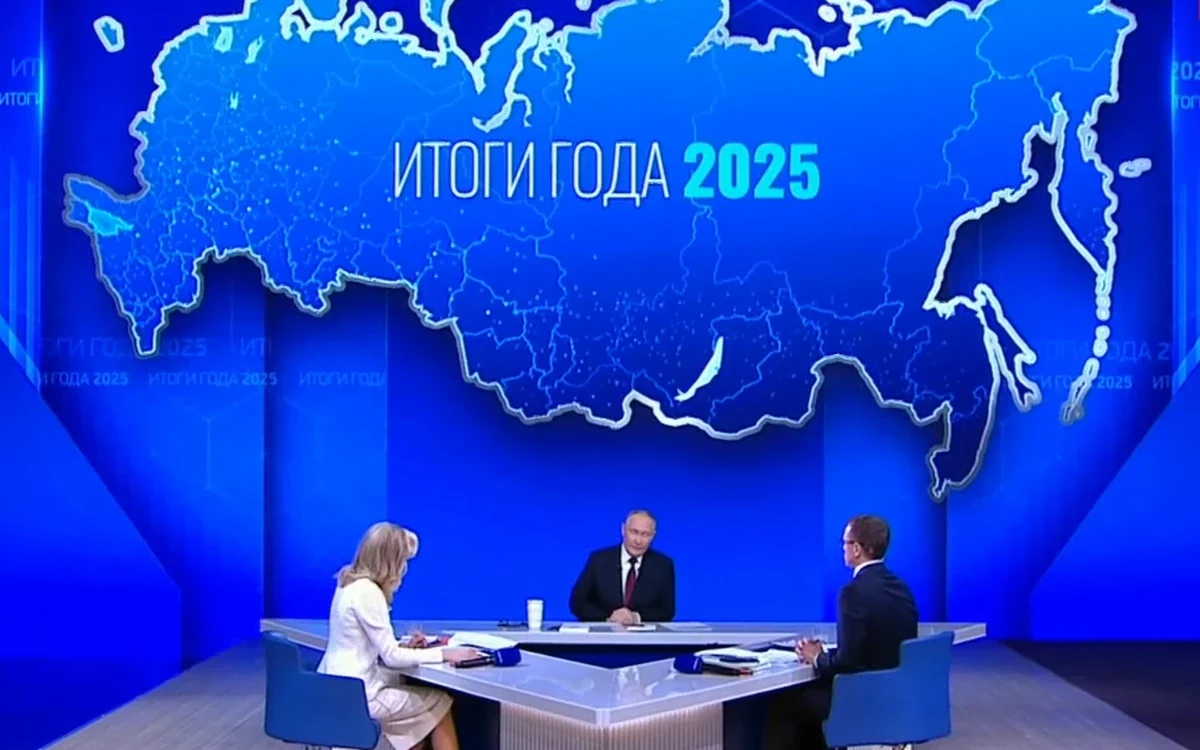
Russian President Vladimir Putin traditionally answered appeals from the country’s residents and questions from journalists in a live broadcast on December 19.
In just two weeks, 3.1 million questions were sent to the head of state from all corners of Russia via various channels. In 4 hours and 27 minutes, Vladimir Putin managed to cover over 70 topics.
— Russia’s actions in Ukraine are aimed at eliminating the root causes. It all started with the 2014 coup in Ukraine. The Russian Federation is ready and willing to resolve the conflict peacefully.
— Russian troops are successfully conducting their operation in Ukraine. In the near future, Krasny Lyman, Konstantinovka, Gulyaipole, and Dimitrov will come under the control of the Russian Armed Forces, with advancement towards Slavyansk continuing.
— More than 400,000 people have signed contracts with the Russian Ministry of Defense in 2025. The number of people wishing to serve in the recently created branch of Unmanned Systems Troops is increasing.
— The generation of the 90s is the backbone of the country. About 700,000 servicemen are in the special military operation zone — the majority are representatives of this generation.
— The unemployment rate in Russia has reached a historic low — 2.2%. The country maintains a good pace of real wage growth — they have increased by 4.5% over the year.
— Increasing the VAT. Increasing the value-added tax was “the most correct, honest, and transparent” way to solve tasks, including in the financial sphere.
— Russia has no problems related to fulfilling social obligations. The country has managed to balance the budget. It is now at the level of 2021.
— The number of crimes by phone scammers has decreased by 40%, and the damage from their actions has decreased by 33%. The head of state advised immediately hanging up if the caller starts talking about money.
— Average food price indicators often raise questions because they usually do not match what a person encounters in real life. The authorities are closely monitoring what is happening in each segment.
— Reducing support for large families when their work income increases on the part of the Russian Government is a mistake. It is necessary to maintain payments for the third child until the age of three.
— More work needs to be done with children. A family should not feel a decrease in their standard of living with the birth of a child.
— Demographic programs will be expanded in Russia. It is better not to postpone having a child — waiting for improved financial conditions, obtaining an education, and other things can go on indefinitely.
— There will be no mandatory distribution of medical graduates to cities. Starting March 1, 2026, it will be necessary to work in a targeted placement only after completing a residency.
— Increasing the recycling fee in Russia is a fair measure. The measure applies to fairly expensive cars and affects Russians with at least average, good incomes, mainly in large cities, and is necessary for “solving a noble goal.”
— Preferential medicines are available in pharmacies. All necessary funds to provide beneficiaries with medicines have been delivered to the regions in full.
— The main problem with foreign messengers is their refusal to comply with Russian laws, therefore blocking them was necessary for Russia.
— In 200 years, the Russian Federation will be a technological leader and will use these technologies to solve all tasks in the fields of economy, healthcare, and social policy.