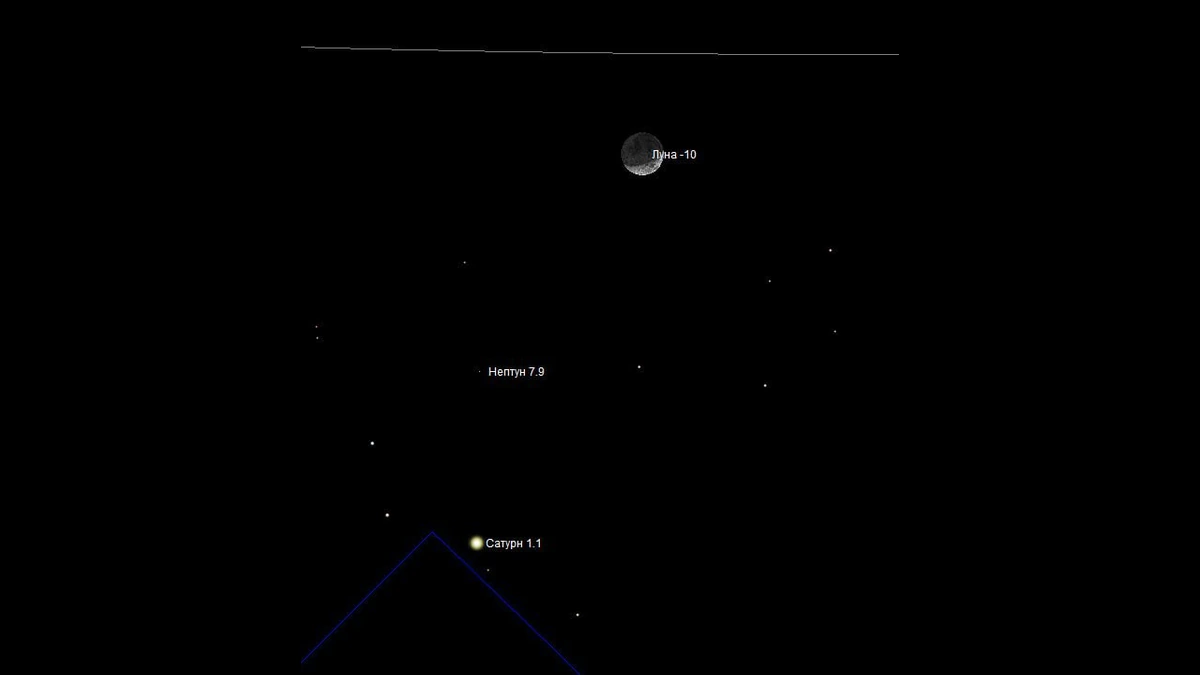
Information that an unusual astronomical phenomenon could be observed on January 23 after sunset spread online.
It was reported that on Saturday night, the Moon, Saturn, and Neptune would align in the constellation Pisces and supposedly form a “smiley face.” Above the crescent Moon, according to the publications, Saturn and Neptune were supposed to be clearly visible. The authors also claimed this could be observed across the entire country without a telescope—only a phone with zoom or binoculars would be needed.
To clarify information about the rare astronomical phenomenon, an inquiry was made to the head of the Center for Astronomy and Cosmonautics of the Krasnodar Regional Branch of the Russian Geographical Society, the head of the observatory at Kuban State University.
He stated that the information is not true—it will be impossible to see a “smiley face” in the sky. According to the positions of the Moon, Saturn, and Neptune at 9:00 PM Moscow time on January 23, the configuration claimed in Telegram channels does not form.
“Not to mention that Neptune is not visible to the naked eye at all,” he added.
He also warned that the lunar eclipse expected on March 3 will not be visible in the Krasnodar region.
Also read: the polar aurora in the sky over Kuban on the night of January 20.
Moon
The Moon is Earth’s only natural satellite, formed approximately 4.5 billion years ago from debris after a massive collision between Earth and a smaller planet. Culturally, it has been a central object in mythology, timekeeping, and artistic inspiration across human civilizations, and it became the first celestial body visited by humans during the Apollo missions in the 20th century.
Saturn
Saturn is the sixth planet from the Sun and a gas giant in our solar system, known for its spectacular ring system. While not a human-built cultural site, it holds significant history in astronomy, having been observed since ancient times and studied in detail by spacecraft like Voyager and Cassini. Its name comes from the Roman god of agriculture and wealth, the counterpart to the Greek deity Cronus.
Neptune
“Neptune” most commonly refers to the Roman god of the sea, equivalent to the Greek Poseidon, a major figure in classical mythology. However, as a place, it often refers to the town of Neptune City, New Jersey, USA, founded in 1881 and named after the Roman deity. It is a residential community near the Jersey Shore with no single prominent historical site directly tied to the ancient god.
Pisces
“Pisces” is not a specific place or cultural site, but rather the twelfth astrological sign in the zodiac, represented by two fish. In mythology, it is often linked to the Greek story of Aphrodite and Eros transforming into fish to escape the monster Typhon. As a cultural concept, it has been significant in astrology, art, and symbolism for millennia, but it does not refer to a physical location.
Krasnodar Regional Branch of the Russian Geographical Society
The Krasnodar Regional Branch of the Russian Geographical Society was founded in 1946, continuing the legacy of the Imperial Russian Geographical Society to promote the study of the Kuban region’s nature, history, and culture. It serves as a key scientific and educational center, organizing expeditions, research, and public lectures to document and preserve the unique heritage of southern Russia.
Kuban State University
Kuban State University, located in Krasnodar, Russia, was founded in 1920 as the Kuban Institute of Education. It has since grown into a major regional center for higher education and research in southern Russia, playing a significant role in the academic and cultural development of the Kuban region.
Krasnodar region
The Krasnodar region, located in southern Russia along the Black and Azov Seas, is a historically significant area known as the Kuban. It was a major Cossack territory from the late 18th century and is celebrated for its fertile agricultural land, subtropical coastline, and vibrant cultural mix of Russian, Ukrainian, and Caucasian influences. Today, it is a key economic and tourist hub, home to the resort city of Sochi, which hosted the 2014 Winter Olympics.
Kuban
“Kuban” refers to the Kuban River region in southern Russia, historically known as the homeland of the Circassian people and later a major Cossack territory after the Russian Empire’s expansion in the 18th and 19th centuries. Today, it is a vital agricultural and cultural area within Krasnodar Krai, known for its Black Sea resorts, fertile plains, and a blend of Russian and Caucasus traditions.