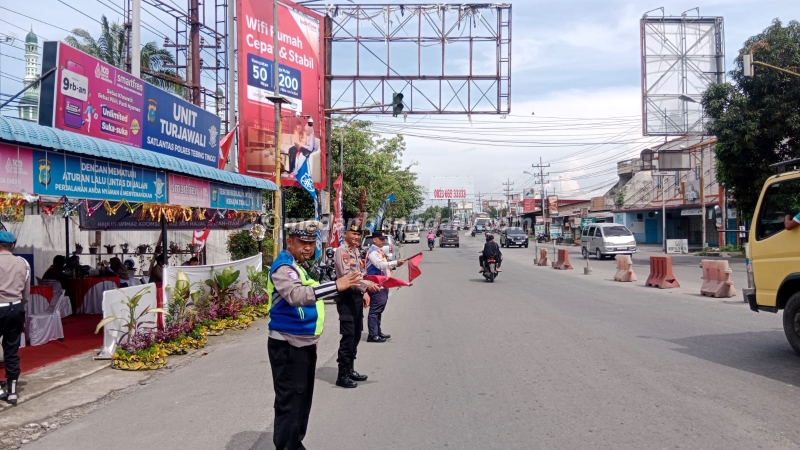
Traffic in Tebing Tinggi Quiet Ahead of New Year’s Eve
Traffic flow in Tebing Tinggi City, North Sumatra, was observed to be quiet and sparse on the afternoon leading up to New Year’s Eve.
Until midday, no increase in vehicle volume was seen passing through several main points of the city.
Observations at Simpang Beo showed vehicle flow from the direction of Medan heading towards Pematang Siantar or Asahan, and vice versa, was still relatively sparse. Two-wheeled and four-wheeled vehicles were seen passing through without significant density.
The volume of vehicles usually heading towards the Lake Toba tourist area also had not yet been seen passing busily through the Tebing Tinggi City region.
A similar condition occurred with traffic flow from the direction of Asahan and Pematang Siantar heading towards the city center, which was still observed to be quiet.
The Officer in Charge of the Simpang Beo Service Post stated that until midday, traffic conditions were still running normally and smoothly without a surge in the number of vehicles.
«So far, there has been no increase in the number of vehicles. Traffic flow is still quiet and smooth,» he said.
According to him, one of the causes for the reduced volume of vehicles passing through Tebing Tinggi City is the operation of the toll road.
Many drivers, especially those undertaking long-distance travel during Christmas and leading up to the New Year, choose to use the toll route.
«Since the opening of the toll road, vehicle volume during Christmas and leading up to the New Year passing through Tebing Tinggi has indeed tended to be quiet and smooth. Only a small portion of vehicles pass through the city roads,» he explained.
Police officers remain on standby at several service posts to anticipate a possible increase in vehicle flow on New Year’s Eve and to maintain smooth and secure traffic.
Tebing Tinggi City
Tebing Tinggi is a city in North Sumatra, Indonesia, which historically developed as a key trading and transportation hub due to its strategic location between the larger cities of Medan and Pematang Siantar. It officially gained city status in the 1980s and is known for its diverse population and as a center for local commerce and industry.
North Sumatra
North Sumatra is a province on the Indonesian island of Sumatra, most famous for being home to the vast, biodiverse Lake Toba—the largest volcanic lake in the world, formed by a cataclysmic super-eruption around 74,000 years ago. The region is a cultural heartland of the Batak people, whose distinct traditions, architecture (notably the boat-shaped *rumah adat*), and Christian faith shape its identity. Historically, it also contained significant pre-colonial kingdoms like Srivijaya and later the Sultanate of Deli, centered in the bustling modern capital of Medan.
Medan
Medan is the capital and largest city of Indonesia’s North Sumatra province, historically established as a significant trading hub in the late 19th century during the Dutch colonial era, largely due to the booming plantation industry for commodities like tobacco and rubber. Today, it is a vibrant, multicultural metropolis known as the gateway to Lake Toba and for its diverse architectural heritage, including the iconic Maimun Palace and the Great Mosque of Medan.
Pematang Siantar
Pematang Siantar is a major city in North Sumatra, Indonesia, which developed significantly in the early 20th century under Dutch colonial administration as a key plantation and trading center. Today, it is known for its diverse cultural mix of Batak, Javanese, and Chinese communities, with notable sites like the Vihara Avalokitesvara temple and the Siantar Zoo.
Asahan
Asahan is a small village located in the mountains of East Java, Indonesia, historically known as a colonial-era hill station established by Dutch plantation owners in the 1930s as a retreat from the heat. Today, it is recognized for its well-preserved heritage, including the historic Asahan Mountain Resort, and offers a quiet, cool escape with colonial architecture amidst scenic tea plantations and volcanic landscapes.
Lake Toba
Lake Toba is a massive volcanic lake on the Indonesian island of Sumatra, formed by a cataclysmic supereruption approximately 74,000 years ago. It is the world’s largest crater lake and a significant cultural site for the indigenous Batak people, whose traditional villages and unique architecture dot its shores. Today, it is a major tourist destination renowned for its stunning natural scenery and rich cultural heritage.
Резеки Геа до сих пор прикован к постели дома. Про...
Мы используем файлы cookie, чтобы обеспечить удобство работы с сайтом и анализировать трафик. Продолжая использовать сайт, вы соглашаетесь с нашей
[Политикой cookie]. 🍪